Dynamic tree algorithms
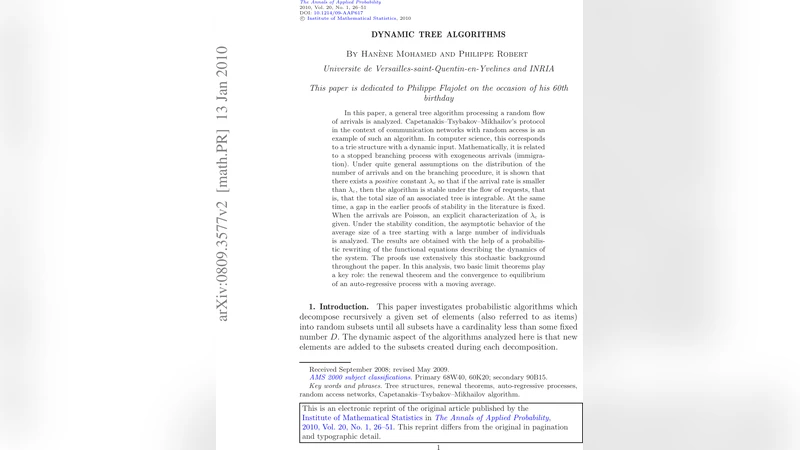
In this paper, a general tree algorithm processing a random flow of arrivals is analyzed. Capetanakis–Tsybakov–Mikhailov’s protocol in the context of communication networks with random access is an example of such an algorithm. In computer science, this corresponds to a trie structure with a dynamic input. Mathematically, it is related to a stopped branching process with exogeneous arrivals (immigration). Under quite general assumptions on the distribution of the number of arrivals and on the branching procedure, it is shown that there exists a positive constant $\lambda_c$ so that if the arrival rate is smaller than $\lambda_c$, then the algorithm is stable under the flow of requests, that is, that the total size of an associated tree is integrable. At the same time, a gap in the earlier proofs of stability in the literature is fixed. When the arrivals are Poisson, an explicit characterization of $\lambda_c$ is given. Under the stability condition, the asymptotic behavior of the average size of a tree starting with a large number of individuals is analyzed. The results are obtained with the help of a probabilistic rewriting of the functional equations describing the dynamics of the system. The proofs use extensively this stochastic background throughout the paper. In this analysis, two basic limit theorems play a key role: the renewal theorem and the convergence to equilibrium of an auto-regressive process with a moving average.
💡 Research Summary
The paper presents a rigorous probabilistic analysis of a broad class of dynamic tree algorithms that process a random stream of arrivals. The authors model the algorithm as a stopped branching process with exogenous immigration: each node independently generates a random number of offspring according to a branching distribution, while at each discrete time step a random number of new requests (immigrants) are inserted into the tree. This framework captures well‑known communication protocols such as the Capetanakis‑Tsybakov‑Mikhailov random‑access scheme and, in computer science, the evolution of a trie under a dynamic input sequence.
The central question is stability: for which arrival rates λ does the total size of the tree remain integrable (i.e., have a finite expectation) over time? Under very mild moment assumptions on both the offspring distribution and the arrival distribution (essentially the existence of first and second moments), the authors prove the existence of a positive critical rate λ_c. If λ < λ_c the system is stable; if λ > λ_c the expected tree size diverges. The proof proceeds by rewriting the dynamics in a probabilistic “re‑writing” form: \
Comments & Academic Discussion
Loading comments...
Leave a Comment