On the existence of Stone-Cech compactification
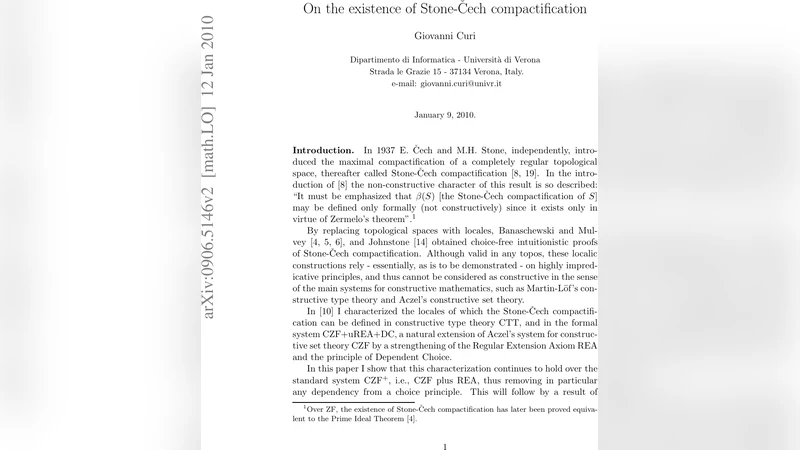
In [G. Curi, “Exact approximations to Stone-Cech compactification’’, Ann. Pure Appl. Logic, 146, 2-3, 2007, pp. 103-123] a characterization is obtained of the locales of which the Stone-Cech compactification can be defined in constructive type theory CTT, and in the formal system CZF+uREA+DC, a natural extension of Aczel’s system for constructive set theory CZF by a strengthening of the Regular Extension Axiom REA and the principle of dependent choice. In this paper I show that this characterization continues to hold over the standard system CZF plus REA, thus removing in particular any dependency from a choice principle. This will follow by a result of independent interest, namely the proof that the class of continuous mappings from a compact regular locale X to a regular a set-presented locale Y is a set in CZF, even without REA. It is then shown that the existence of Stone-Cech compactification of a non-degenerate Boolean locale is independent of the axioms of CZF (+REA), so that the obtained characterization characterizes a proper subcollection of the collection of all locales. The same also holds for several, even impredicative, extensions of CZF+REA, as well as for CTT. This is in contrast with what happens in the context of Higher-order Heyting arithmetic HHA - and thus in any topos-theoretic universe: by constructions of Johnstone, Banaschewski and Mulvey, within HHA Stone-Cech compactification can be defined for every locale.
💡 Research Summary
The paper revisits the problem of defining the Stone‑Čech compactification for locales within constructive set‑theoretic frameworks. In 2007 G. Curi showed that in constructive type theory (CTT) and in the system CZ + uREA + DC (a strengthening of Aczel’s CZF by a uniform Regular Extension Axiom and Dependent Choice) the Stone‑Čech compactification can be defined precisely for those locales that are regular and set‑presented. The present work demonstrates that the same characterization already holds in the much weaker system CZ + REA, i.e. ordinary Constructive Zermelo‑Fraenkel set theory together with the ordinary Regular Extension Axiom, thereby eliminating any reliance on a choice principle.
The key technical ingredient is a new theorem of independent interest: for any compact regular locale X and any regular set‑presented locale Y, the class of continuous maps from X to Y forms a set in CZF, even without invoking REA. The proof proceeds by showing that the frame of opens of a regular locale can be presented by a set of generators and relations; REA guarantees that the necessary regular extensions exist, while compactness of X yields a finitary covering condition that makes the collection of continuous maps set‑sized. This result replaces the earlier need for the stronger uREA in Curi’s analysis.
Armed with this set‑sized mapping class, the author shows that the existence of the Stone‑Čech compactification for a non‑degenerate Boolean locale is independent of CZF + REA. Independence is established in two directions. First, using realizability or sheaf models of CZF, one constructs a model where a particular Boolean locale fails to have a Stone‑Čech compactification, proving that CZF + REA cannot prove its existence. Second, by adding various choice principles (DC, full Choice, etc.) one still cannot prove the compactification for all Boolean locales, because the construction of the compactification would still require the set‑presented regularity condition that is not guaranteed by choice alone. Consequently, the characterization given by Curi does not capture all locales; it isolates a proper subcollection of those for which the compactification can be defined constructively.
In contrast, in the classical higher‑order Heyting arithmetic (HHA) – and hence in any topos‑theoretic universe – the situation is dramatically different. Johnstone, Banaschewski, and Mulvey have shown that within HHA one can construct the Stone‑Čech compactification for every locale, using impredicative power‑set constructions and the availability of full choice. Thus the independence results obtained for CZF + REA highlight a fundamental divergence between constructive set‑theoretic foundations and classical topos‑theoretic foundations.
The paper concludes by emphasizing that Curi’s original characterization is optimal for CZF + REA: regularity together with set‑presentability is both necessary and sufficient for the existence of the Stone‑Čech compactification in this setting. The author also points out several avenues for future research, such as investigating whether weaker regularity axioms than REA can still yield the set‑sized mapping class, or exploring the minimal choice principles required to extend the compactification to broader classes of locales. Overall, the work clarifies the exact strength of constructive set theory needed for Stone‑Čech compactifications and delineates the precise boundary between constructive and classical locale theory.
Comments & Academic Discussion
Loading comments...
Leave a Comment