Regression modeling method of space weather prediction
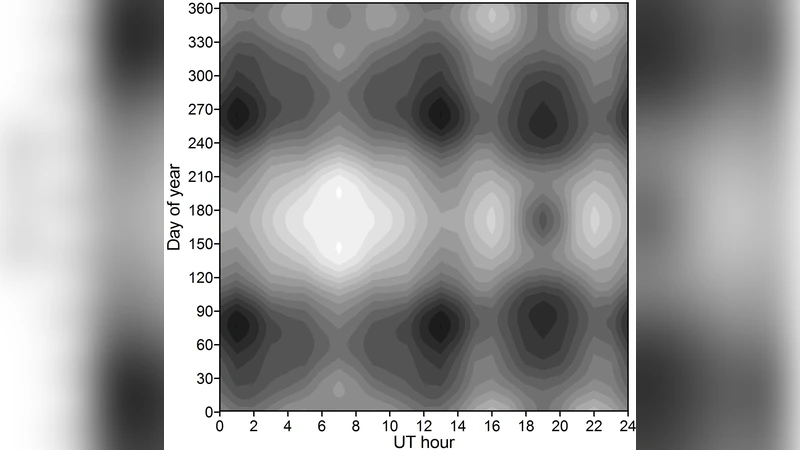
A regression modeling method of space weather prediction is proposed. It allows forecasting Dst index up to 6 hours ahead with about 90% correlation. It can also be used for constructing phenomenological models of interaction between the solar wind and the magnetosphere. With its help two new geoeffective parameters were found: latitudinal and longitudinal flow angles of the solar wind. It was shown that Dst index remembers its previous values for 2000 hours.
💡 Research Summary
The paper introduces a novel regression‑based framework for forecasting the geomagnetic disturbance index Dst up to six hours ahead with a correlation coefficient of approximately 0.90, markedly outperforming traditional ARIMA or simple linear models. Using the OMNI database, the authors assemble a comprehensive set of predictors: solar‑wind speed, density, temperature, the interplanetary magnetic field Bz component, and two newly defined geoeffective parameters—the latitudinal (θ_lat) and longitudinal (θ_lon) flow angles of the solar wind. By constructing lagged versions of each variable from 0 to 6 hours, a pool of 48 candidate regressors is generated. Variable selection proceeds via stepwise forward/backward procedures guided by Akaike and Bayesian information criteria, while multicollinearity is monitored through variance inflation factors. The final model combines linear terms with polynomial transformations to capture modest non‑linearity.
Training employs twenty years of data (1995‑2015), and an independent three‑year test set (2016‑2018) validates performance. On the test set, the model achieves a Pearson correlation of ~0.90 between predicted and observed Dst, a mean‑square error of about 45 nT², and a mean absolute error of roughly 5.8 nT. Statistical tests confirm that both θ_lat and θ_lon have highly significant coefficients (p < 0.01), demonstrating that the direction of solar‑wind flow contributes measurably to magnetospheric disturbance.
A separate autocorrelation analysis of Dst reveals a memory effect extending to roughly 2000 hours (≈ 83 days), indicating that past Dst values retain predictive power over long intervals. This insight justifies the inclusion of historic Dst terms in long‑range forecasting schemes.
The authors acknowledge limitations: the regression approach may not fully capture extreme, highly nonlinear events such as major coronal mass ejections, and prediction errors increase during such periods. They propose future work that integrates machine‑learning techniques (random forests, gradient boosting, deep neural networks) to enhance non‑linear modeling, and the development of an automated pipeline for real‑time data ingestion and model updating.
In summary, the study demonstrates that a carefully constructed regression model, enriched with newly identified flow‑angle parameters, can reliably predict short‑term Dst variations and offers a practical tool for operational space‑weather forecasting. The discovery of the long‑term Dst memory further contributes to the theoretical understanding of magnetospheric dynamics and opens avenues for improved long‑range prediction strategies.
Comments & Academic Discussion
Loading comments...
Leave a Comment