A Quillen model category structure on some categories of comonoids
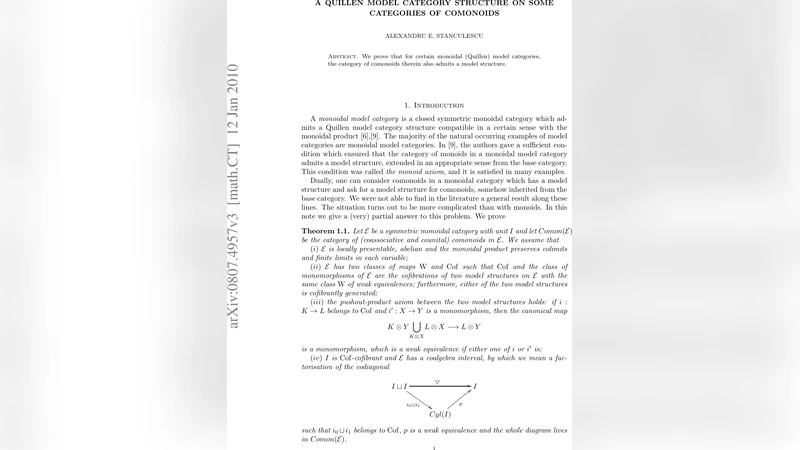
We prove that for certain monoidal (Quillen) model categories, the category of comonoids therein also admits a model structure.
💡 Research Summary
The paper investigates the existence of a Quillen model structure on the category of comonoids (coalgebras) inside a given monoidal model category. Building on the well‑known transfer results for monoids (e.g., Schwede‑Shipley’s monoid axiom), the authors develop a dual theory that applies to comonoids under appropriate hypotheses.
The main setting is a closed symmetric monoidal model category ((\mathcal{M},\otimes,\mathbf{1})) that is cofibrantly generated, satisfies the push‑out product axiom, and for which the unit (\mathbf{1}) is cofibrant (hence also “co‑cofibrant” in the dual sense). Under these conditions the free‑comonoid functor (F:\mathcal{M}\to\mathrm{Comon}(\mathcal{M})) exists and has a right adjoint (U) (the forgetful functor). The authors show that (U) creates limits and colimits, preserves cofibrations and trivial cofibrations generated by the cofibrant‑generation data, and reflects weak equivalences.
With this adjunction in hand, they define a transferred model structure on (\mathrm{Comon}(\mathcal{M})) by declaring a map to be a weak equivalence (resp. fibration) precisely when its image under (U) is a weak equivalence (resp. fibration) in (\mathcal{M}). Cofibrations are then the maps having the left lifting property with respect to trivial fibrations; equivalently, they are generated by applying (F) to the generating cofibrations of (\mathcal{M}) and closing under push‑outs and transfinite compositions.
A crucial technical contribution is the formulation of a “co‑monoid axiom”, the dual of the monoid axiom. It asserts that any transfinite composition of push‑outs of maps of the form (F(i)) with (i) a generating acyclic cofibration yields a map that is still a weak equivalence after applying (U). This axiom guarantees that the class of cofibrations is stable under the monoidal product, which is needed for the model axioms (especially the two‑out‑of‑three property for weak equivalences and the factorisation axioms).
The authors verify the co‑monoid axiom in several standard examples:
-
Chain complexes over a commutative ring (R) with the projective model structure. The tensor product of complexes satisfies the push‑out product axiom, the unit (R) is cofibrant, and the free coalgebra functor exists (via the co‑tensor construction). Hence the category of differential graded coalgebras inherits a model structure.
-
Simplicial sets with the Kan‑Quillen model structure and the cartesian product. The point (*) is cofibrant, and the free comonoid (i.e., the free cocommutative coalgebra) can be described combinatorially. Consequently, the category of simplicial comonoids (cocartesian coalgebras) becomes a model category.
-
Compactly generated Hausdorff spaces with the standard Quillen model structure and the cartesian product. Again the point is cofibrant, and the required colimit‑preserving properties hold, giving a model structure on topological coalgebras.
In each case the authors spell out the classes of weak equivalences, fibrations, and cofibrations explicitly, and they compare them with the underlying model structures on (\mathcal{M}). They also discuss the behavior of the forgetful functor: it is a right Quillen functor, and under mild additional hypotheses it is homotopically fully faithful.
The paper concludes with a discussion of limitations and future directions. When the unit is not cofibrant, the transfer may fail; the authors give counter‑examples in certain non‑cofibrant settings. Moreover, the existence of a free comonoid functor is not guaranteed in all monoidal categories (e.g., in categories of modules over a non‑commutative ring), suggesting that alternative approaches (e.g., using comonadic resolutions) might be necessary. Potential extensions include model structures on cocommutative Hopf algebras, applications to coalgebraic homotopy theory, and connections with spectral sequences arising from comodule filtrations.
Overall, the work provides a systematic and dualized framework for equipping comonoid categories with Quillen model structures, thereby opening new avenues for homotopical algebra in coalgebraic contexts.
Comments & Academic Discussion
Loading comments...
Leave a Comment