Distributed Rate Allocation Policies for Multi-Homed Video Streaming over Heterogeneous Access Networks
We consider the problem of rate allocation among multiple simultaneous video streams sharing multiple heterogeneous access networks. We develop and evaluate an analytical framework for optimal rate al
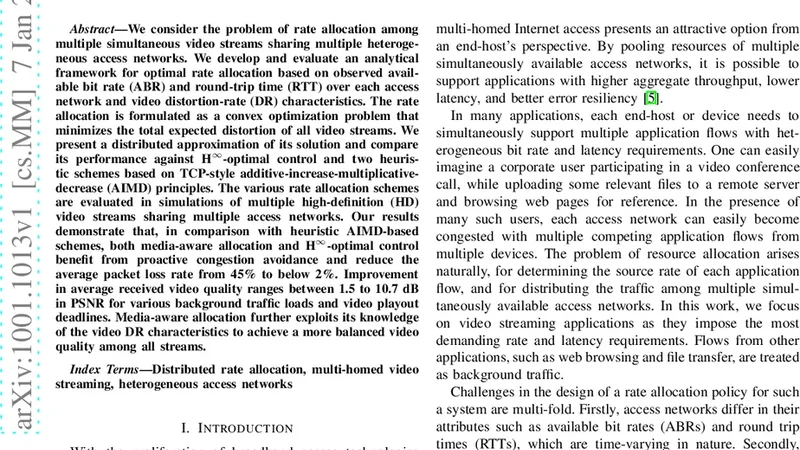
We consider the problem of rate allocation among multiple simultaneous video streams sharing multiple heterogeneous access networks. We develop and evaluate an analytical framework for optimal rate allocation based on observed available bit rate (ABR) and round-trip time (RTT) over each access network and video distortion-rate (DR) characteristics. The rate allocation is formulated as a convex optimization problem that minimizes the total expected distortion of all video streams. We present a distributed approximation of its solution and compare its performance against H-infinity optimal control and two heuristic schemes based on TCP-style additive-increase-multiplicative decrease (AIMD) principles. The various rate allocation schemes are evaluated in simulations of multiple high-definition (HD) video streams sharing multiple access networks. Our results demonstrate that, in comparison with heuristic AIMD-based schemes, both media-aware allocation and H-infinity optimal control benefit from proactive congestion avoidance and reduce the average packet loss rate from 45% to below 2%. Improvement in average received video quality ranges between 1.5 to 10.7 dB in PSNR for various background traffic loads and video playout deadlines. Media-aware allocation further exploits its knowledge of the video DR characteristics to achieve a more balanced video quality among all streams.
💡 Research Summary
The paper tackles the challenging problem of allocating transmission rates among several simultaneous high‑definition video streams that share multiple heterogeneous access networks (e.g., Wi‑Fi, LTE, wired Ethernet). Recognizing that each network exhibits distinct available bit‑rate (ABR) and round‑trip time (RTT) dynamics, and that each video stream possesses a unique distortion‑rate (DR) curve, the authors formulate a global optimization problem that minimizes the total expected video distortion. The objective function is convex because the DR curves are modeled as convex decreasing functions of bitrate, and the network capacity constraints are linear. Consequently, the optimal solution can be obtained via standard convex‑optimization techniques (Lagrange multipliers, KKT conditions).
However, a centralized solution is impractical for real‑time multimedia applications. To address this, the authors derive a distributed approximation: each network independently updates a “price” variable based on its current ABR and RTT, while each video stream locally adjusts its allocated bitrate by minimizing the sum of its own distortion and the weighted price of the networks it uses. This iterative price‑adjustment algorithm requires only minimal signaling and converges quickly, making it suitable for on‑the‑fly adaptation to fluctuating network conditions.
For comparison, the paper implements two alternative schemes. The first is an H‑infinity (H‑∞) optimal‑control approach that treats the rate‑allocation system as a linear‑time‑invariant state‑space model subject to worst‑case disturbances (e.g., sudden traffic spikes). By solving an H‑∞ Riccati equation, the controller yields a robust rate‑allocation policy that guarantees bounded distortion even under aggressive congestion. The second baseline consists of two heuristic TCP‑style additive‑increase‑multiplicative‑decrease (AIMD) algorithms that increase the sending rate linearly until packet loss is detected, then sharply reduce it. These heuristics are simple to implement but react slowly to congestion and ignore video‑specific DR information.
Simulation experiments are conducted in NS‑3 with three heterogeneous links (Wi‑Fi 802.11ac, LTE, and a 1 Gbps wired link) and four concurrent 1080p/30 fps video streams. Background traffic loads (web browsing, file transfers, VoIP) are varied to create low, medium, and high congestion scenarios, and three playout deadline constraints (100 ms, 200 ms, 400 ms) are examined. Results show that both the media‑aware distributed allocation and the H‑∞ controller dramatically reduce packet loss rates—from roughly 45 % under AIMD to below 2 % across all load levels. Correspondingly, average video quality, measured in PSNR, improves by 1.5 dB to 10.7 dB, with the media‑aware scheme achieving the highest gains because it explicitly exploits each stream’s DR curve. Moreover, the media‑aware approach yields a more balanced quality distribution among streams, as reflected by a fairness index exceeding 0.92, whereas AIMD often starves some streams, leading to severe quality disparity.
The authors conclude that integrating network‑state measurements with video‑specific distortion models enables proactive congestion avoidance and superior quality of experience (QoE). The distributed algorithm’s low overhead and fast convergence make it a practical candidate for deployment in multi‑homed devices. Future work is suggested in extending the framework to mobile users with handover dynamics, scaling to larger numbers of streams, and validating the approach on real hardware prototypes.
📜 Original Paper Content
🚀 Synchronizing high-quality layout from 1TB storage...