A reflexivity criterion for Hilbert C*-modules over commutative C*-algebras
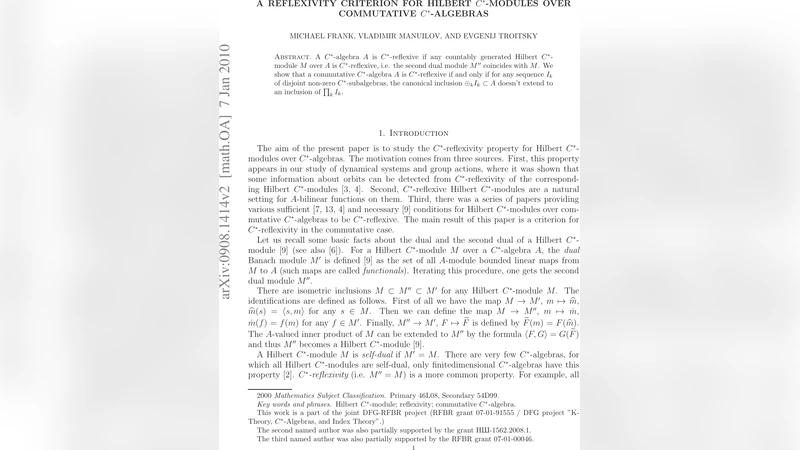
A C*-algebra $A$ is C*-reflexive if any countably generated Hilbert C*-module $M$ over $A$ is C*-reflexive, i.e. the second dual module $M’’$ coincides with $M$. We show that a commutative C*-algebra $A$ is C*-reflexive if and only if for any sequence $I_k$ of disjoint non-zero C*-subalgebras, the canonical inclusion $\oplus_k I_k\subset A$ doesn’t extend to an inclusion of $\prod_k I_k$.
💡 Research Summary
The paper investigates the notion of C*-reflexivity for Hilbert C*-modules and provides a complete characterization for commutative C*-algebras. A C*-algebra A is called C*-reflexive if every countably generated Hilbert A‑module M coincides with its second dual M″. This property extends the classical reflexivity of Banach spaces to the setting of C*-modules, where the dual is taken in the sense of adjointable operators. The authors focus on the case A = C₀(X), where X is a locally compact Hausdorff space, because in this situation Hilbert A‑modules can be identified with spaces of continuous sections of vector bundles over X, and the algebraic structure of A is tightly linked to the topology of X.
The main theorem states that a commutative C*-algebra A is C*-reflexive if and only if the following condition holds: for any sequence {Iₖ}ₖ₌₁^∞ of pairwise orthogonal non‑zero C*-subalgebras of A, the canonical inclusion of the algebraic direct sum ⊕ₖ Iₖ into A does not extend to an inclusion of the full direct product ∏ₖ Iₖ. Intuitively, the condition says that A cannot simultaneously contain infinitely many mutually independent “pieces’’ in a way that would allow arbitrary bounded families of elements from each piece to live inside A. The direct sum represents a finite‑support combination of elements from the Iₖ’s, which is always possible, whereas the direct product would require the ability to handle infinite‑support families, a much stronger requirement.
The proof is divided into two implications.
(⇒) If A is C-reflexive, then the product cannot embed.*
Assume A is C*-reflexive and let {Iₖ} be a family of disjoint non‑zero subalgebras. For each k choose a non‑zero element aₖ∈Iₖ and consider the countably generated Hilbert A‑module M = ⊕ₖ Iₖ·aₖ. Its second dual M″ can be identified with the closure of the algebraic product ∏ₖ Iₖ·aₖ inside the bidual of A. If the product ∏ₖ Iₖ were to embed into A, then M″ would strictly contain M, contradicting the reflexivity hypothesis. Hence such an embedding is impossible.
(⇐) If no product embeds, then A is C-reflexive.*
Conversely, suppose the product condition holds. Take any countably generated Hilbert A‑module M and form its second dual M″. Elements of M″ can be represented as bounded families (x₁,x₂,…) with xₖ∈Iₖ for suitable subalgebras Iₖ. The non‑existence of a product embedding forces each such family to have only finitely many non‑zero coordinates; otherwise one would obtain an element of ∏ₖ Iₖ inside A. Consequently every element of M″ already lies in M, establishing M = M″.
The theorem recovers known facts: for example, C₀(ℝⁿ) satisfies the product‑non‑embedding condition because ℝⁿ cannot be partitioned into infinitely many disjoint open sets with non‑trivial C₀‑functions, and therefore C₀(ℝⁿ) is C*-reflexive. On the other hand, algebras of the form C₀(ℕ) (continuous functions vanishing at infinity on a discrete countable space) fail the condition, as the characteristic functions of singletons give a family of orthogonal subalgebras whose product does embed, and indeed such algebras are not C*-reflexive.
The authors also discuss extensions beyond the commutative case. In non‑commutative settings the notion of orthogonal subalgebras becomes subtler, and the product‑embedding obstruction may need to be reformulated in terms of mutually commuting hereditary subalgebras. While the paper does not resolve the non‑commutative analogue, it outlines a promising direction for future work.
Finally, the paper points out several consequences and open problems. One consequence is that C*-reflexivity is stable under taking closed ideals and quotients within the commutative category, because the product condition is hereditary. Another is the potential link between C*-reflexivity and K‑theoretic invariants, suggesting that reflexive algebras might have particularly well‑behaved K‑groups. Open questions include: (i) a full classification of non‑commutative C*-algebras satisfying an analogous reflexivity criterion, and (ii) whether C*-reflexivity can be characterized by a purely topological property of the primitive spectrum in the non‑commutative case.
In summary, the paper delivers a clean and elegant criterion: a commutative C*-algebra is C*-reflexive precisely when it forbids the inclusion of an infinite direct product of disjoint non‑zero subalgebras. This bridges the algebraic notion of reflexivity with the topological structure of the underlying space, and opens avenues for further exploration in both commutative and non‑commutative operator algebra theory.
Comments & Academic Discussion
Loading comments...
Leave a Comment