Coherence for Monoidal Monads and Comonads
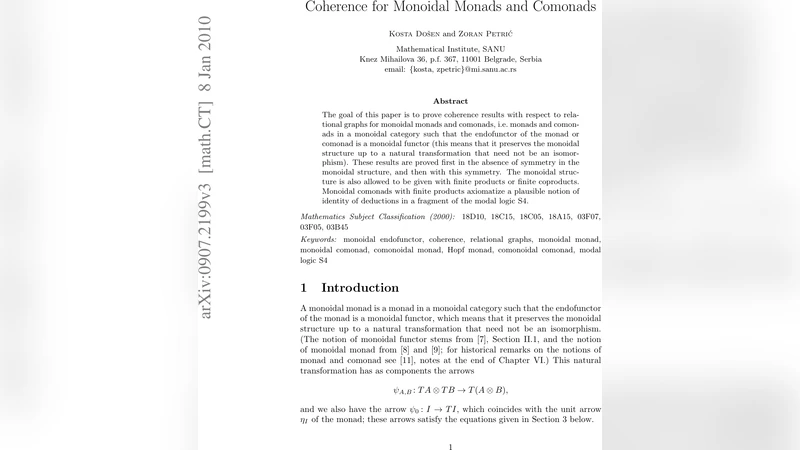
The goal of this paper is to prove coherence results with respect to relational graphs for monoidal monads and comonads, i.e. monads and comonads in a monoidal category such that the endofunctor of the monad or comonad is a monoidal functor (this means that it preserves the monoidal structure up to a natural transformation that need not be an isomorphism). These results are proved first in the absence of symmetry in the monoidal structure, and then with this symmetry. The monoidal structure is also allowed to be given with finite products or finite coproducts. Monoidal comonads with finite products axiomatize a plausible notion of identity of deductions in a fragment of the modal logic S4.
💡 Research Summary
The paper “Coherence for Monoidal Monads and Comonads” establishes coherence theorems for monads and comonads whose underlying endofunctors are monoidal in a weak sense: they preserve the monoidal structure up to a natural transformation that need not be an isomorphism. This weak, or “non‑strong”, monoidal condition broadens the usual setting where the monoidal structure is preserved strictly (or up to a strong, invertible natural transformation). The authors develop a concrete graphical semantics—relational graphs—to represent objects, morphisms, and the additional monoidal natural transformations. In this setting, the composition of complex morphisms corresponds to relational composition, and coherence reduces to the statement that any two syntactically different but well‑typed composites denote the same relational graph up to graph isomorphism.
The work proceeds in several stages. First, the authors formalise monoidal monads ((T,\eta,\mu,\phi)) and monoidal comonads ((G,\varepsilon,\delta,\psi)). Here (\phi_{A,B}:TA\otimes TB\to T(A\otimes B)) (and its comonadic counterpart (\psi_{A,B}:G(A\otimes B)\to GA\otimes GB)) are the weak monoidal structure maps; they are not required to be invertible. The usual monad (or comonad) unit and multiplication (or comultiplication) are retained, and the usual monad/comonad axioms are supplemented by coherence equations linking (\phi) (or (\psi)) with (\eta,\mu) (or (\varepsilon,\delta)).
To prove coherence, the authors introduce relational graphs: a graph whose vertices are objects of the base category and whose edges are binary relations representing morphisms. A morphism built from the primitive operations (tensor, unit, (\eta,\mu,\varepsilon,\delta,\phi,\psi)) is interpreted as a specific relation obtained by composing the elementary relations associated with each primitive. The key observation is that the coherence equations translate into elementary graph‑rewriting rules that preserve the underlying relation. Consequently, any two derivations of the same formal composite give rise to the same relation, i.e. the same graph up to isomorphism. This provides a concrete, visual proof of coherence that avoids the more abstract term‑model constructions common in the literature.
The paper treats two major variants of the underlying monoidal category. In the non‑symmetric case (plain monoidal categories), the authors verify that the weak monoidal structure maps interact correctly with the tensor product and unit, and that the monad/comonad axioms are respected in the relational model. The proof proceeds by structural induction on the syntax of morphism terms, checking base cases (unit, multiplication, monoidal maps) and inductive steps (tensoring, composition).
In the symmetric case (symmetric monoidal categories), an additional natural isomorphism (\sigma_{A,B}:A\otimes B\to B\otimes A) is present. The authors extend the relational graph language with edges representing the symmetry and prove extra commutation equations involving (\sigma) together with (\phi) (or (\psi)). They show that the presence of symmetry does not break coherence: the relational interpretation of a term that uses symmetry in different ways still yields the same underlying relation.
Beyond pure tensor structure, the authors also consider monoidal categories equipped with finite products ((\wedge)) or finite coproducts ((\vee)). When a product is present, a monoidal monad is required to preserve the product up to a (possibly non‑invertible) natural transformation, and analogous conditions hold for a comonad with coproducts. The relational graph model is enriched with projection and pairing edges for products (or injection and case‑analysis edges for coproducts). The authors verify that the additional equations governing product (or coproduct) preservation are sound in the relational semantics, thereby extending the coherence results to these richer categorical settings.
A particularly compelling application is presented for monoidal comonads with finite products as a categorical model of a fragment of the modal logic S4. In this interpretation, the comonad’s counit (\varepsilon) corresponds to the “necessity” modality □, while the comultiplication (\delta) models the S4 axiom □A → □□A (i.e., the ability to duplicate a necessary statement). The product structure captures conjunction, and the relational graph semantics yields a concrete notion of identity of deductions: two S4 proofs are identified precisely when they give rise to the same relational graph. This provides a clean, algebraic account of proof identity that complements more traditional syntactic approaches.
Overall, the paper makes several significant contributions:
- Generalisation – It lifts the coherence theory from strong monoidal monads/comonads to the weaker, more realistic setting where the monoidal structure is preserved only up to a non‑invertible transformation.
- Graphical Semantics – By employing relational graphs, the authors give an intuitive, visual proof technique that can be readily understood by both category theorists and computer scientists.
- Symmetry and Products – The results are shown to hold in both non‑symmetric and symmetric monoidal categories, and they extend naturally to categories with finite products or coproducts.
- Logical Interpretation – The connection with S4 modal logic demonstrates that the categorical machinery has concrete logical applications, particularly in formalising proof identity.
Future work suggested includes extending the framework to higher‑dimensional monoidal structures (e.g., braided or closed monoidal categories), integrating the coherence results into type‑theoretic effect systems, and exploring other modal logics (K, T, GL) within the same relational graph paradigm.
In summary, the paper provides a robust, graph‑based coherence theory for weakly monoidal monads and comonads, covering a broad spectrum of categorical environments and offering a clear bridge to logical systems such as S4. This advances both the theoretical foundations of monoidal category theory and its practical relevance to logic and programming language semantics.
Comments & Academic Discussion
Loading comments...
Leave a Comment