Constraints on the kinematics of the 44Ti ejecta of Cassiopeia A from INTEGRAL/SPI
The medium-lived 44Ti isotope is synthesised by explosive Si-burning in core-collapse supernovae. It is extremely sensitive to the dynamics of the explosion and therefore can be used to indirectly pro
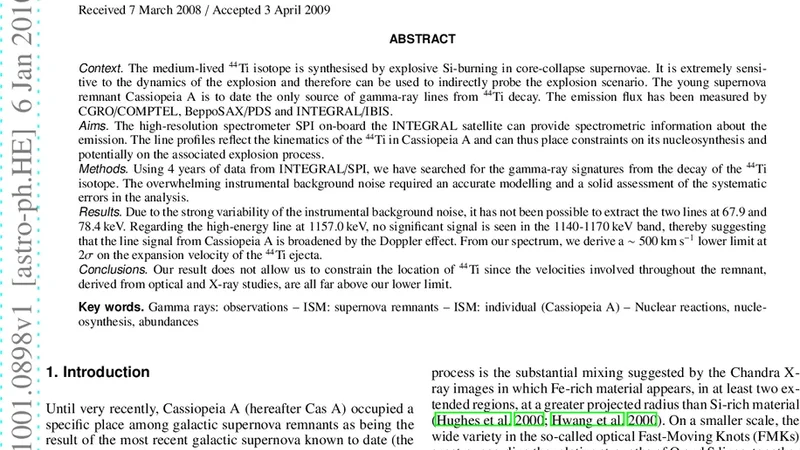
The medium-lived 44Ti isotope is synthesised by explosive Si-burning in core-collapse supernovae. It is extremely sensitive to the dynamics of the explosion and therefore can be used to indirectly probe the explosion scenario. The young supernova remnant Cassiopeia A is to date the only source of gamma-ray lines from 44Ti decay. The emission flux has been measured by CGRO/COMPTEL, BeppoSAX/PDS and INTEGRAL/IBIS. The high-resolution spectrometer SPI on-board the INTEGRAL satellite can provide spectrometric information about the emission. The line profiles reflect the kinematics of the 44Ti in Cassiopeia A and can thus place constraints on its nucleosynthesis and potentially on the associated explosion process. Using 4 years of data from INTEGRAL/SPI, we have searched for the gamma-ray signatures from the decay of the 44Ti isotope. The overwhelming instrumental background noise required an accurate modelling and a solid assessment of the systematic errors in the analysis. Due to the strong variability of the instrumental background noise, it has not been possible to extract the two lines at 67.9 and 78.4keV. Regarding the high-energy line at 1157.0keV, no significant signal is seen in the 1140-1170keV band, thereby suggesting that the line signal from Cassiopeia A is broadened by the Doppler effect. From our spectrum, we derive a ~ 500km/s lower limit at 2sigma on the expansion velocity of the 44Ti ejecta. Our result does not allow us to constrain the location of 44Ti since the velocities involved throughout the remnant, derived from optical and X-ray studies, are all far above our lower limit.
💡 Research Summary
The paper investigates the kinematics of the radioactive isotope ^44Ti in the young supernova remnant Cassiopeia A (Cas A) using four years of data from the high‑resolution spectrometer SPI aboard the INTEGRAL satellite. ^44Ti is produced in explosive silicon burning during core‑collapse supernovae and decays with a half‑life of about 60 years, emitting three characteristic γ‑ray lines at 67.9 keV, 78.4 keV, and 1157 keV. Because the line profiles are directly shaped by the motion of the ejecta, measuring their widths and centroid shifts can constrain the expansion velocity of the ^44Ti‑rich material and, indirectly, the dynamics of the explosion itself.
Previous missions (CGRO/COMPTEL, BeppoSAX/PDS, INTEGRAL/IBIS) have measured the total flux from Cas A but lacked the spectral resolution to resolve line shapes. SPI, with an energy resolution of ~2 keV, is ideally suited for this purpose. The authors processed all public SPI observations of Cas A from 2003 to 2007, amounting to roughly 30 Ms of exposure. A major challenge is the overwhelming instrumental background, which varies strongly with time, detector, and orbital conditions. To mitigate this, the analysis employed detector‑wise background templates derived from empty‑field observations and introduced time‑dependent scaling factors to track the background intensity on an orbit‑by‑orbit basis. Monte‑Carlo simulations and blank‑field checks were used to quantify systematic uncertainties.
For the low‑energy lines (67.9 keV and 78.4 keV) the background is dominated by internal Ge fluorescence lines and activation features that fluctuate on short timescales. Despite the sophisticated background model, the authors could not extract a statistically significant signal from these lines; the residuals are consistent with background fluctuations. Consequently, no constraints on the line width or velocity could be derived at these energies.
The high‑energy line at 1157 keV lies in a comparatively cleaner part of the spectrum. The authors performed a Gaussian fit in the 1140–1170 keV band. No excess above background was detected at the expected line centroid. Assuming a narrow line (instrumental width only) yields a 3σ upper limit on the flux that agrees with previous IBIS measurements, confirming the consistency of the analysis. However, allowing the line width to vary leads to a lower limit on the Doppler broadening: the data require a line width corresponding to an expansion velocity of at least ~500 km s⁻¹ at the 2σ confidence level. This suggests that the ^44Ti line is broadened by bulk motion, but the sensitivity is insufficient to measure the full width.
The derived velocity lower limit is modest compared with velocities inferred from optical and X‑ray studies of Cas A, which typically exceed several thousand km s⁻¹ for both the forward shock and interior ejecta. Therefore, the SPI result does not pinpoint the spatial location of the ^44Ti within the remnant (e.g., whether it resides in the inner core, in high‑velocity jets, or is mixed throughout). Nonetheless, establishing even a weak kinematic constraint is valuable: it demonstrates that the ^44Ti is not confined to a static, low‑velocity component and that future instruments with higher sensitivity and better background control could measure the full velocity distribution.
In summary, the paper presents a careful analysis of SPI data, highlights the critical role of background modeling for faint γ‑ray line studies, and provides the first quantitative lower bound on the ^44Ti expansion speed in Cas A from high‑resolution spectroscopy. While the current limits are not sufficient to discriminate among detailed explosion models, they set a benchmark for upcoming missions such as COSI, AMEGO, or next‑generation Compton telescopes, which may finally resolve the ^44Ti line profile and thus deliver direct insight into the asymmetry and nucleosynthesis of core‑collapse supernovae.
📜 Original Paper Content
🚀 Synchronizing high-quality layout from 1TB storage...