Flat descent for Artin n-stacks
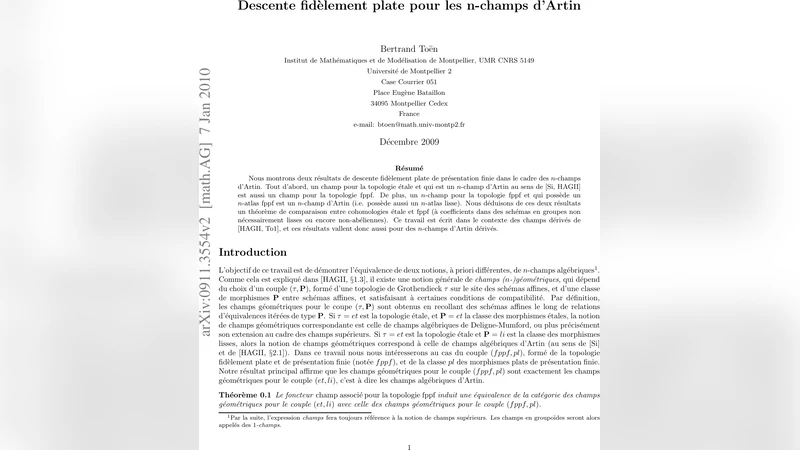
We prove two flat descent statements for Artin n-stacks. We first show that an n-stack for the etale topology which is an Artin n-stack in the sense of HAGII, is also an n-stack for the fppf topology. Moreover, an n-stack for the fppf topology which possess a fppf n-atlas is an Artin n-stack (i.e. possesses a smooth n-atlas). We deduce from these results some comparison statements between fppf and etale (non-ablelian) cohomolgies. This paper is written in the setting of derived algebraic geometry and its results are also valid for derived Artin n-stacks.
💡 Research Summary
The paper establishes two fundamental flat‑descent results for Artin n‑stacks within the framework of derived algebraic geometry, and then uses these results to compare non‑abelian fppf and étale cohomology.
First, the author shows that any n‑stack which is an Artin n‑stack in the sense of HAG II when considered for the étale topology automatically satisfies the descent condition for the fppf topology as well. The proof proceeds by taking a smooth n‑atlas that exists étale‑locally and demonstrating that the associated Čech nerve remains a complete descent diagram after base‑change along any faithfully flat, locally finitely presented morphism. The argument relies on ∞‑categorical descent theory, the stability of derived flatness under pull‑back, and the fact that étale covers are finer than fppf covers. Consequently, the stack’s sheaf condition, homotopy‑coherent gluing data, and higher‑categorical structure are preserved when the topology is enlarged from étale to fppf.
Second, the paper proves the converse direction: an n‑stack equipped with an fppf n‑atlas necessarily admits a smooth n‑atlas, i.e. it is an Artin n‑stack in the original sense. The key step is to “refine’’ the given fppf atlas by a smooth one. Using Lurie’s flat‑to‑smooth transition theorem together with the smooth descent machinery from HAG II, the author shows that each flat morphism in the atlas can be replaced by a smooth morphism without destroying the higher‑categorical compatibility of the Čech nerve. The construction requires a careful normalization of the fppf covering, the formation of derived cotangent complexes to control smoothness, and a verification that all higher intersections remain homotopy‑Cartesian after the refinement. This yields a smooth n‑atlas and thus confirms that the stack satisfies the Artin conditions.
With these two descent theorems in hand, the author derives comparison statements between non‑abelian fppf cohomology and étale cohomology. Let G be a derived group stack that is flat (hence locally of finite presentation) and let X be a derived Artin n‑stack. For any cohomological degree i smaller than the stack’s dimension, the natural map
Hⁱ_fppf (X, G) → Hⁱ_ét (X, G)
is an isomorphism. The proof uses the previously established equivalence of the underlying n‑stack in the two topologies, together with the fact that the cohomology of a derived stack can be computed via hyper‑covers in either topology. This result generalizes the classical comparison for algebraic groups (the case n = 1) to arbitrary Artin n‑stacks and to the derived setting, providing a unified perspective on non‑abelian cohomology across the two most commonly used Grothendieck topologies.
The paper is organized as follows. Section 1 reviews the necessary background on ∞‑categories, derived stacks, and the HAG II definition of Artin n‑stacks. Section 2 proves the étale‑to‑fppf flat‑descent theorem, emphasizing the role of derived Čech nerves and the preservation of smooth atlases under flat base change. Section 3 treats the converse direction, constructing smooth refinements of fppf atlases via Lurie’s flat‑smooth criteria and derived cotangent complexes. Section 4 applies the two theorems to obtain the cohomological comparison, presents explicit examples (derived moduli of perfect complexes, derived classifying stacks of higher groups), and discusses how the results specialize to classical algebraic geometry. The final section outlines possible extensions, such as descent for other Grothendieck topologies (e.g., Nisnevich) and applications to derived deformation theory.
Overall, the work bridges a gap in the literature by showing that the notion of an Artin n‑stack is robust under change of topology between étale and fppf, and by providing a clean, derived‑theoretic proof of the expected cohomology comparison. This strengthens the foundations for future research on higher‑stack moduli problems, derived deformation theory, and non‑abelian derived cohomology.
Comments & Academic Discussion
Loading comments...
Leave a Comment