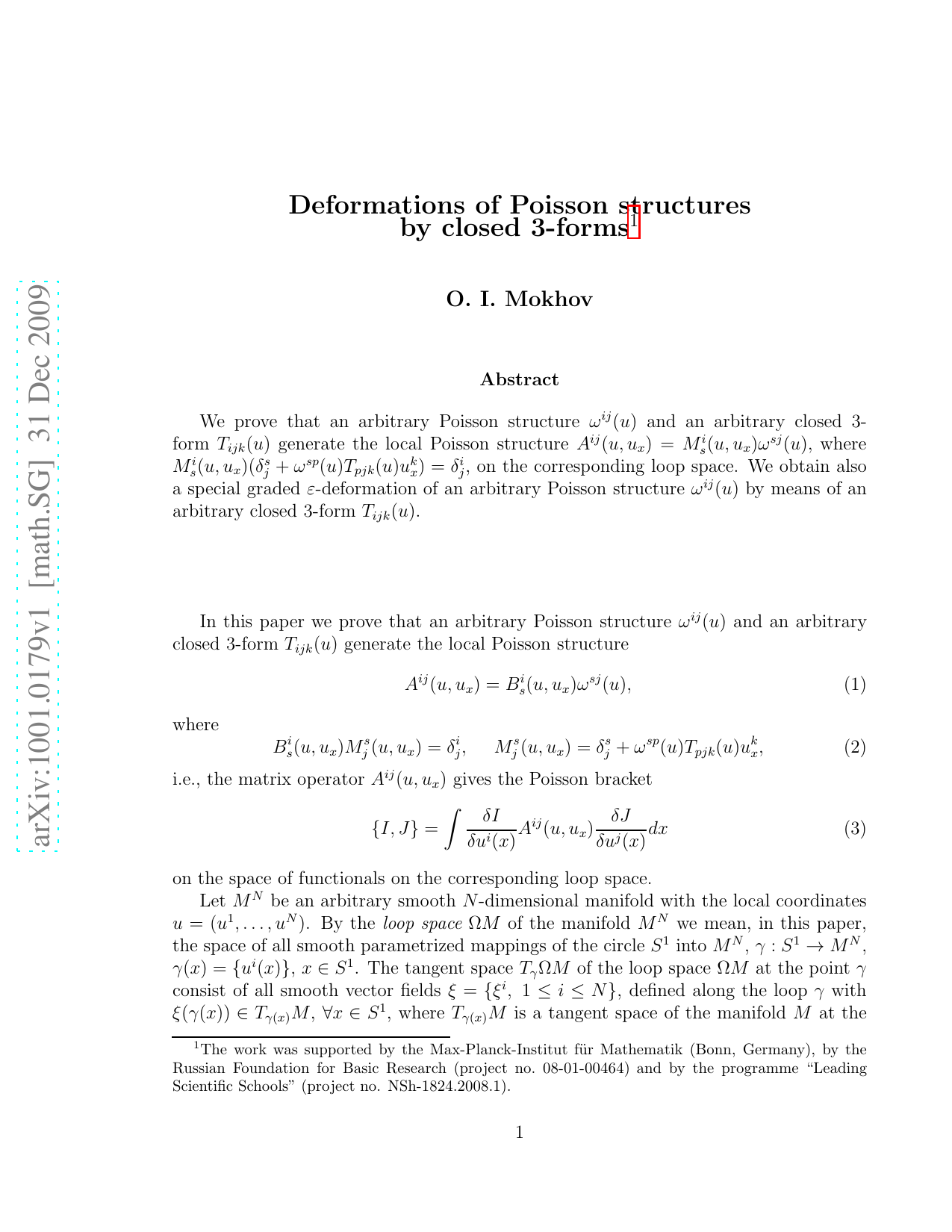
We prove that an arbitrary Poisson structure omega^{ij}(u) and an arbitrary closed 3-form T_{ijk}(u) generate the local Poisson structure A^{ij}(u,u_x) = M^i_s(u,u_x)omega^{sj}(u), where M^i_s(u,u_x)(delta^s_j + omega^{sp}(u)T_{pjk}(u)u^k_x) = delta^i_j, on the corresponding loop space. We obtain also a special graded epsilon-deformation of an arbitrary Poisson structure omega^{ij}(u) by means of an arbitrary closed 3-form T_{ijk}(u).
Deep Dive into Deformations of Poisson structures by closed 3-forms.
We prove that an arbitrary Poisson structure omega^{ij}(u) and an arbitrary closed 3-form T_{ijk}(u) generate the local Poisson structure A^{ij}(u,u_x) = M^i_s(u,u_x)omega^{sj}(u), where M^i_s(u,u_x)(delta^s_j + omega^{sp}(u)T_{pjk}(u)u^k_x) = delta^i_j, on the corresponding loop space. We obtain also a special graded epsilon-deformation of an arbitrary Poisson structure omega^{ij}(u) by means of an arbitrary closed 3-form T_{ijk}(u).
In this paper we prove that an arbitrary Poisson structure ω ij (u) and an arbitrary closed 3-form T ijk (u) generate the local Poisson structure
where
i.e., the matrix operator A ij (u, u x ) gives the Poisson bracket
on the space of functionals on the corresponding loop space. Let M N be an arbitrary smooth N-dimensional manifold with the local coordinates u = (u1 , . . . , u N ). By the loop space ΩM of the manifold M N we mean, in this paper, the space of all smooth parametrized mappings of the circle
The tangent space T γ ΩM of the loop space ΩM at the point γ consist of all smooth vector fields ξ = {ξ i , 1 ≤ i ≤ N}, defined along the loop γ with ξ(γ(x)) ∈ T γ(x) M, ∀x ∈ S 1 , where T γ(x) M is a tangent space of the manifold M at the point γ(x). All closed 2-forms (presymplectic structures) on the loop space ΩM that are given by matrix operators of the form ω ij (u, u x , . . . , u (k) ), i.e., all closed 2-forms of the form ω(ξ, η) =
where ξ, η ∈ T γ ΩM, were completely described in [1] (see also descriptions of various differential-geometric classes of symplectic (presymplectic) and Poisson structures in [2]- [9]).
Theorem 1 [1]. A bilinear form (4) is a closed skew-symmetric 2-form (a presymplectic structure) on the loop space ΩM if and only if
where T ijk (u) is an arbitrary closed 3-form on the manifold
)) = 0, then the corresponding presymplectic form (4), ( 5) is symplectic and the inverse matrix
on the loop space ΩM, i.e., the bracket ( 6) is skew-symmetric and satisfy the Jacobi identity. Therefore Theorem 1 gives the complete description of all nondegenerate Poisson structures on the loop space ΩM that are given by matrix operators of the form ω ij (u, u x , . . . , u (k) ), i.e., all the nondegenerate Poisson brackets of the form (6), det(ω ij (u, u x , . . . , u (k) )) = 0 (such nondegenerate Poisson structures were studied by Astashov and Vinogradov in [9], see also [7]- [8] and [1]- [6]). We note that if the closed 2-form Ω ij (u) is nondegenerate, det(Ω ij (u)) = 0, i.e, the form Ω ij (u) is symplectic on M N , then the 2-form ( 5) is a nondegenerate form on ΩM for any closed 3-form T ijk (u) on the manifold M N since it is obvious that in this case det(T ijk (u)u k x + Ω ij (u)) = 0. Thus we can define, on the loop space of an arbitrary symplectic manifold M N , the Poisson bracket
where
I and J being arbitrary functionals on ΩM. The Poisson bracket ( 7), ( 8) is a partial case of the bracket (1)-( 3), namely, the case when the Poisson structure
where
The case of degenerate Poisson structures ω ij (u), det(ω ij (u)) = 0, is much more complicated. We note that in contrast to the case of all closed 2-forms (presymplectic structures) of the form (4) (Theorem 1) the problem of description of all degenerate Poisson structures of the form ( 6) is a very complicated and unsolved problem. First of all, we note that obviously the matrix operator A ij (u, u x ) (1), ( 2) is skewsymmetric.
Lemma. A skew-symmetric matrix operator A ij (u, u x ) (1) gives a Poisson bracket (3) if and only if the following relations hold:
x , then relations (11), (12) hold for an arbitrary Poisson structure ω ij (u) and an arbitrary closed 3-form T ijk (u).
Let us add an arbitrary parameter ε in the formula for our Poisson structure:
where
We can now expand the Poisson structure A ij (ε, u, u x ) in series in ε:
This expansion give an ε-deformation of an arbitrary Poisson structure ω ij (u) by means of an arbitrary closed 3-form T ijk (u). We note that this ε-deformation of an arbitrary Poisson structure ω ij (u) belongs to a special class of graded ε-deformations of Poisson structures (see, for example, [10], [11]).
The work was supported by the Max-Planck-Institut für Mathematik (Bonn, Germany), by the Russian Foundation for Basic Research (project no. 08-01-00464) and by the programme “Leading Scientific Schools” (project no. NSh-1824.2008.1).
This content is AI-processed based on ArXiv data.