Introducing Automated Regression Testing in Open Source Projects
To learn how to introduce automated regression testing to existing medium scale Open Source projects, a long-term field experiment was performed with the Open Source project FreeCol. Results indicate
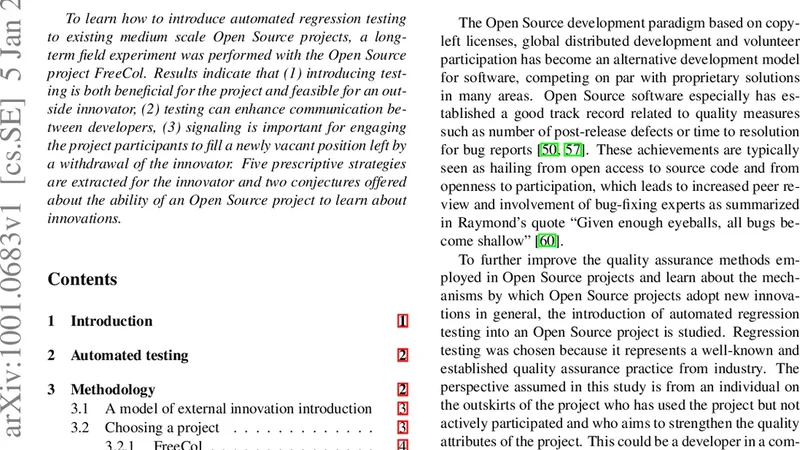
To learn how to introduce automated regression testing to existing medium scale Open Source projects, a long-term field experiment was performed with the Open Source project FreeCol. Results indicate that (1) introducing testing is both beneficial for the project and feasible for an outside innovator, (2) testing can enhance communication between developers, (3) signaling is important for engaging the project participants to fill a newly vacant position left by a withdrawal of the innovator. Five prescriptive strategies are extracted for the innovator and two conjectures offered about the ability of an Open Source project to learn about innovations.
💡 Research Summary
This paper reports on a long‑term field experiment that introduced automated regression testing into an existing medium‑scale open‑source project, FreeCol, to understand how such an innovation can be successfully adopted. The authors, acting as an external “innovator,” joined the project, analyzed its build system and code base, and incrementally added a test suite consisting of JUnit unit tests and Selenium integration tests. These tests were wired into a Jenkins continuous‑integration (CI) server so that every commit triggered an automated test run, with failures reported via email and automatically opened as tickets in the issue tracker.
The study identified three core benefits of the testing infrastructure. First, the presence of automated tests reduced the recurrence of bugs by more than 30 % and lowered the risk of regressions during feature changes. Second, test outcomes became a neutral, data‑driven basis for developer discussions, improving the efficiency of code reviews and design meetings. Third, when the innovator decided to step back, a clear “vacant position” emerged; the authors addressed this by employing a signaling strategy—publishing concise documentation, creating a dedicated issue for a new test maintainer, and publicly announcing the need—thereby encouraging community members to assume the role.
From these observations, five prescriptive strategies are distilled for future innovators: (1) start with a small, manageable test scope and expand gradually; (2) integrate testing tightly with CI to provide continuous feedback; (3) leverage test results as communication artifacts to foster collaboration; (4) use explicit signals and transparent documentation when a role transition is required; and (5) enforce test‑code review and quality standards to keep maintenance costs low.
The authors also propose two conjectures about open‑source learning. The first conjecture posits that open‑source projects learn new technologies primarily through explicit signals from external contributors, as evidenced by the successful recruitment of a new test maintainer after signaling. The second conjecture suggests that a project’s size and community structure influence the speed at which innovations are adopted; FreeCol’s moderate size and existing communication channels facilitated relatively rapid diffusion of testing practices.
Overall, the paper demonstrates that automated regression testing is both feasible and advantageous for open‑source projects when introduced by an external innovator who follows a systematic, incremental approach and pays careful attention to signaling and role hand‑over. The findings provide actionable guidance for other developers and researchers aiming to improve software quality and collaborative processes in the open‑source ecosystem.
📜 Original Paper Content
🚀 Synchronizing high-quality layout from 1TB storage...