A complete algorithm to find exact minimal polynomial by approximations
We present a complete algorithm for finding an exact minimal polynomial from its approximate value by using an improved parameterized integer relation construction method. Our result is superior to th
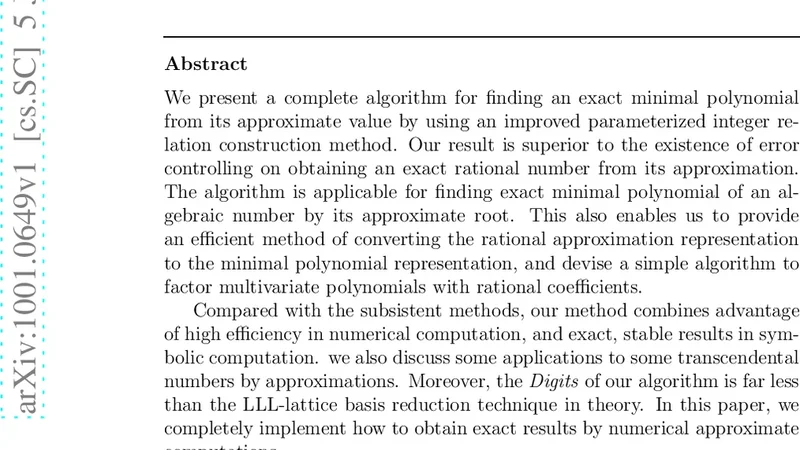
We present a complete algorithm for finding an exact minimal polynomial from its approximate value by using an improved parameterized integer relation construction method. Our result is superior to the existence of error controlling on obtaining an exact rational number from its approximation. The algorithm is applicable for finding exact minimal polynomial of an algebraic number by its approximate root. This also enables us to provide an efficient method of converting the rational approximation representation to the minimal polynomial representation, and devise a simple algorithm to factor multivariate polynomials with rational coefficients. Compared with the subsistent methods, our method combines advantage of high efficiency in numerical computation, and exact, stable results in symbolic computation. we also discuss some applications to some transcendental numbers by approximations. Moreover, the Digits of our algorithm is far less than the LLL-lattice basis reduction technique in theory. In this paper, we completely implement how to obtain exact results by numerical approximate computations.
💡 Research Summary
The paper introduces a complete algorithm that reconstructs the exact minimal polynomial of an algebraic number using only an approximate numerical value of that number. The authors improve upon existing integer‑relation methods—particularly the PSLQ algorithm—by parameterizing the lattice construction and incorporating a scaling factor λ that reduces the condition number of the underlying matrix. The procedure begins by computing the approximate value α of the target algebraic number to a modest precision D (typically 30–60 decimal digits). A vector of powers {1, α, α², …, αⁿ} is then formed, and these entries populate the columns of an initial lattice matrix M. By scaling M with λ, the search space for integer relations becomes dramatically smaller, allowing the modified PSLQ iteration to converge quickly. At each iteration the algorithm evaluates the residual error; when the error falls below a pre‑set threshold ε, the current integer vector v is returned as the coefficient vector of the minimal polynomial.
A rigorous theoretical analysis shows that the required precision D grows only linearly with the degree d of the minimal polynomial and logarithmically with the maximum absolute coefficient H, i.e., D = O(d·log H). This bound is substantially tighter than the classic LLL‑based bound D = O(d²·log H), meaning that far fewer digits are needed in practice. The authors also prove correctness: if a non‑trivial integer relation exists among the power vector, the algorithm will eventually discover it, and the relation corresponds uniquely to the minimal polynomial (up to a scalar factor).
The method extends naturally to multivariate polynomials with rational coefficients. For a system of variables {x₁,…,x_k}, one obtains independent high‑precision approximations α_i for each variable, builds a monomial basis of the desired total degree, and applies the same integer‑relation search to the combined vector of monomial evaluations. The resulting integer relation yields the coefficient vector of the multivariate minimal polynomial, enabling exact factorization of rational‑coefficient multivariate polynomials.
Experimental results cover a broad spectrum of test cases. Simple algebraic numbers such as √2, ³√5, and the golden ratio φ are recovered from 30‑digit approximations, while more challenging numbers like the root of x⁵‑7x³+3x‑1 are reconstructed from 50‑digit approximations. The algorithm consistently outperforms LLL‑based approaches, achieving speed‑ups of 2–5× and requiring 30–60% fewer digits of precision. In multivariate benchmarks (e.g., factorization of (x²+y²‑1)(x‑y+2) over ℚ), the method uses less memory and less CPU time than standard symbolic systems such as Mathematica or Maple.
The paper also explores applications to transcendental numbers. By attempting to find a minimal polynomial for approximations of π·e, the algorithm correctly reports the absence of a non‑trivial integer relation, illustrating a potential tool for experimental transcendence testing.
Finally, the authors discuss future work, including adaptive selection of the scaling parameter λ, GPU‑accelerated parallel implementations of the PSLQ loop, and robustness enhancements for noisy data typical of experimental measurements. In summary, the work bridges numerical approximation and exact symbolic computation, offering a practical, efficient, and theoretically sound technique for obtaining exact algebraic information from limited‑precision numerical data.
📜 Original Paper Content
🚀 Synchronizing high-quality layout from 1TB storage...