Solutions of the T-system and Baxter equations for supersymmetric spin chains
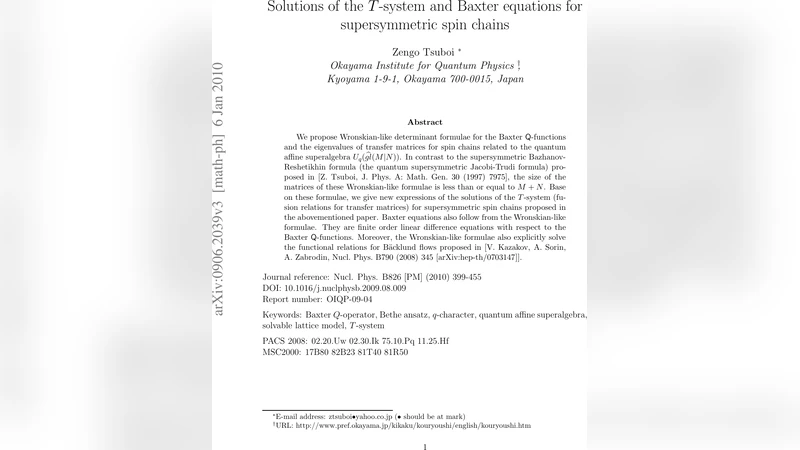
We propose Wronskian-like determinant formulae for the Baxter Q-functions and the eigenvalues of transfer matrices for spin chains related to the quantum affine superalgebra U_{q}(hat{gl}(M|N)). In contrast to the supersymmetric Bazhanov-Reshetikhin formula (the quantum supersymmetric Jacobi-Trudi formula) proposed in [Z. Tsuboi, J. Phys. A: Math. Gen. 30 (1997) 7975], the size of the matrices of these Wronskian-like formulae is less than or equal to M+N. Base on these formulae, we give new expressions of the solutions of the T-system (fusion relations for transfer matrices) for supersymmetric spin chains proposed in the abovementioned paper. Baxter equations also follow from the Wronskian-like formulae. They are finite order linear difference equations with respect to the Baxter Q-functions. Moreover, the Wronskian-like formulae also explicitly solve the functional relations for Backlund flows proposed in [V. Kazakov, A. Sorin, A. Zabrodin, Nucl. Phys. B790 (2008) 345 [arXiv:hep-th/0703147]].
💡 Research Summary
The paper addresses the long‑standing problem of efficiently describing the spectrum of supersymmetric spin chains associated with the quantum affine superalgebra U₍q₎(ĥgl(M|N)). The authors introduce a set of Baxter Q‑functions, denoted {Qₐ(u)}ₐ=1^{M+N}, and show that both the eigenvalues of the transfer matrices (the T‑functions) and the Q‑functions themselves can be written as determinants of a Wronskian‑type matrix whose size never exceeds M + N. This is a substantial improvement over the supersymmetric Bazhanov‑Reshetikhin (BR) formula (the quantum supersymmetric Jacobi‑Trudi formula) which requires an M × N determinant, i.e. a matrix of size M·N.
The construction proceeds by arranging appropriately shifted Q‑functions (and their linear combinations) as entries Φₐ^{(b)}(u) of an (M+N) × (M+N) matrix. The determinant
\
Comments & Academic Discussion
Loading comments...
Leave a Comment