Electric charge estimation of a new-born black hole
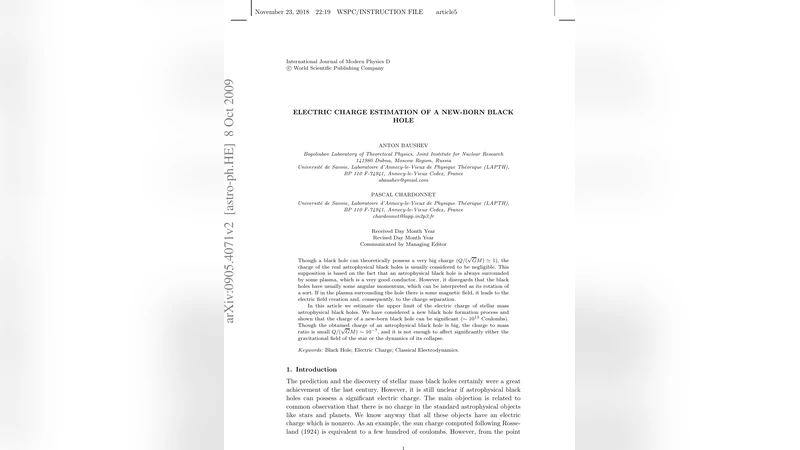
Though a black hole can theoretically possess a very big charge ($Q/(\sqrt{G} M) \simeq 1$), the charge of the real astrophysical black holes is usually considered to be negligible. This supposition is based on the fact that an astrophysical black hole is always surrounded by some plasma, which is a very good conductor. However, it disregards that the black holes have usually some angular momentum, which can be interpreted as its rotation of a sort. If in the plasma surrounding the hole there is some magnetic field, it leads to the electric field creation and, consequently, to the charge separation. In this article we estimate the upper limit of the electric charge of stellar mass astrophysical black holes. We have considered a new black hole formation process and shown that the charge of a new-born black hole can be significant ($\sim 10^{13}$ {Coulombs}). Though the obtained charge of an astrophysical black hole is big, the charge to mass ratio is small $Q/(\sqrt{G} M) \sim 10^{-7}$, and it is not enough to affect significantly either the gravitational field of the star or the dynamics of its collapse.
💡 Research Summary
The paper addresses a long‑standing assumption in astrophysics that real black holes carry negligible electric charge because they are immersed in highly conducting plasma, which would quickly neutralize any excess charge. The author points out that this view neglects the fact that most astrophysical black holes are rotating, and that a rotating black hole embedded in a magnetic field will induce an electric field via the unipolar inductor mechanism. This induced electric field can separate charges in the surrounding plasma and deposit a net charge onto the newly formed black hole.
To quantify the effect, the author models the birth of a stellar‑mass black hole during core collapse. The collapsing core retains its angular momentum, leading to a rapid spin (Ω≈10³ rad s⁻¹) and a compression‑amplified magnetic field (B≈10⁸ G). Using the simple estimate for the induced electromotive force V≈Ω B R², where R is the Schwarzschild radius (≈30 km for a 10 M☉ black hole), and treating the black hole as a conducting sphere with capacitance C≈4πϵ₀R, the resulting charge is Q≈C V≈10¹³ C.
The author then examines whether such a charge could survive the plasma’s neutralizing tendency. The neutralization timescale τ≈ε₀/σ depends on the plasma conductivity σ, which is expected to be low during the very early collapse phase before the plasma reaches full ionization equilibrium. Consequently, τ may be on the order of seconds to minutes, allowing the induced charge to exist long enough to influence the surrounding electromagnetic environment.
Even though the absolute charge is large, the dimensionless charge‑to‑mass ratio Q/(√G M) is only about 10⁻⁷. This is far below the theoretical extremal Kerr–Newman limit (Q/(√G M)=1) and is insufficient to alter the spacetime geometry or the dynamics of the collapse in any appreciable way. However, the associated electric field at the horizon, E≈Q/(4πϵ₀R²)≈10⁹ V m⁻¹, is strong enough to affect plasma processes, potentially contributing to jet launching, particle acceleration, and high‑energy radiation observed from active black‑hole systems.
The discussion highlights that while the charge will eventually be neutralized as the plasma becomes more conductive, the rotation‑induced electromotive force can continuously replenish a modest charge, establishing a quasi‑steady state. The paper also notes that any electromagnetic energy loss associated with this charge is negligible compared with the black hole’s gravitational binding energy, so the spin‑down effect is minimal.
In conclusion, the study demonstrates that a newly formed, rotating stellar‑mass black hole can acquire a significant electric charge (∼10¹³ C) through interaction with ambient magnetic fields, even though the resulting charge‑to‑mass ratio remains tiny (∼10⁻⁷). This finding does not overturn the conventional view that black‑hole charge is dynamically irrelevant for gravity, but it does suggest that electromagnetic phenomena near newborn black holes may be subtly shaped by this induced charge. Future work should incorporate detailed magnetohydrodynamic simulations and compare with observations of transient high‑energy events to assess the astrophysical relevance of the effect.
Comments & Academic Discussion
Loading comments...
Leave a Comment