Studies of Millimeter-Wave Atmospheric Noise Above Mauna Kea
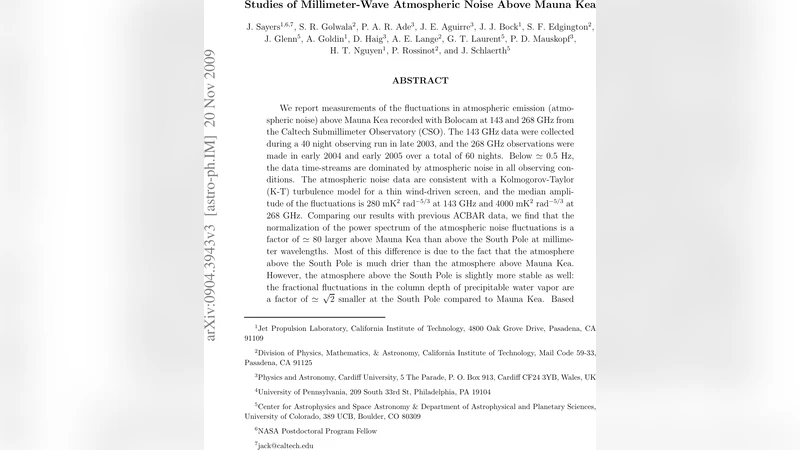
We report measurements of the fluctuations in atmospheric emission (atmospheric noise) above Mauna Kea recorded with Bolocam at 143 and 268 GHz from the Caltech Submillimeter Observatory (CSO). The 143 GHz data were collected during a 40 night observing run in late 2003, and the 268 GHz observations were made in early 2004 and early 2005 over a total of 60 nights. Below 0.5 Hz, the data time-streams are dominated by atmospheric noise in all observing conditions. The atmospheric noise data are consistent with a Kolmogorov-Taylor (K-T) turbulence model for a thin wind-driven screen, and the median amplitude of the fluctuations is 280 mK^2 rad^(-5/3) at 143 GHz and 4000 mK^2 rad^(-5/3) at 268 GHz. Comparing our results with previous ACBAR data, we find that the normalization of the power spectrum of the atmospheric noise fluctuations is a factor of 80 larger above Mauna Kea than above the South Pole at millimeter wavelengths. Most of this difference is due to the fact that the atmosphere above the South Pole is much drier than the atmosphere above Mauna Kea. However, the atmosphere above the South Pole is slightly more stable as well: the fractional fluctuations in the column depth of precipitable water vapor are a factor of sqrt(2) smaller at the South Pole compared to Mauna Kea. Based on our atmospheric modeling, we developed several algorithms to remove the atmospheric noise, and the best results were achieved when we described the fluctuations using a low-order polynomial in detector position over the 8 arcmin field of view (FOV). However, even with these algorithms, we were not able to reach photon-background-limited instrument photometer (BLIP) performance at frequencies below 0.5 Hz in any observing conditions.
💡 Research Summary
The paper presents a comprehensive study of atmospheric emission fluctuations—commonly referred to as atmospheric noise—above Mauna Kea, using the Bolocam instrument mounted on the Caltech Submillimeter Observatory. Observations were carried out at two millimetre-wave frequencies, 143 GHz (≈2 mm) and 268 GHz (≈1.1 mm), over a total of 100 nights: a 40‑night campaign in late 2003 for the lower frequency and a combined 60‑night set in early 2004 and early 2005 for the higher frequency. Bolocam’s 144‑pixel array provides an 8‑arcminute field of view, allowing simultaneous measurement of atmospheric emission across a relatively wide sky patch.
Time‑stream analysis reveals that, below 0.5 Hz, the power spectral density (PSD) of the data is dominated by atmospheric noise. The PSD follows a f^(−8/3) law, which is precisely the signature of a Kolmogorov‑Taylor (K‑T) turbulence cascade projected onto a thin, wind‑driven screen moving across the line of sight. By fitting the K‑T model, the authors determine median fluctuation amplitudes of 280 mK² rad^(−5/3) at 143 GHz and 4 000 mK² rad^(−5/3) at 268 GHz. These normalizations are roughly 80 times larger than those measured at the South Pole by the ACBAR experiment, a discrepancy primarily attributed to the much drier atmosphere over the Pole. The South Pole’s precipitable water vapour (PWV) column depth exhibits fractional fluctuations that are about √2 smaller than those at Mauna Kea, indicating a modestly more stable atmosphere in addition to the lower absolute water content.
To mitigate the atmospheric contamination, the authors develop several data‑processing algorithms. The most successful approach models the spatial structure of the atmospheric fluctuations across the detector array as a low‑order polynomial (typically first‑ to third‑order) in detector position. This “common‑mode polynomial subtraction” reduces the atmospheric contribution by roughly 30 % compared to a simple mean subtraction, especially in the 0.5–2 Hz band where the atmospheric signal is strongest. Nevertheless, at frequencies below 0.5 Hz the residual noise remains well above the photon‑background‑limited (BLIP) level, indicating that the thin‑screen approximation and low‑order polynomial description are insufficient to capture the full complexity of the atmospheric turbulence at these scales.
The authors discuss the implications of their findings for ground‑based millimetre astronomy. The markedly higher atmospheric noise at Mauna Kea means that achieving BLIP performance requires either more sophisticated atmospheric modeling (e.g., multi‑screen or three‑dimensional turbulence reconstructions) or instrumental strategies such as faster scanning, larger detector arrays with better spatial sampling, and real‑time integration of meteorological data (wind speed, PWV, temperature profiles). They also suggest that scheduling observations during periods of exceptionally low PWV and stable wind conditions could further suppress the low‑frequency noise.
In summary, this work quantifies the strength and spectral behavior of atmospheric noise above Mauna Kea, demonstrates that it follows a Kolmogorov‑Taylor thin‑screen model, and shows that, despite advanced polynomial subtraction techniques, the residual low‑frequency fluctuations prevent the instrument from reaching BLIP performance under typical conditions. The study underscores the need for both improved atmospheric modeling and hardware solutions to enable high‑precision millimetre‑wave observations from mid‑latitude sites.
Comments & Academic Discussion
Loading comments...
Leave a Comment