Ternary Social Networks: Dynamic Balance and Self-Organized Criticality
Antal et al. [Phys. Rev. E textbf{72}, 036121 (2005)] have studied the balance dynamics on the social networks. In this paper, based on the model proposed by Antal et al., we improve it and generaliz
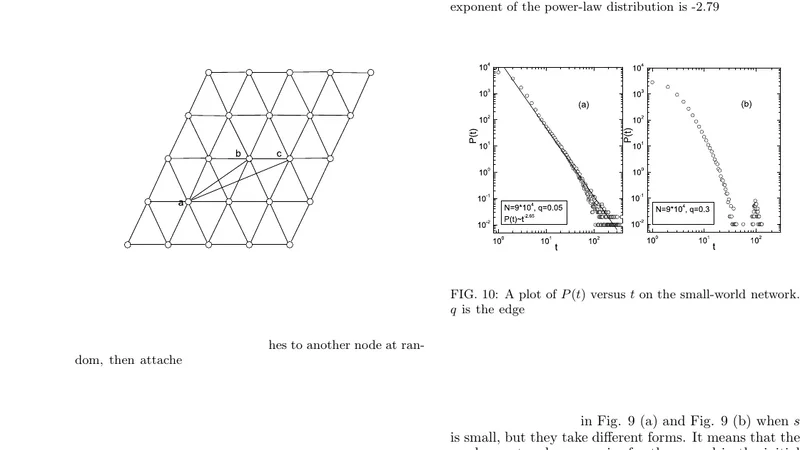
Antal et al. [Phys. Rev. E \textbf{72}, 036121 (2005)] have studied the balance dynamics on the social networks. In this paper, based on the model proposed by Antal et al., we improve it and generalize the binary social networks to the ternary social networks. When the social networks get dynamically balanced, we obtain the distributions of each relation and the time needed for dynamic balance. Besides, we study the self-organized criticality on the ternary social networks based on our model. For the ternary social networks evolving to the sensitive state, any small disturbance may result in an avalanche. The occurrence of the avalanche satisfies the power-law form both spatially and temporally. Numerical results verify our theoretical expectations.
💡 Research Summary
The paper builds on the balance dynamics framework introduced by Antal et al. for binary social networks and extends it to a ternary setting where each node can adopt one of three states: +1 (friend), 0 (neutral), or –1 (enemy). The authors retain the triadic interaction Hamiltonian (H_{\Delta}= -\alpha\sum_{i<j}s_i s_j), but the inclusion of the neutral state effectively nullifies interaction terms involving a 0, thereby reducing the total energy contribution of a triad whenever neutrality is present. This modification captures realistic social situations in which individuals may remain indifferent or avoid taking sides.
Dynamic balance is achieved through Glauber‑type stochastic updates. The transition probability for a node (i) to change from state (s_i) to (s_i’) is given by
\
📜 Original Paper Content
🚀 Synchronizing high-quality layout from 1TB storage...