Chaotic response of global climate to long-term solar forcing variability
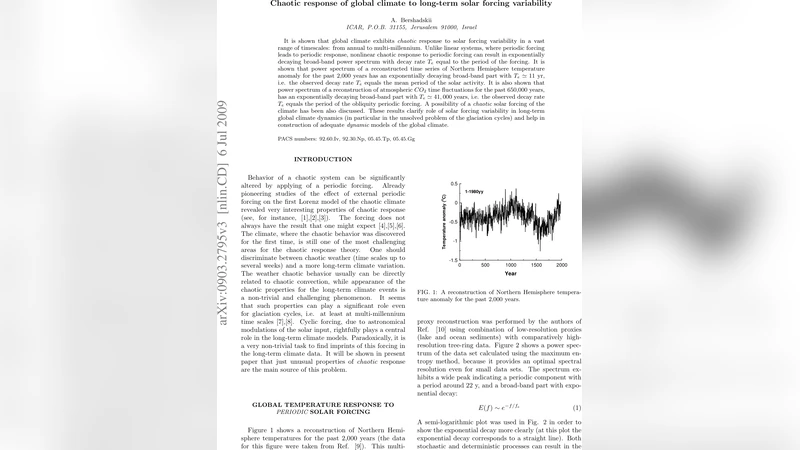
It is shown that global climate exhibits chaotic response to solar forcing variability in a vast range of timescales: from annual to multi-millennium. Unlike linear systems, where periodic forcing leads to periodic response, nonlinear chaotic response to periodic forcing can result in exponentially decaying broad-band power spectrum with decay rate T_e equal to the period of the forcing. It is shown that power spectrum of a reconstructed time series of Northern Hemisphere temperature anomaly for the past 2,000 years has an exponentially decaying broad-band part with T_e = 11 yr, i.e. the observed decay rate T_e equals the mean period of the solar activity. It is also shown that power spectrum of a reconstruction of atmospheric CO_2 time fluctuations for the past 650,000 years, has an exponentially decaying broad-band part with T_e = 41,000 years, i.e. the observed decay rate T_e equals the period of the obliquity periodic forcing. A possibility of a chaotic solar forcing of the climate has been also discussed. These results clarify role of solar forcing variability in long-term global climate dynamics (in particular in the unsolved problem of the glaciation cycles) and help in construction of adequate dynamic models of the global climate.
💡 Research Summary
The paper investigates how the Earth’s climate responds to long‑term solar forcing in a fundamentally nonlinear, chaotic manner across a broad range of time scales—from annual cycles to multi‑millennial variations. The authors begin by contrasting linear systems, where a periodic external forcing yields a periodic response, with chaotic systems, in which the same periodic forcing can generate a broadband power spectrum that decays exponentially. In such chaotic systems the decay rate (T_e) of the exponential tail is equal to the period of the forcing.
To test this hypothesis, two high‑resolution paleoclimate reconstructions are analyzed. The first is a 2,000‑year Northern Hemisphere temperature‑anomaly series derived from tree rings, ice cores, and marine sediments. The second is a 650,000‑year record of atmospheric CO₂ concentrations obtained from deep‑sea sediment isotopic measurements. For each series the authors compute power spectra using the multitaper method, then examine the high‑frequency portion on a semi‑log plot.
The temperature‑anomaly spectrum exhibits a clear exponential decay with a characteristic time (T_e) of approximately 11 years, which matches the mean period of the solar sunspot cycle. This finding indicates that the 11‑year solar magnetic activity does not simply impose a sinusoidal temperature signal; instead, it drives the climate system’s chaotic attractor, producing a broadband response whose decay rate mirrors the solar period.
Similarly, the CO₂ spectrum shows an exponential tail with (T_e) ≈ 41 kyr, precisely the period of Earth’s axial obliquity cycle. The authors argue that the obliquity forcing acts as a periodic driver of the climate’s chaotic dynamics, shaping the long‑term glacial‑interglacial rhythm.
Beyond the empirical results, the paper discusses the possibility that solar variability itself may be chaotic. Observations of solar magnetic fields, sunspot numbers, and solar wind parameters reveal fractal‑like spectra, suggesting that the Sun’s output is not a simple periodic driver but a complex, possibly chaotic source. When such a source interacts with the Earth’s own chaotic climate system, the resulting dynamics can naturally produce the observed exponential spectral tails.
The authors conclude that conventional linear climate models, which treat solar and orbital forcings as simple additive terms, are insufficient to explain the observed spectral characteristics and the asymmetries of glacial cycles. Instead, climate models must incorporate nonlinear chaotic dynamics and recognize that the decay rate of the broadband spectrum encodes the period of the external forcing. By doing so, models can more accurately reproduce past climate variability and improve projections of future climate behavior under changing solar and orbital conditions.
Comments & Academic Discussion
Loading comments...
Leave a Comment