Splitting families and the Noetherian type of $betaomega-omega$
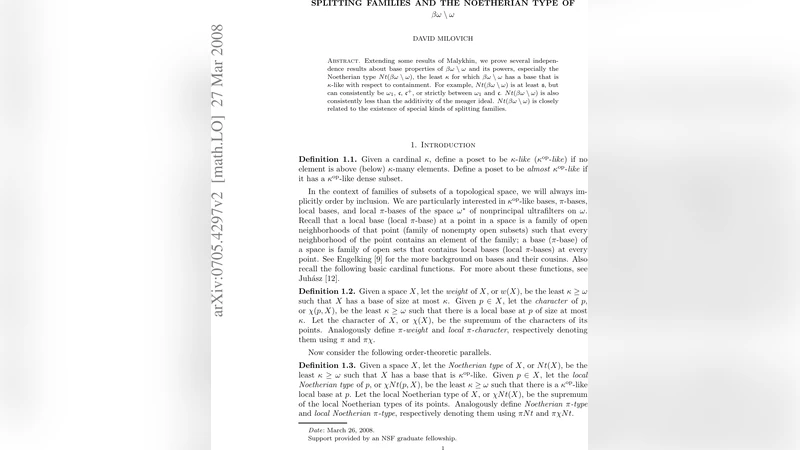
Extending some results of Malykhin, we prove several independence results about base properties of $\beta\omega-\omega$ and its powers, especially the Noetherian type $Nt(\beta\omega-\omega)$, the least $\kappa$ for which $\beta\omega-\omega$ has a base that is $\kappa$-like with respect to containment. For example, $Nt(\beta\omega-\omega)$ is never less than the splitting number, but can consistently be that $\omega_1$, $2^\omega$, $(2^\omega)^+$, or strictly between $\omega_1$ and $2^\omega$. $Nt(\beta\omega-\omega)$ is also consistently less than the additivity of the meager ideal. $Nt(\beta\omega-\omega)$ is closely related to the existence of special kinds of splitting families.
💡 Research Summary
The paper investigates the base structure of the Čech–Stone remainder βω \ ω, focusing on a newly introduced cardinal invariant called the Noetherian type, denoted Nt(βω \ ω). A base is said to be κ‑like with respect to inclusion if every chain of basic open sets has size < κ; Nt is the smallest κ for which such a base exists. This notion refines classical invariants such as weight or π‑weight by measuring how “well‑ordered” the inclusion hierarchy of a base can be.
The authors first establish a fundamental lower bound: Nt(βω \ ω) is never smaller than the splitting number s. The splitting number is the minimal size of a family ℱ ⊆
Comments & Academic Discussion
Loading comments...
Leave a Comment