Integrability of Kupershmidt deformations
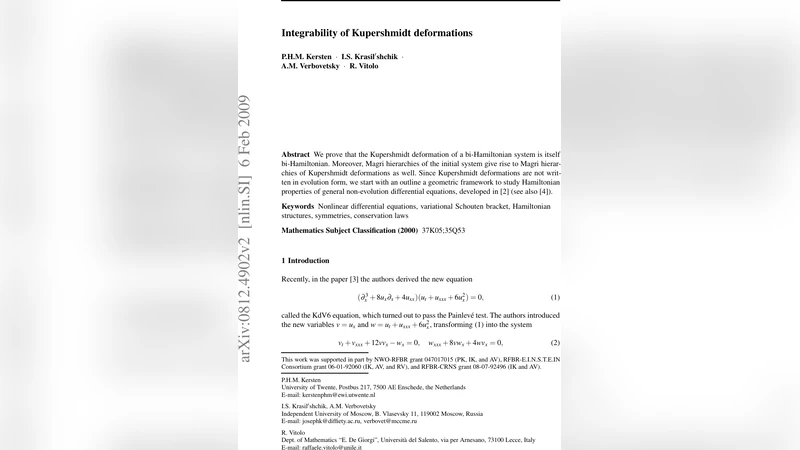
We prove that the Kupershmidt deformation of a bi-Hamiltonian system is itself bi-Hamiltonian. Moreover, Magri hierarchies of the initial system give rise to Magri hierarchies of Kupershmidt deformations as well. Since Kupershmidt deformations are not written in evolution form, we start with an outline a geometric framework to study Hamiltonian properties of general non-evolution differential equations, developed in [2] (see also arXiv:0812.4895).
💡 Research Summary
The paper investigates the integrability properties of Kupershmidt deformations of bi‑Hamiltonian systems. A bi‑Hamiltonian system possesses two compatible Hamiltonian operators (P_{1}) and (P_{2}) (i.e., their variational Schouten bracket vanishes) and therefore admits an infinite hierarchy of commuting flows generated by a Magri sequence of conserved functionals. Kupershmidt’s construction modifies a given system by adding a non‑conservative term (K) that is not written in evolution form, producing a new differential equation (\tilde F = F + K = 0). Because the resulting equation is generally non‑evolutionary, the usual Hamiltonian formalism based on evolutionary vector fields does not apply directly.
To overcome this obstacle, the authors adopt a geometric framework developed in earlier work (reference
Comments & Academic Discussion
Loading comments...
Leave a Comment