Frobenius Manifolds as a Special Class of Submanifolds in Pseudo-Euclidean Spaces
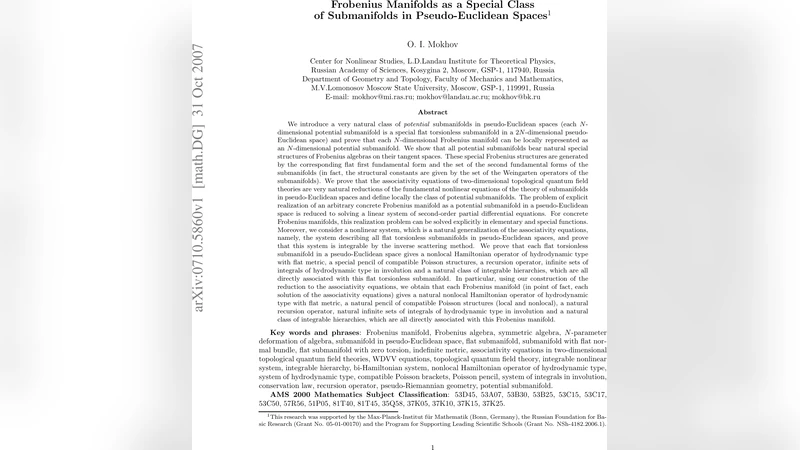
We introduce a class of potential submanifolds in pseudo-Euclidean spaces (each N-dimensional potential submanifold is a special flat torsionless submanifold in a 2N-dimensional pseudo-Euclidean space) and prove that each N-dimensional Frobenius manifold can be locally represented as an N-dimensional potential submanifold. We show that all potential submanifolds bear natural special structures of Frobenius algebras on their tangent spaces. These special Frobenius structures are generated by the corresponding flat first fundamental form and the set of the second fundamental forms of the submanifolds (in fact, the structural constants are given by the set of the Weingarten operators of the submanifolds). We prove that the associativity equations of two-dimensional topological quantum field theories are very natural reductions of the fundamental nonlinear equations of the theory of submanifolds in pseudo-Euclidean spaces and define locally the class of potential submanifolds. The problem of explicit realization of an arbitrary concrete Frobenius manifold as a potential submanifold in a pseudo-Euclidean space is reduced to solving a linear system of second-order partial differential equations. For concrete Frobenius manifolds, this realization problem can be solved explicitly in elementary and special functions.
💡 Research Summary
The paper establishes a precise geometric correspondence between Frobenius manifolds and a distinguished class of submanifolds in pseudo‑Euclidean spaces, which the author calls “potential submanifolds”. A potential submanifold is defined as an N‑dimensional submanifold of a 2N‑dimensional pseudo‑Euclidean space ℝ^{N,N} whose first fundamental form is flat and whose torsion vanishes. In this setting the second fundamental forms are encoded by a family of Weingarten operators A₁,…,A_N. The crucial observation is that these operators commute, can be simultaneously diagonalised with the flat metric, and therefore endow each tangent space with a commutative, associative algebra whose structure constants are exactly the components of the A_i. This algebraic structure coincides with the Frobenius algebra naturally attached to a Frobenius manifold.
The author proves that any N‑dimensional Frobenius manifold (M,·,η,∇,e,E) can be locally realised as a potential submanifold. The flat metric η is identified with the first fundamental form, while the multiplication tensor c^k_{ij}=∂_i∂_j∂_k Φ (Φ being the Frobenius potential) is identified with the Weingarten operators. Consequently the WDVV associativity equations, which are originally a highly non‑linear system, become the compatibility conditions for the commuting family {A_i}: ∂_i A_j = ∂_j A_i and
Comments & Academic Discussion
Loading comments...
Leave a Comment