The Eilenberg-Watts theorem over schemes
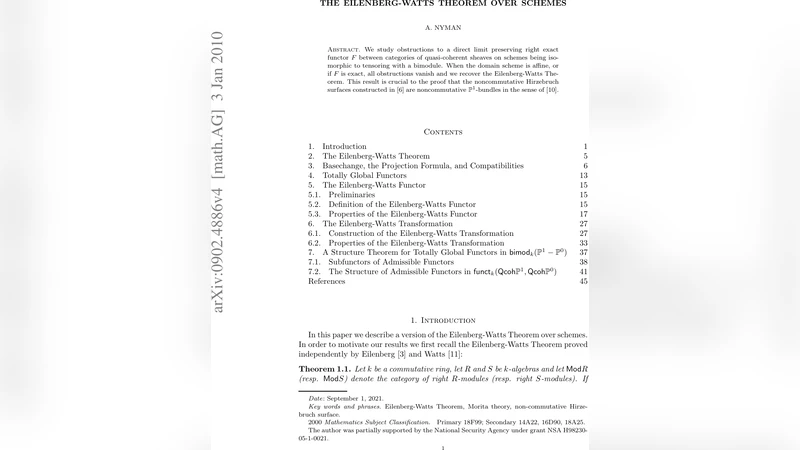
We study obstructions to a direct limit preserving right exact functor $F$ between categories of quasi-coherent sheaves on schemes being isomorphic to tensoring with a bimodule. When the domain scheme is affine, or if $F$ is exact, all obstructions vanish and we recover the Eilenberg-Watts Theorem. This result is crucial to the proof that the noncommutative Hirzebruch surfaces constructed by C. Ingalls and D. Patrick are noncommutative $\mathbb{P}^{1}$-bundles in the sense of M. Van den Bergh.
💡 Research Summary
The paper addresses a natural generalisation of the classical Eilenberg‑Watts theorem from module categories to the categories of quasi‑coherent sheaves on arbitrary schemes. In the classical setting, a right‑exact functor that commutes with direct limits between module categories $\operatorname{Mod}!-!A$ and $\operatorname{Mod}!-!B$ is always isomorphic to tensoring with an $A$‑$B$ bimodule. When one replaces $A$ and $B$ by schemes $X$ and $Y$, the situation becomes subtler because quasi‑coherent sheaves are glued from local data and the functor need not preserve coherence.
The authors begin by fixing a $k$‑linear, right‑exact functor $F:\operatorname{QCoh}(X)\to\operatorname{QCoh}(Y)$ that preserves direct limits. They introduce two families of natural transformations that measure the failure of $F$ to be a tensor functor:
- The localisation maps
\
Comments & Academic Discussion
Loading comments...
Leave a Comment