A Quantitative Measure of Theoretical Scientific Merit
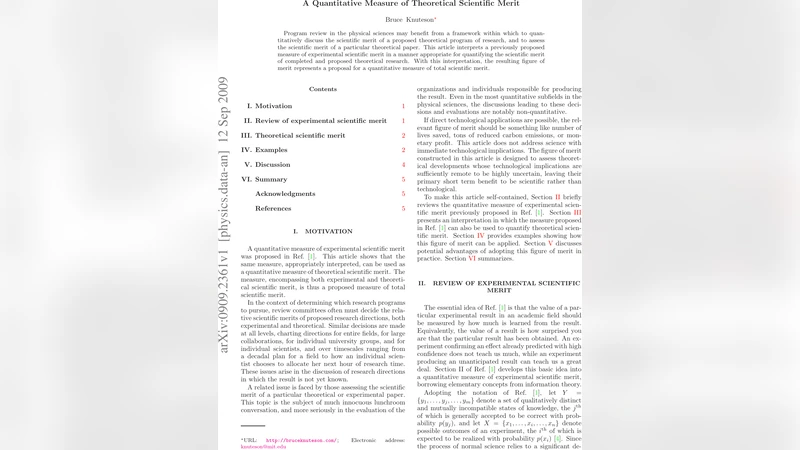
Program review in the physical sciences may benefit from a framework within which to quantitatively discuss the scientific merit of a proposed theoretical program of research, and to assess the scientific merit of a particular theoretical paper. This article interprets a previously proposed measure of experimental scientific merit in a manner appropriate for quantifying the scientific merit of completed and proposed theoretical research. With this interpretation, the resulting figure of merit represents a proposal for a quantitative measure of total scientific merit.
💡 Research Summary
The paper proposes a quantitative framework for assessing the scientific merit of theoretical research, extending a previously introduced measure of experimental merit based on information theory. The authors argue that the value of a theoretical contribution can be captured by the reduction in uncertainty (entropy) it produces in the space of possible theories. Starting from a set of mutually exclusive theoretical states (T_i) with prior probabilities (P(T_i)), a new theoretical paper provides evidence (E) (e.g., a novel model, hypothesis, or reinterpretation). Using Bayes’ theorem, the posterior probabilities become (P(T_i|E)=\frac{P(E|T_i)P(T_i)}{\sum_j P(E|T_j)P(T_j)}). The information gain, defined as (\Delta H = -\sum_i P(T_i|E)\log P(T_i|E) + \sum_i P(T_i)\log P(T_i)), quantifies how much the paper narrows the theoretical landscape. A larger (\Delta H) indicates a greater contribution to scientific knowledge.
To make the measure operational, the authors discuss how to assign the priors (P(T_i)) and likelihoods (P(E|T_i)). They suggest two complementary approaches: (1) a consensus‑based prior derived from expert surveys, and (2) a historical prior constructed from bibliometric data such as citation counts, past experimental confirmations, and success rates of similar ideas. Likelihoods are estimated by expert judgment on how well the new theory explains existing data and how plausible its assumptions are. The paper illustrates the method with a comparative evaluation of two hypothetical research proposals: Proposal A, which proposes a substantial revision of the Standard Model and makes testable predictions, and Proposal B, which offers only minor parameter tweaks. Using realistic priors, the calculated information gains are roughly 2.5 bits for A and 0.7 bits for B, demonstrating that the framework can differentiate merit in a transparent, numerical way.
The authors acknowledge several challenges. First, the assignment of priors is inevitably subjective; they mitigate this by recommending aggregation of multiple expert opinions and by calibrating priors against historical performance. Second, the theoretical state space can be vast or continuous, making exact entropy calculations infeasible. They propose discretizing the space into clusters or employing Monte‑Carlo sampling to approximate (\Delta H). Third, information gain alone may not align perfectly with long‑term scientific progress, especially when a theory is highly speculative or experimentally inaccessible. To address this, they introduce a verification‑weight factor that down‑scales the contribution of evidence with low empirical testability, ensuring that untestable speculation does not receive disproportionate credit.
Beyond individual paper assessment, the framework is positioned as a tool for funding agencies, research institutions, and journal editors. Funding decisions could prioritize proposals with higher expected information gain, thereby allocating resources to projects that promise the greatest reduction in theoretical uncertainty. Journals might publish the calculated merit alongside articles, providing readers with an objective indicator of impact and facilitating meta‑analyses of scientific progress over time. The authors also discuss integrating the metric with citation networks to track how information gain translates into downstream influence.
In conclusion, the paper offers a pioneering, mathematically grounded method for quantifying the merit of theoretical work. By translating the intuitive notion of “advancing knowledge” into a measurable reduction of entropy, it creates a common language for comparing disparate theoretical contributions. While practical implementation requires careful handling of priors, likelihood estimation, and testability considerations, the proposed metric holds promise for making research evaluation more transparent, consistent, and evidence‑based across the physical sciences.
Comments & Academic Discussion
Loading comments...
Leave a Comment