The Black Hole Case: The Injunction Against the End of the World
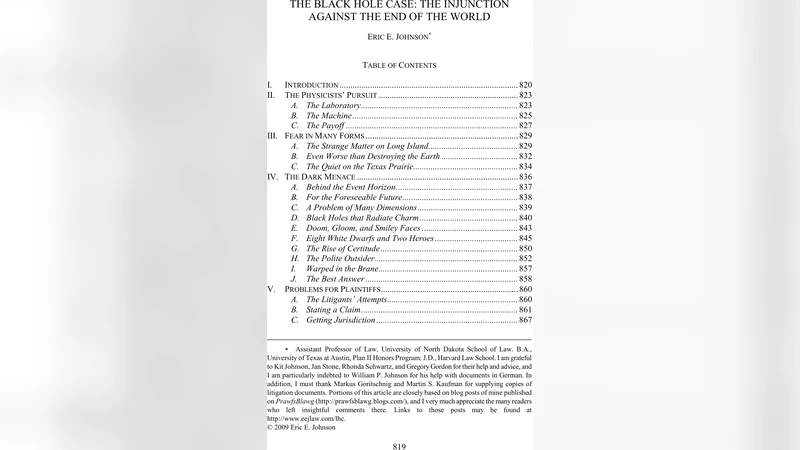
What should a court do with a preliminary-injunction request to halt a multi-billion-dollar particle-physics experiment that plaintiffs claim could create a black hole that will devour the planet? The real-life case of CERN’s LHC seems like a legal classic in the making. Unfortunately, however, no court has braved the extreme factual terrain to reach the merits. This article steps into the void. First, the relevant facts of the scientific debate and its human context are memorialized and made ripe for legal analysis. Next, the article explores the daunting challenges the case presents to equity, evidence, and law-and-economics analysis. Finally, a set of analytical tools are offered that provide a way out of the thicket - a method for providing meaningful judicial review even in cases, such as this one, where the scientific issues are almost unfathomably complex.
💡 Research Summary
The article treats a hypothetical lawsuit seeking a preliminary injunction to stop CERN’s Large Hadron Collider (LHC) on the grounds that the machine could create a microscopic black hole capable of swallowing the Earth. It proceeds in three logical stages: (1) a concise exposition of the scientific background, (2) a rigorous legal‑policy analysis, and (3) a methodological proposal for courts faced with similarly opaque, high‑stakes scientific disputes.
In the scientific overview, the author outlines two dominant theoretical frameworks that allow black‑hole production at particle‑accelerator energies: (a) quantum‑gravity corrections to the Standard Model and (b) extra‑dimensional scenarios derived from string theory. Both predict a threshold near the Planck scale, but the LHC operates several orders of magnitude below that level. Moreover, Hawking‑radiation calculations indicate that any black hole formed would evaporate in an infinitesimal fraction of a second, precluding any macroscopic danger. The author stresses that while the probability of black‑hole creation is not mathematically zero, current peer‑reviewed literature places it at less than 10⁻⁴⁰, a figure that is effectively negligible for legal standards of proof.
The legal analysis then maps the case onto the traditional four‑prong test for preliminary injunctions: (i) urgency, (ii) irreversibility of harm, (iii) seriousness of the alleged injury, and (iv) balance of equities. The “urgency” prong is examined through the lens of “catastrophic risk”: even an astronomically low probability may satisfy urgency if the potential harm is existential. However, the author cautions that courts cannot substitute scientific judgment for expert testimony; the injunction must be grounded in admissible, peer‑reviewed evidence rather than speculative fear. The “irreversibility” prong is satisfied because planetary destruction, if it occurred, would be permanent, but the “seriousness” prong collapses under the weight of the scientific consensus that the danger is effectively nonexistent.
Equity considerations pit the precautionary principle—advocated by the plaintiffs—against the public‑interest arguments raised by CERN. The LHC’s contributions to fundamental physics, technology transfer (superconducting magnets, data‑grid infrastructure), and the multinational research ecosystem amount to billions of dollars in economic benefit and countless intangible gains in knowledge. The author argues that a court that blocks the experiment solely on speculative risk would set a precedent that could stifle future high‑risk, high‑reward scientific endeavors.
A cost‑benefit analysis follows, quantifying the expected societal benefit of the LHC (direct employment, downstream industrial applications, educational impact) against the expected cost of a hypothetical black‑hole catastrophe. Using expected‑value methodology, the minuscule probability multiplied by the infinite loss yields a value that is dwarfed by the measurable, positive returns of the collider program. Consequently, from an economic standpoint, the injunction lacks justification.
The final contribution of the paper is a “multilayered assessment framework” designed for judicial review of complex scientific controversies. The framework comprises: (1) a scientific‑uncertainty matrix that grades confidence levels, model robustness, and expert consensus; (2) a risk‑aversion index that captures societal tolerance for low‑probability, high‑impact events; (3) a societal‑value rubric that evaluates public‑interest factors such as international collaboration, educational outreach, and technological spillovers; and (4) a procedural checklist for injunctions, including standards for expert testimony, evidentiary thresholds, and mechanisms for post‑injunction review. By applying this structured approach, courts can navigate the “black‑hole” of scientific opacity without overstepping their institutional competence.
In conclusion, the author finds that, given the current state of physics and the overwhelming public benefits of the LHC, a preliminary injunction would be legally unsound. Nonetheless, the proposed analytical toolkit offers a pragmatic pathway for future cases where emerging technologies pose existential but highly uncertain risks.
Comments & Academic Discussion
Loading comments...
Leave a Comment