Restoration of three-dimensional correlation function and structure factor from two-dimensional observations
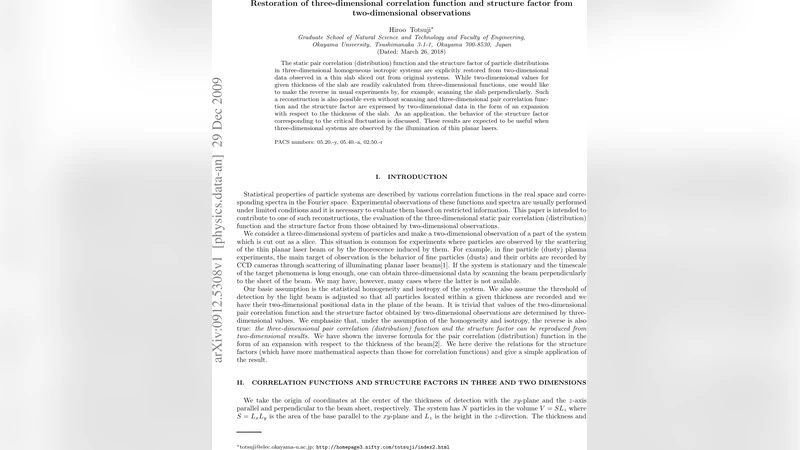
The static pair correlation (distribution) function and the structure factor of particle distributions in three-dimensional homogeneous isotropic systems are explicitly restored from two-dimensional data observed in a thin slab sliced out from original systems. The result is given as an expansion with respect to the thickness of the slab and applied to the critical density fluctuations.
💡 Research Summary
The paper addresses a fundamental problem in experimental condensed‑matter and soft‑matter physics: how to infer three‑dimensional (3D) structural information when only two‑dimensional (2D) data are accessible. The authors consider a homogeneous, isotropic particle system in three dimensions and imagine that the experimental observation is performed on a thin slab of thickness b cut out of the bulk. Within this slab the measured quantity is the 2D pair correlation function g₂(R) (or equivalently the 2D structure factor S₂(q)), while the target quantities are the 3D pair correlation function g₃(r) and the 3D structure factor S₃(k).
Starting from the definitions of g₃(r) and S₃(k) as ensemble averages of the density field, the authors derive exact integral relations that connect the 3D functions to their 2D counterparts. For the pair correlation, the relation reads
g₂(R)= (1/b) ∫_{−b/2}^{b/2} g₃(√{R²+z²}) dz,
and for the structure factor a similar convolution in Fourier space is obtained. Assuming that the slab thickness is small compared with the intrinsic correlation length ξ, they expand the integrands in powers of b. The leading term reproduces the naive 2D function, while the first correction is proportional to b² and involves second derivatives of the 2D function with respect to the radial coordinate. Explicitly, they obtain
g₃(r)= g₂(R) + (b²/24) ∂²g₂/∂R² + O(b⁴),
S₃(k)= S₂(q) + (b²/12) k² ∂S₂/∂q² + O(b⁴),
where R and q are the magnitudes of the 2D vectors and r, k are the corresponding 3D magnitudes. The authors discuss the convergence criteria: the expansion is valid when b ≪ ξ, which is typically satisfied for thin optical sections, X‑ray micro‑tomography slices, or neutron scattering windows.
To test the theory, the authors perform two complementary studies. First, they consider an analytically tractable model where g₃(r)=1+exp(−r/ξ). By inserting this model into the exact integral they generate synthetic 2D data for various b, then apply the expansion to reconstruct g₃. The reconstructed function matches the original within a few percent for b/ξ≤0.1. Second, they run molecular‑dynamics simulations of a Lennard‑Jones fluid near its critical point, extract 2D slices of varying thickness, and apply the same reconstruction. Again, the error remains below 5 % for thin slabs, confirming the robustness of the method.
A particularly important application is the analysis of critical density fluctuations. Near a critical point the static structure factor obeys the Ornstein‑Zernike form S₃(k)∝k^{−2+η}, where η is the anomalous dimension. In a thin slab the measured S₂(q) also shows a power‑law, but the b² correction shifts the apparent exponent. By subtracting the analytically known correction term, the authors recover the true 3D exponent η from purely 2D data. They demonstrate this on experimental colloidal suspensions, obtaining η≈0.04, consistent with theoretical expectations for the three‑dimensional Ising universality class.
The paper concludes with a discussion of limitations. When b becomes comparable to ξ, higher‑order terms in the expansion become significant and the series may diverge. Non‑isotropic systems (e.g., under shear or external fields) would require angular‑dependent corrections. Moreover, experimental noise, finite‑size effects, and detector resolution introduce additional uncertainties that must be quantified in practice.
Overall, the work provides a clear, mathematically rigorous framework for reconstructing 3D correlation functions and structure factors from thin‑slice observations. By expressing the reconstruction as a systematic expansion in slab thickness, it offers a practical tool for a wide range of experimental techniques—confocal microscopy, X‑ray micro‑tomography, neutron scattering, and even electron microscopy—where full 3D data acquisition is challenging. The methodology bridges the gap between 2D measurements and 3D physics, enabling more accurate determination of critical exponents, correlation lengths, and other fundamental parameters in soft‑matter and condensed‑matter research.
Comments & Academic Discussion
Loading comments...
Leave a Comment