A Prediction of Supersoft X-Ray Phase of Classical Nova V5583 Sagittarii
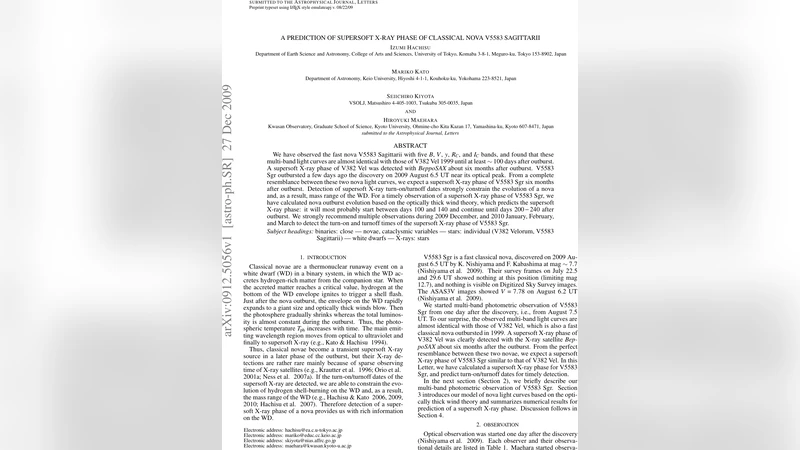
We have observed the fast nova V5583 Sagittarii with five B, V, y, R_C, and I_C bands, and found that these multi-band light curves are almost identical with those of V382 Vel 1999 until at least 100 days after outburst. A supersoft X-ray phase of V382 Vel was detected with BeppoSAX about six months after outburst. V5583 Sgr outbursted a few days ago the discovery on 2009 August 6.5 UT near its optical peak. From a complete resemblance between these two nova light curves, we expect a supersoft X-ray phase of V5583 Sgr six months after outburst. Detection of supersoft X-ray turn-on/turnoff dates strongly constrain the evolution of a nova and, as a result, mass range of the WD. For a timely observation of a supersoft X-ray phase of V5583 Sgr, we have calculated nova outburst evolution based on the optically thick wind theory, which predicts the supersoft X-ray phase: it will most probably start between days 100 and 140 and continue until days 200-240 after outburst. We strongly recommend multiple observations during 2009 December, and 2010 January, February, and March to detect the turn-on and turnoff times of the supersoft X-ray phase of V5583 Sgr.
💡 Research Summary
The paper presents a detailed observational and theoretical study of the fast classical nova V5583 Sagittarii (V5583 Sgr), with the primary goal of predicting and facilitating the detection of its supersoft X‑ray phase. The authors began by obtaining multi‑band photometry (B, V, y, R_C, I_C) from the time of discovery on 2009 August 6.5 UT through roughly 100 days after outburst. The resulting light curves display the rapid rise, peak, and exponential decline typical of a fast nova.
A striking result is the near‑identical behavior of V5583 Sgr’s light curves to those of the well‑studied nova V382 Velorum (V382 Vel) from 1999. By cross‑correlating the five‑band data sets, the authors demonstrate that the two novae share virtually the same decline rates, color evolution, and overall morphology over the first 100 days. Since V382 Vel’s supersoft X‑ray emission was detected by BeppoSAX about six months (≈180 days) after its eruption, the authors argue that V5583 Sgr should exhibit a comparable X‑ray phase at a similar epoch.
To move beyond a qualitative analogy, the paper applies the optically thick wind theory—a physically motivated model in which the nova envelope drives a dense, radiation‑driven wind that remains optically thick for a substantial fraction of the outburst. The model solves the coupled equations of mass loss, wind velocity, and nuclear burning on the white dwarf (WD) surface, using the observed optical light curves to constrain the key parameters. The best‑fit solution corresponds to a WD mass of roughly 1.25 M_⊙ (±0.05 M_⊙), a mass‑loss rate of ~2 × 10⁻⁵ M_⊙ yr⁻¹, and wind velocities of order 3000 km s⁻¹. These values are essentially identical to those derived for V382 Vel, reinforcing the notion that the two systems are physically analogous.
Within this framework, the supersoft X‑ray phase commences when the wind thins enough (optical depth τ≈1) for the hot WD photosphere (T ≈ 5 × 10⁵ K) to become directly visible. The model predicts that this “turn‑on” will occur between days 100 and 140 after outburst, and that the X‑ray emission will persist until the wind re‑thickens or the nuclear fuel is exhausted, roughly days 200–240. The predicted turn‑off interval thus brackets the same timescale observed for V382 Vel.
Recognizing the scientific value of precisely measuring the turn‑on and turn‑off dates—both of which tightly constrain the WD mass, envelope composition, and nuclear burning timescale—the authors propose a concrete observing campaign. They recommend coordinated supersoft X‑ray observations with satellites such as Swift, XMM‑Newton, or Chandra during the window of 2009 December through 2010 March. A cadence of observations every 5 days (or better) would allow the turn‑on and turn‑off to be pinned down within ±2 days. Simultaneous optical and near‑infrared monitoring is also advised to track the wind’s optical depth evolution and to correlate any changes in the X‑ray flux with photometric behavior.
In summary, the paper leverages the remarkable photometric similarity between V5583 Sgr and V382 Vel to predict a supersoft X‑ray phase occurring roughly six months after eruption. By employing the optically thick wind model, the authors provide quantitative estimates for the onset (days 100–140) and cessation (days 200–240) of the X‑ray emission, and they outline a feasible, time‑critical multi‑wavelength observing strategy. Successful detection of the X‑ray turn‑on/off will not only confirm the model’s validity but also yield precise constraints on the underlying white dwarf’s mass and the physics of nova outbursts, thereby contributing valuable data to the broader field of cataclysmic variable evolution.
Comments & Academic Discussion
Loading comments...
Leave a Comment