The paper investigates the variation of the spectrum of operators in infinite dimensional Banach spaces. In particular, it is shown that the spectrum function is Borel from the space of bounded operators on a separable Banach space; equipped with the strong operator topology, into the Polish space of compact subsets of the closed unit disc of the complex plane; equipped with the Hausdorff topology. Remarks and results are given when other topologies are used.
Deep Dive into Borel Spectrum of Operators on Banach Spaces.
The paper investigates the variation of the spectrum of operators in infinite dimensional Banach spaces. In particular, it is shown that the spectrum function is Borel from the space of bounded operators on a separable Banach space; equipped with the strong operator topology, into the Polish space of compact subsets of the closed unit disc of the complex plane; equipped with the Hausdorff topology. Remarks and results are given when other topologies are used.
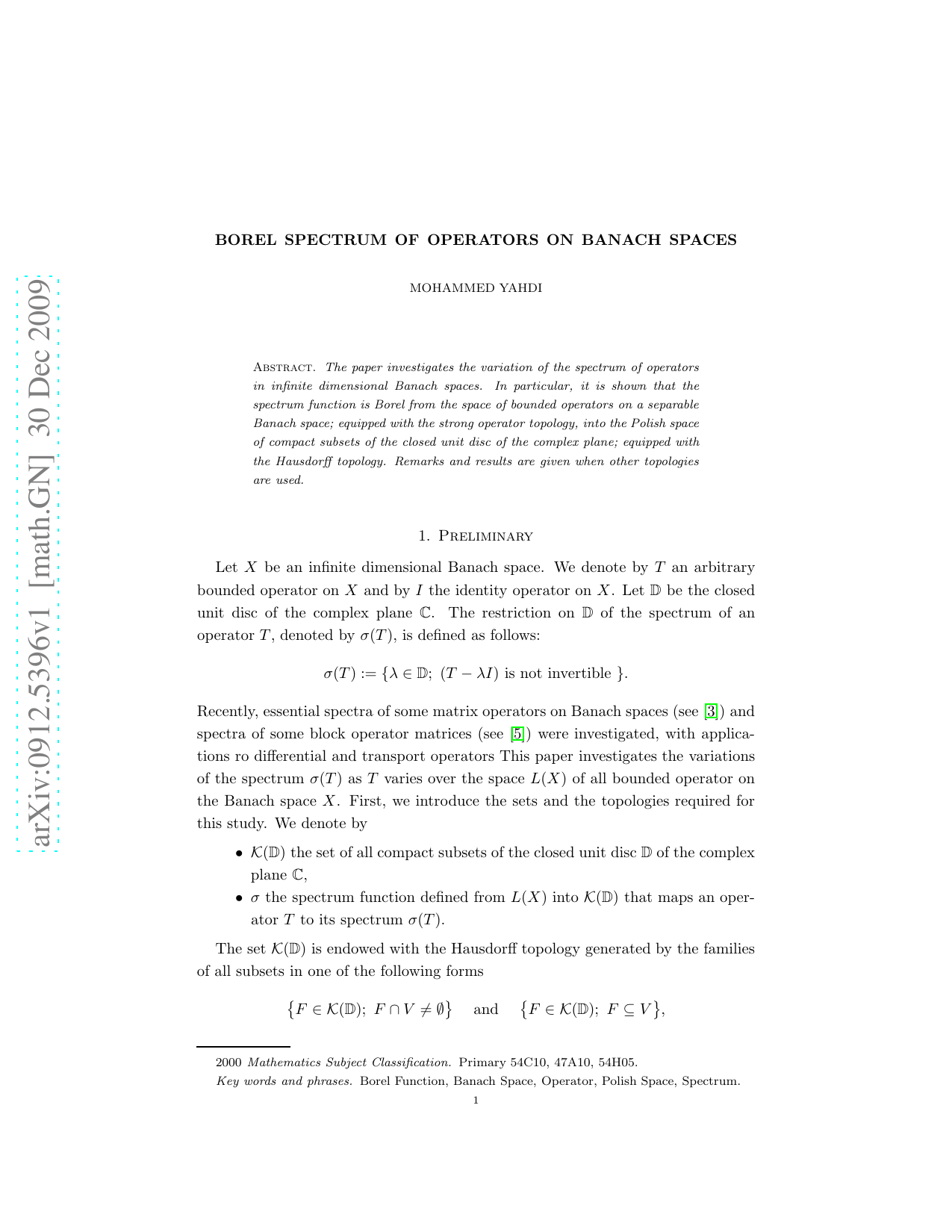
Let X be an infinite dimensional Banach space. We denote by T an arbitrary bounded operator on X and by I the identity operator on X. Let D be the closed unit disc of the complex plane C. The restriction on D of the spectrum of an operator T , denoted by σ(T ), is defined as follows:
Recently, essential spectra of some matrix operators on Banach spaces (see [3]) and spectra of some block operator matrices (see [5]) were investigated, with applications ro differential and transport operators This paper investigates the variations of the spectrum σ(T ) as T varies over the space L(X) of all bounded operator on the Banach space X. First, we introduce the sets and the topologies required for this study. We denote by • K(D) the set of all compact subsets of the closed unit disc D of the complex plane C, • σ the spectrum function defined from L(X) into K(D) that maps an operator T to its spectrum σ(T ).
The set K(D) is endowed with the Hausdorff topology generated by the families of all subsets in one of the following forms
for V an open subset of D. Therefore, K(D) is a Polish space, i.e., a separable metrizable complete space, since D is Polish (see [7], [8] or [2]). It is shown below that we can reduce the families that generate the above Hausdorff topology.
Proposition 1.1. Let K(D) be the set of compact subsets of the closed unit disc D.
Then K(D) equipped with the Hausdorff topology is a Polish space; where the Borel structure is generated by one of the following two families
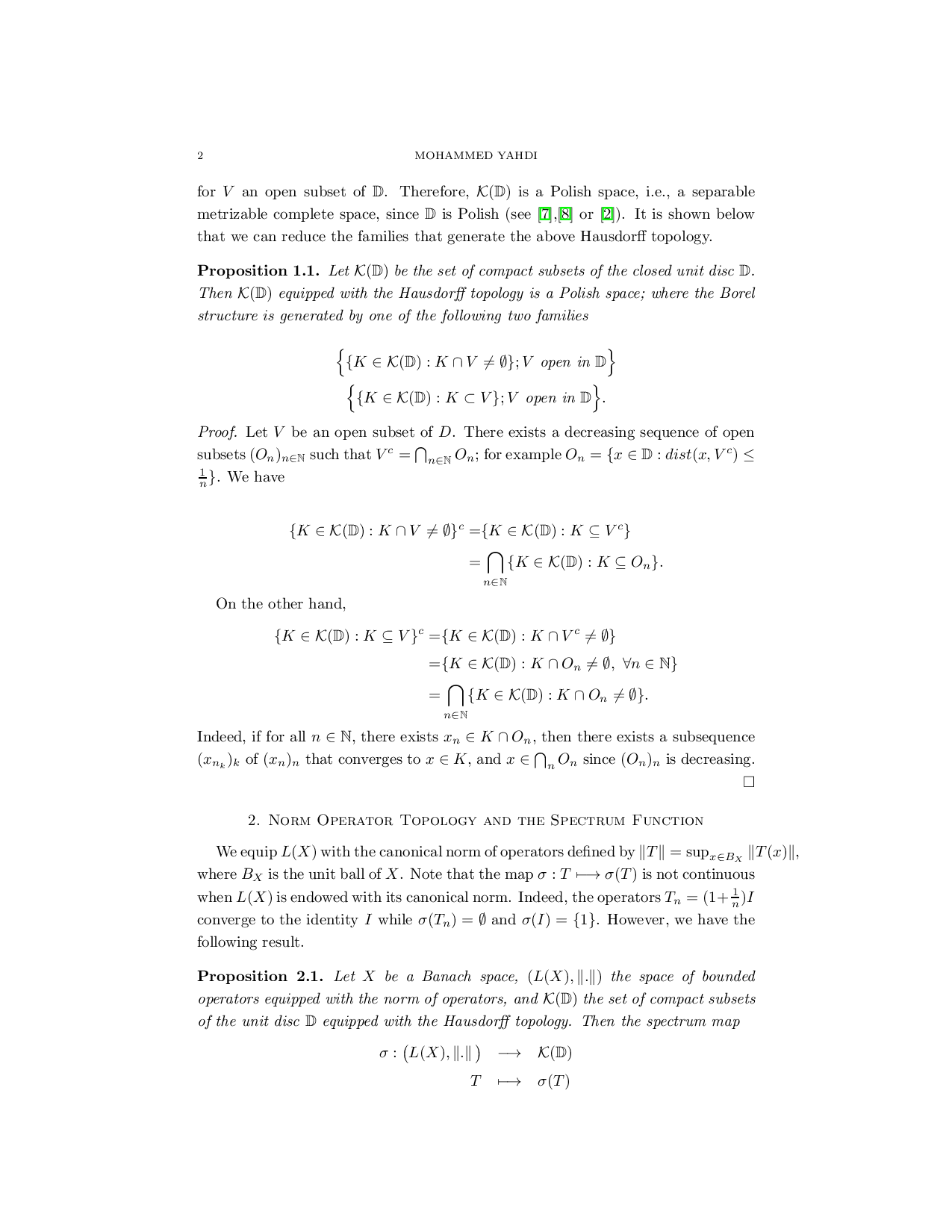
Proof. Let V be an open subset of D. There exists a decreasing sequence of open subsets
On the other hand,
Indeed, if for all n ∈ N, there exists
We equip L(X) with the canonical norm of operators defined by T = sup x∈BX T (x) , where B X is the unit ball of X. Note that the map σ : T -→ σ(T ) is not continuous when L(X) is endowed with its canonical norm. Indeed, the operators T n = (1+ 1 n )I converge to the identity I while σ(T n ) = ∅ and σ(I) = {1}. However, we have the following result.
Proposition 2.1. Let X be a Banach space, (L(X), . ) the space of bounded operators equipped with the norm of operators, and K(D) the set of compact subsets of the unit disc D equipped with the Hausdorff topology. Then the spectrum map σ : L(X), .
-→ K(D)
is upper-semi continuous.
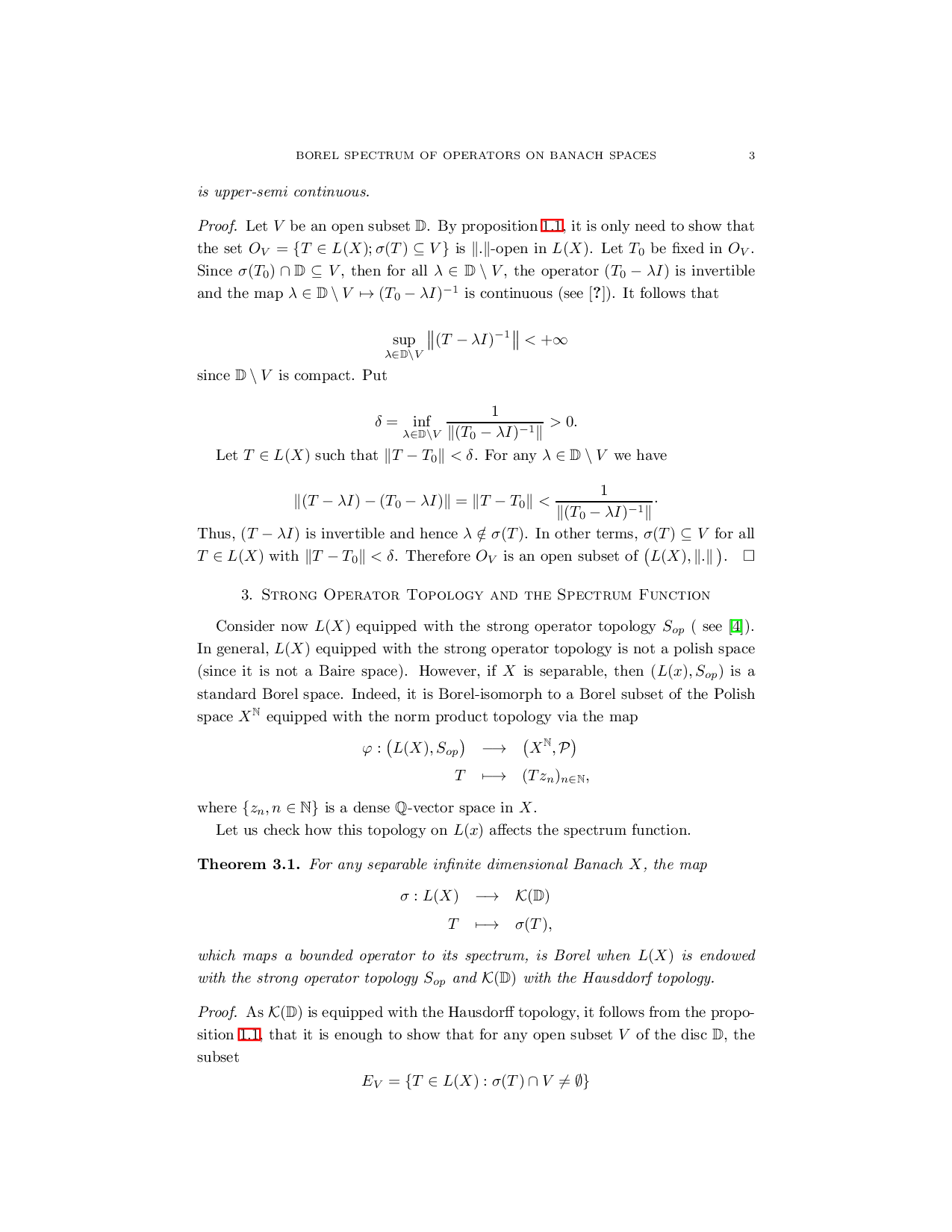
Proof. Let V be an open subset D. By proposition 1.1, it is only need to show that the set
Consider now L(X) equipped with the strong operator topology S op ( see [4]). In general, L(X) equipped with the strong operator topology is not a polish space (since it is not a Baire space). However, if X is separable, then (L(x), S op ) is a standard Borel space. Indeed, it is Borel-isomorph to a Borel subset of the Polish space X N equipped with the norm product topology via the map
where {z n , n ∈ N} is a dense Q-vector space in X.
Let us check how this topology on L(x) affects the spectrum function.
Theorem 3.1. For any separable infinite dimensional Banach X, the map
which maps a bounded operator to its spectrum, is Borel when L(X) is endowed with the strong operator topology S op and K(D) with the Hausddorf topology.
Proof. As K(D) is equipped with the Hausdorff topology, it follows from the proposition 1.1, that it is enough to show that for any open subset V of the disc D, the subset
Let V be a fixed open subset of D. We have
where P L(X) stands for the canonical projection of L(X) × D onto L(X), and
By a descriptive set theory result from [9], to show that E V is a Borel set it suffices to show that Ω is a Borel set with K σ vertical sections.
For T ∈ L(X), the vertical section of the set Ω ⊆ L(X) × D along the direction T is given by
Therefore
Hence, to finish the proof, it is enough to prove the following claim.
Claim: ∆ is a Borel set of L(X) × D. First, note that ∆ = A ∪ B with
Indeed, if T -λI is an isomorphism onto its range, then (T -λI)(X) is a closed subspace that will be strict if λ ∈ σ(T ), and thus not dense in X.
On the other hand, since X is separable, there exists a countable and dense subset Y in the sphere S X of X, and there exists a dense sequence {x n } n∈N in X. Now, we will show that A and B are Borel sets. Let (T, λ) ∈ L(X) × D. From the definition of A, We have (T, λ) ∈ A if and only if
In other term, this is equivalent to
By choosing the subsequence (z N k ) k∈N instead of (z n ) n∈N , the previous statement is equivalent to
Since L(X) is equipped with the the strong operator convergence S , it follows that A x k are open sets. Hence, A is a Borel set. On the other hand, “(T -λI)(X) is not dense in X” is equivalent to Similarly to A x k , it is not difficult to see that the sets B y k,n are Borel sets. Hence B is also a Borel set. This proves the claim and ends the proof of the theorem 3.1.
This content is AI-processed based on ArXiv data.