Robust chaos with prescribed natural invariant measure and Lyapunov exponent
We extend in several ways a recently proposed method to construct one-dimensional chaotic maps with exactly known natural invariant measure [Sogo 1999, 2009]. First, we assume that the given invariant measure depends on a continuous parameter and sho…
Authors: Juan M. Aguirregabiria
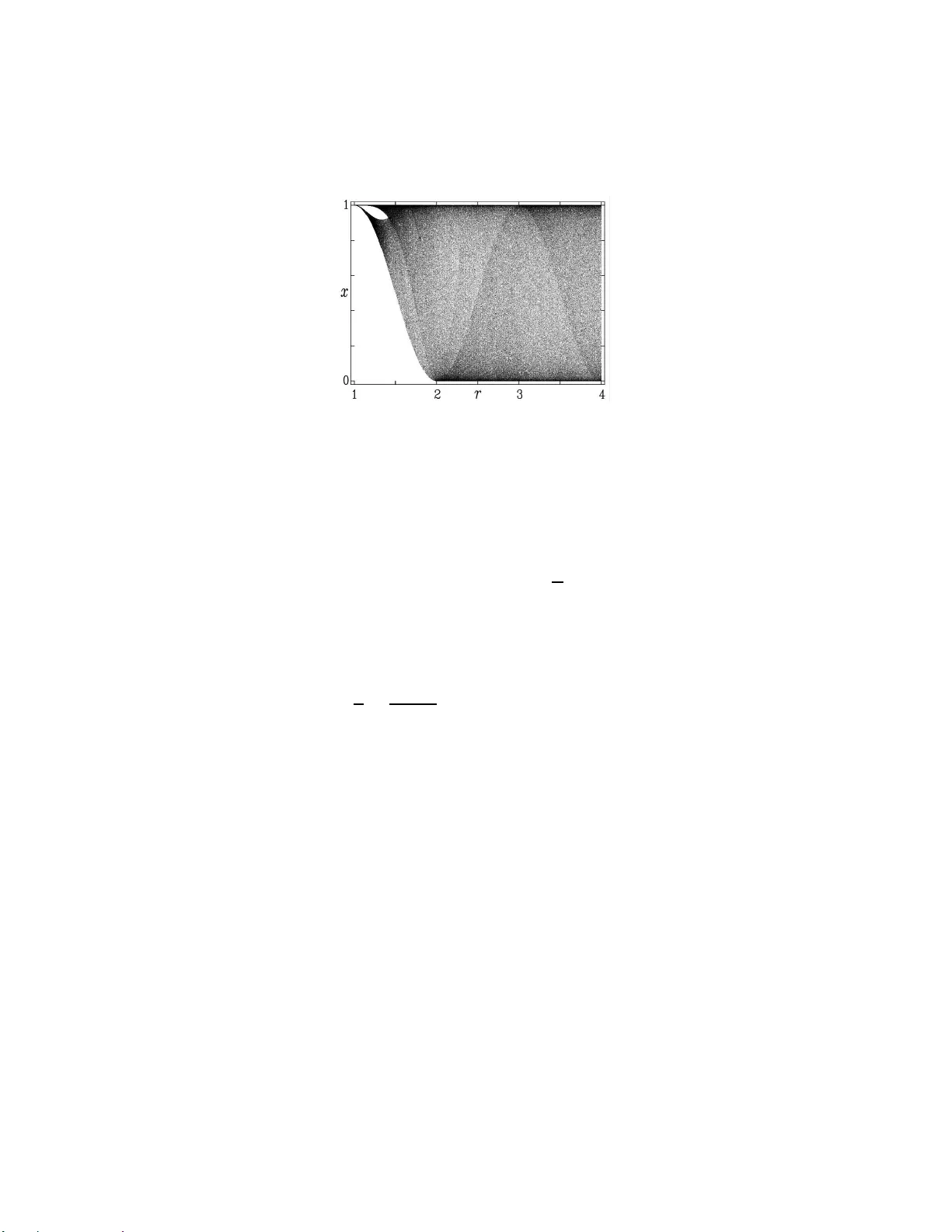
Rob ust chaos with prescribed natural in v ariant measure and L yapunov exponent Juan M. Aguirregabiria 1 Theor etical Physics, The University of the Basque Country , P . O. Box 644, 4808 0 Bilbao, Spain Abstract W e e xtend in sev eral w ays a recently proposed method to cons truct one-dimensional chaotic maps with e xactly known natural in v ariant measure [1, 2]. First, we as- sume that the given in va riant measure depends on a cont inuous parameter and show how to cons truct m aps with robust chaos —i.e., chaos that is not d estroyed by arbitrarily small changes of the parameter— and prescribed in variant measure and const ant L yapunov e xponent. Then, by relaxin g one condition in the approach of Refs. [1, 2], we describe a method t o construct robust chaos with prescribed constant in v ariant measure and v arying L yapunov exponent. Another extension of a condition in Refs. [1, 2] provides a ne w method to ge t robust chaos with kno wn var ying L yapunov e xponent. In this third approach the in v ariant measure can be computed exactly in many particular c ases. Finally we dis cuss how to use diffeo- morphisms to construct maps with rob ust chaos, any number of p arameters and prescribed in v ariant measure and L y apunov exponent. K e y wor ds: nonlinear dynamical system, deterministi c c haos, rob ust chaos, natural in variant measure P ACS: 05.45.Ac, 05.45.-a 1. Intr oduction The in verse problem for chaotic one-dimensional maps has been re cently pro- posed and solved i n some cases by Sogo [1, 2]. Starting from a given in variant measure, t he m ethod allows to cons truct maps wi th that measure and L yapunov 1 Correspon ding author: juanmari. aguirregabir ia@ehu.es T el. +34 9461 0591 5, F ax +34 94601350 0 Pr eprint submitted to Physics Letter s A November 21, 2018 exponents in th e form λ = ln m , with m = 2 , 3 , . . . This method can be used to construct exact examples of chaotic one-dimens ional maps depending on the dis- crete parameter m and ha ving exactly kno wn in variant measure and L yapunov ex- ponent. The first goal of th is work is to extend this method t o families of maps that depend on a continuous parameter , display robust chaos —i .e., they have a chaotic attractor wh ich is not destroyed by arbitrarily small changes of the parameter — and hav e kno wn in variant measure and L y apunov exponent. Piece wise s mooth maps m ay show robust chaos and h a ve been used to de- scribe robust chaos in circuits [3]. On the other h and, many families o f s mooth maps have fragile chaos. F or ins tance, the l ogistic map, x n +1 = 4 r x n (1 − x n ) , is chaot ic for r = 1 , b ut the attractor i s period ic for a s et of values of the param- eter r that is dense in the int erva l 0 ≤ r ≤ 1 [4]. If such a d ynamical system describes a real de vice, it may be im possible to know in advance whether t he be- havior of the s ystem will in fact be chaotic or periodic for so me parameter value, which is always known with finite p recision. Howe v er , robust chaotic beha vior is required in many applications , i ncluding encrypting mess ages [5, 6 ], random number generators [7] and engineering appl ications [8]. Robust chaos also arises in neural networks [9, 10] as well as in the study o f brain and population dynam- ics [11, 12]. Thus, sim ple and easy ways of cons tructing robust chaotic attractors with exactly kno wn properties, as those explored in this work, can be of interest in dif ferent fields of science and engineering. Andrecut and Ali first fo und a smo oth map [13] and later a method of gen- erating smooth m aps [14] whose ev olution is chaotic for whole int erv als of the parameter . Another case is d iscussed in Ref. [15] and we ha ve recently explored sev eral n e w ways to const ruct smoot h one-dim ensional maps with robust chaos [16]. The purpose of this work is to present other ways of const ructing maps wit h robust chaos. The advantage of these ne w methods is that the L y apunov exponent is kno wn exactly and the in v ariant measure is known alw ays with the fi rst, second and fourth methods and in many p articular cases in the third approach. The first three methods will be e xtensions of Sogo’ s in v erse probl em [1, 2]. In Sect. 2 w e will show how t o con struct families of chaotic m aps with a constant L yapunov exponent and a give n in variant measure depending continuou sly on a parameter . In Sect. 3 we present a meth od t o construct families o f chaotic maps sharing the same prescribed i n v ariant m easure and having a known L yapu nov exponent de- pending on the parameter . In Sect. 4 we will e xplore a method to construct rob ust chaos with a kno wn L yapunov exponent v arying c ontinuousl y with the parameter and a natural m easure that can be computed exactly in m any particular cases. Fi- 2 nally , in Se ct. 5 and 6 we will discuss se v eral ways to construct rob ust chaos with prescribed L yapunov exponent and natural in v ariant measure by using diffeomor - phisms. W e will consider o ne-dimensional maps on a finite interval [ a, b ] , which for commodity will be reduced to [0 , 1] by means of a linear transformation. 2. Rob ust chaos with pr escribed in variant measure W e will use an easy extension of Sogo ’ s method [1, 2] to construct families of dynamical systems, x n +1 = f r ( x n ) , that are chaotic for a full range of t he parameter r and have exactly known i n v ariant measure and L y apunov e xponent. Let u s ass ume that the maps f r are m -to-1 so that each value x ∈ [0 , 1] has m preimages y k , such that f r ( y k ) = x , for k = 1 , 2 , . . . , m . the natural in v ariant measure dµ r = ρ r ( x ) dx satisfies the Frobenius-Perron equati on [4]: ρ r ( x ) = Z 1 0 ρ r ( y ) δ ( x − f r ( y )) dy = m X k =1 ρ r ( y k ) | f ′ r ( y k ) | . (1) T o find solution s of this equation we w ill simplify i t by furt her assuming th at all the terms in the s um m ake the sam e con tribution, so t hat the s ubstitut ion y 1 → x giv es the condition ρ r ( f r ( x )) | f ′ r ( x ) | = mρ r ( x ) . (2) Eq. (2) provides a useful practical way to construct a family of maps f r with a prescribed in v ariant density ρ r : just choose, for a g iv en integer value of m ≥ 2 , a family of s olutions of the differential equation (2) that map the phase space [0 , 1] onto itself and are m -to-1. T his will be a family of maps with robust chaos . By extending the argument in Ref. [2] one can show that all the maps i n the family will hav e the same L yapunov exponent: λ r = Z 1 0 ρ r ( x ) ln | f ′ r ( x ) | d x = ln m + Z 1 0 ρ r ( x ) ln ρ r ( x ) dx − Z 1 0 ρ r ( x ) ln ρ r ( f r ( x )) d x = ln m. (3) 3 The two last integra ls cancels each other because of (1): Z 1 0 ρ r ( x ) ln ρ r ( x ) dx = Z 1 0 dy ρ r ( y ) Z 1 0 dx δ ( x − f r ( y )) ln ρ r ( x ) = Z 1 0 ρ r ( y ) ln ρ r ( f r ( y )) d y . (4) 2.1. Some solutions w ith m =2 T o giv e some examples, l et u s furt her assum e m = 2 and that the in v ariant densities ρ r ∈ C 0 (0 , 1) are strictly posi tiv e, ρ r ( x ) > 0 for 0 < x < 1 , so that µ r ( x ) ≡ Z x 0 ρ r ( y ) dy (5) monotonou sly increases from µ r (0) = 0 to µ r (1) = 1 and has a uni que in verse µ − 1 r ( x ) in [0 , 1] . If we choose the boundary conditions f r (0) = f r (1) = 0 , the solution of (2) is f r ( x ) = µ − 1 r (1 − | 1 − 2 µ r ( x ) | ) . (6) Each map will increase from f r (0) = 0 to the maximum f r ( α r ) = 1 , α r ≡ µ − 1 r 1 2 (7) and then decrease to f r (1) = 0 . The L yapunov exponent will be λ r = ln 2 . 2.1.1. A family of piece wise smooth c haotic maps If one chooses the in v ariant densities ρ r ( x ) = r x r − 1 , ( r > 0) , (8) the solution (6) will be f r ( x ) = (1 − | 1 − 2 x r | ) 1 /r , ( r > 0) . (9) Three members of th is family of chaotic maps are d isplayed in Fig. 1 . The full tent map T ( x ) = 1 − | 1 − 2 x | is recove red with r = 1 . 4 Figure 1: Three members of the family of maps (9). 2.1.2. A family of smooth c haotic maps The solutions (9) are not differentiable a t x = α r . In fact, since lim x → α ± r f ′ r ( x ) = ∓ 2 ρ r ( α r ) ρ r (1) , (10) the condition for f ′ r to be continuous at the maximum is lim x → 1 ρ r ( x ) = ∞ . W e can use this condition to find families of chaotic m aps that are sm ooth along th e full i nterval [0 , 1] . T o provide an example, let us consid er the f amily of densities gi ven for e very r > 0 by ρ r ( x ) = 2 r − 1 r arcsin r − 1 √ x π r p x (1 − x ) . (11) Then the solution (6) is f r ( x ) = ( sin 2 2 1 /r arcsin √ x , 0 ≤ x ≤ α r ; sin 2 2 1 /r π r 2 r − arcsin r √ x 1 /r , α r ≤ x ≤ 1 , (12) with α r ≡ sin 2 2 − (1+1 /r ) π . Some members of the family (12) are d isplayed in Fig. 2, where one rec- ognizes the full log istic map f 1 ( x ) = 4 x (1 − x ) . W e h a ve f r ∈ C 1 [0 , 1 ] for 0 < r ≤ 1 , but f ′ r ( x ) → −∞ as x → 1 for r > 1 . 5 Figure 2: Three members of the family of maps (12). The boundary condit ions for f r ( x ) can be chosen in many other ways. For instance, wit h f r (0) = f r (1) = 1 the maps will hav e a single minimum , ins tead of a maximum, and the substitute for (6) is f r ( x ) = µ − 1 r ( | 1 − 2 µ r ( x ) | ) . (13) The single minimu m is f r ( α r ) = 0 with α r ≡ µ − 1 r (1 / 2) . W i th the densities (8) one gets f r ( x ) = | 1 − 2 x r | 1 /r , ( r > 0) , (14) which has a smooth minimum only for 0 < r < 1 , since now t he cond ition is lim x → 0 ρ r ( x ) = ∞ . It is also easy to extend the results of this section for values of m 6 = 2 . But let us present another way to construct rob ust chaos. 3. Rob ust chaos with constant in variant measur e Follo wing Refs. [1, 2], to get Eq . (2) we assum ed that all t erms in sum (1) had the same value. It is obvious that this s implifyin g conditi on can b e relaxed in many ways. L et us explore a s imple one. One could construct a family o f 2- to-1 maps, with the same prescribed in v ariant density ρ ( x ) b ut with a generalized 6 relation between the terms in sum (1), ρ ( y 1 ) | f ′ r ( y 1 ) | = r ρ ( y 2 ) | f ′ r ( y 2 ) | , ( r > 0) , (15) for instance. W ith this assumption, one would replace the constant multip licity m of Eq. (2) by m r ( x ) = ( 1+ r r , 0 ≤ x < α r ; 1 + r, α r < x ≤ 1; (16) where x = α r is t he v alue where the two preimages coinci de: y 1 ( α r ) = y 2 ( α r ) . The family f r would satisfy the follo wing e quation: ρ ( f r ( x )) | f ′ r ( x ) | = m r ( x ) ρ ( x ) , ( r > 0 ) . (17) For example, for any ρ ∈ C 0 (0 , 1) wit h ρ ( x ) > 0 and µ ( x ) ≡ R x 0 ρ ( y ) dy ) , the solution of (17) with f r (0) = f r (1) = 0 is f r ( x ) = ( µ − 1 1+ r r µ ( x ) , 0 ≤ x ≤ α r ; µ − 1 ((1 + r ) (1 − µ ( x ))) , α r ≤ x ≤ 1; (18) with α r ≡ µ − 1 r r 1 + r . (19) By using (17) and (19) the va rying L yapunov e xponent is readily computed: λ r = Z 1 0 ρ ( x ) ln | f ′ r ( x ) | d x = ln(1 + r ) − r 1 + r ln r. (20) This value starts from lim r → 0 λ r = 0 , increases until i ts m aximum λ 1 = ln 2 and then decreases to wards lim r →∞ λ r = 0 . Th e condit ion for the maxim um at x = α r to be smooth is again lim x → 1 ρ ( x ) = ∞ . 3.1. Another family of piece wise-smooth chaotic maps For example, if o ne s elects for all r > 0 the same constant in v ariant density ρ r ( x ) = ρ ( x ) = 1 the solu tion of Eq. (18) is the f amily f r ( x ) = (1 + r ) ( x/r , 0 ≤ x ≤ α r ; 1 − x, α r ≤ x ≤ 1; ( r > 0) , (21) with α r = r / (1 + r ) and the L yapun ov exponent of Eq. (20). f 1 is the full t ent map T ( x ) = 1 − | 1 − 2 x | . 7 3.2. A second family of smoot h c haotic maps If the starting point is the in v ariant density of the full logist ic map, ρ r ( x ) = ρ ( x ) = [ π 2 x (1 − x )] − 1 / 2 , we get, for ev ery r > 0 , f r ( x ) = ( sin 2 1+ r r arcsin √ x , 0 ≤ x ≤ α r ; sin 2 ((1 + r ) arccos √ x ) , α r ≤ x ≤ 1; (22) with α r = cos 2 π 2(1 + r ) (23) and the L yapunov exponent (20). The full logisti c m ap is recov ered with r = 1 : f 1 ( x ) = 4 x (1 − x ) . It is straightforward to extend the method in this section for m = 3 , 4 , . . . 4. Robust chaos with varying L yapunov exponent In Eq. (2) it was assum ed that m is an integer larger t han one. But let us substitut e f or it a real number r > 1 : ρ ( f r ( x )) | f ′ r ( x ) | = r ρ ( x ) , ( r > 1) . (24) Notice that we are using again the same in variant density ρ ( x ) for all v alues of the continuous parameter r , which now replaces the constant mu ltiplicit y m . If we get a solutio n of Eq. (24) for a gi ven ρ ( x ) , the l atter will not satisfy the Frobenius- Perron equation for non-i nteger v alues of r , but this does not prevent the s olution f r from bein g chaotic for all r > 1 , as we will show in the following. In fact, by using an argument very simi lar t o the one l eading to (3), one can show t hat the L yapunov e xponent of the family satisfying (24) will be λ r = ln r , for all r > 1 . The solu tion of Eq. (26) for f r (0) = 0 , f ′ r (0) > 0 and 1 < r ≤ 2 can be written as f r ( x ) = ( µ − 1 ( r µ ( x )) , 0 ≤ x ≤ α r ≡ µ − 1 (1 /r ); µ − 1 (2 − r µ ( x )) , α r ≤ x ≤ 1 , (25) with µ ( x ) ≡ R x 0 ρ ( y ) dy . It is also easy to write down the solut ion for other initial conditions or other ranges of the parameter r . 8 Figure 3: Bifurcation diagram of the map (26). 4.1. A third family of smooth chaotic maps If we choose again the in v ariant densi ty of the full log istic map, ρ ( x ) = [ π 2 x (1 − x )] − 1 / 2 , a solution of Eq. (24) for all r > 1 is f r ( x ) = sin 2 r arcsin √ x . (26) For r = 2 , 3 , . . . the maps f r ( x ) reduce to polynomials and we recove r the ‘Cheby- shev hierarchy’ of Refs. [1, 2]: f n ( x ) = 1 2 − ( − 1) n 2 T n (2 x − 1) , ( n = 2 , 3 , . . . ) , (27) where T n are th e Chebys hev polyno mials of the first kind. All these maps are chaotic, with L yapunov exponent λ n = ln n and the same i n v ariant in variant den- sity as the full logisti c map f 2 ( x ) = 4 x (1 − x ) . The questio n is what happens for non-integer values of r ? Their L yapunov e xponent is λ r = ln r and we can see in the bifurcation dia- gram of Fig. 3 that the attractor only fills the phase space [0 , 1 ] for r ≥ 2 . But, what about the in v ariant measure? The point is that now all points x do not have the same num ber m of preim ages y k , such that f r ( y k ) = x , as assumed in Refs. [1, 2] and Sect. 2 and 3. In consequence, the starting in v ariant density will not satisfy the Frobenius-Perron equati on (1) for non-int eger values of r . Obviously , t he actual inv ariant measure will satisfy that equat ion with a value o f m dependin g on the point x . It it clear from Fig. 4, which display in s olid line the graphs of two members of family (26), that the v alue m ( x ) will change in this example at point x = α ≡ f r (1) and the same will happen at all its im ages, so 9 Figure 4: The maps (26) and (38) for r = φ, 1 + √ 2 . that we can expect the in v ariant measure to be disconti nuous at e very point in the orbit of f r (1) : O r ≡ f k r (1) : k = 1 , 2 , . . . . (28) The task of findi ng the in v ariant measure can thus be ve ry difficult unless the orbit O r is simpl e enough (a cycle), as happens in th e ‘Chebyshev hierarchy’ (where r = 2 , 3 , . . . and O 2 n = { 0 , 0 , . . . } and O 2 n − 1 = { 1 , 1 , . . . } , so t hat the in v ariant dens ity is con tinuous for 0 < x < 1 ), but als o for many n on-integer values of r as we shall see no w . For instance, in the left graph of Fig. 4 t he parameter equals the golden ratio, r = φ ≡ (1 + √ 5) / 2 , and then the orbit of f φ (1) is a 3-cycle: O φ = α ≡ sin 2 φπ 2 , 1 − α, 1 , α, 1 − α , 1 , . . . . (29) Since one can mult iply a solution of Eqs. (1) a nd (24) with an y constant, one may suspect that the actual inv ariant measure of the maps (26) is that of the full logisti c map multip lied by a function which is constant except at the p oints lying on the orbit of f φ (1) . In fact, we can find the exact expression of the in v ariant density for r = φ by using the no rmalization condition R 1 0 ρ φ ( x ) dx = 1 and tryin g in the Frobenius-Perron equation (1) a density in the form ρ φ ( x ) = 1 π p x (1 − x ) a, 0 < x < α ; b, α < x < 1 − α ; c, 1 − α < x < 1; (30) with constant a , b and c and the f ollowing mult iplicity: m ( x ) = ( 1 , 0 < x < α ; 2 , α < x < 1 . (31) 10 One finally finds a = 0 , b = c φ = 1 + 3 φ 5 . (32) The result can be easily checke d by means of num erical simulations [17]. Even simpler is the orbit of f r (1) for r = 1 + √ 2 : O 1+ √ 2 = α = cos 2 π √ 2 , 1 , α, 1 , . . . . (33) From this 2-cycle and t he Frobenius-Perron equation (1) it is easy to find the in v ariant density: ρ 1+ √ 2 = 2 + √ 2 4 π p x (1 − x ) ( √ 2 , 0 < x < α ; 1 , α < x < 1 . (34) Other cases with piecewise conti nuous in v ariant measure can b e found i n a similar way . It should be noticed that m aps (26) are a nice example of solvable rob ust chaos, since the solution can be explicitly written in terms of the initi al condition x 0 as x n = sin 2 r n arcsin √ x 0 . 5. Robust chaos thr ough diffeomorp hisms Another way to con struct examples of robust chaos takes advantage of the in v ariance of L yapunov exponents through dif feomorphisms on the interval [0 , 1] . W e are goin g to consider three dif ferent approaches. 5.1. A sing le diffeomorphism If we know a family of chaotic maps f r ( x ) with in v ariant densities ρ r ( x ) and choose a dif feomorphism ϕ ( x ) , the topologically conjugated f amily ˜ f r = ϕ ◦ f r ◦ ϕ − 1 will hav e the same L yapunov exponent and the following in v ariant density [4]: ˜ ρ r ( x ) = ρ r ( ϕ − 1 ( x )) | ϕ ′ ( ϕ − 1 ( x )) | . (35) For e xample if f r is the family (21) a nd the diffeomorphism ϕ ( x ) = sin 2 π x 2 , (36) the topologically conjugated family is (22). 11 On the other hand, if f r is the family (26) and the diff eomorphism ϕ ( x ) = 2 π arcsin √ x, (37) the topologically conjugated family is ˜ f r ( x ) = 1 − | 1 − rx mo d 2 | . (38) Maps (3 8) are piece wise l inear and two particular cases are depicted in dashed line in Fig. 4. Moreover , one recover s the full t ent map for r = 2 . It is obvious that since the slope of the graph of ˜ f r ( x ) is nearly e verywhere ± r the maps are chaotic for all r > 1 and that th e L yapu nov exponent is λ r = ln r . This in turn proves again t hat the topologicall y conjugated family (12) i s chaotic and has the same L yapunov coefficient. T he in v ariant density is ˜ ρ n ( x ) = 1 for r = n = 2 , 3 , . . . and can be computed fo r o ther values of r b y usi ng (35) or the metho d discus sed in the last section. For exa mple, the m easure corresponding to (34) is piecewise constant: ρ 1+ √ 2 ( x ) = 2 + √ 2 4 ( √ 2 , 0 ≤ x < √ 2 − 1; 1 , √ 2 − 1 < x ≤ 1 . (39) 5.2. A fami ly of dif feomorphisms A second p ossibili ty is to choose a s ingle chaoti c map f ( x ) wit h known in- var iant density ρ ( x ) and L yapunov exponent λ and a family of diffeomorphisms depending on a continuous parameter: ϕ r ( x ) . Then t he maps ˜ f r = ϕ r ◦ f ◦ ϕ − 1 r will hav e the same L yapunov exponent and the follo wing natural density: ˜ ρ r ( x ) = ρ ( ϕ − 1 r ( x )) | ϕ ′ r ( ϕ − 1 r ( x )) | . (40) For instance, if the starting map is the full tent map, f ( x ) = T ( x ) = 1 − | 1 − 2 x | , with ρ ( x ) = 1 and λ = ln 2 and the di f feomorphism ϕ r ( x ) = x 1 /r , wit h r > 0 , the family ˜ f r is precisely (9) with the same L yapun ov exponent and the in v ariant density (8). (Notice that in this example f = ˜ f 1 .) On the ot her hand, gi ven the full tent map and the dif feomorphisms ϕ r ( x ) = sin 1 /r π x 2 , with r > 0 , the topologically conjugated smooth maps ˜ f r ( x ) = sin 1 /r (2 arcsin x r ) = x 4 − 4 x 2 r 1 / 2 r (41) 12 hav e the same L yapunov e xponent a nd the natural densities ˜ ρ r ( x ) = 2 r x r − 1 π √ 1 − x 2 r . (42) This map, which is also obt ained from the full logist ic map f ( x ) = 4 x (1 − x ) by means of the dif feomorphism ϕ r ( x ) = x 1 / 2 r , is a simple e xample of e xactly solv- able robust chaos, in which ev erything is known, inclu ding t he general solution x n = sin 1 /r (2 n arcsin x r 0 ) . W e recover the full logisti c map with r = 1 / 2 . 5.3. Pr escribed in vari ant density Finally , one can choose a chaotic map f ( x ) with kno wn in v ariant dens ity ρ ( x ) and L yapunov exponent λ and a prescribed family of natural densities ˜ ρ r ( x ) de- pending on the parameter r . Then each f amily of dif feomorphisms ϕ r satisfying the dif ferential equation ˜ ρ r ( ϕ r ( x )) | ϕ ′ r ( x ) | = ρ ( x ) (43) will provide a f amily of maps ˜ f r = ϕ r ◦ f ◦ ϕ − 1 r with the same L yapunov exponent and the desired natural measure. If we want ϕ r ( x ) to be increasing, the solution of (43) is ϕ r ( x ) = ˜ µ − 1 r ( µ ( x )) , (44) with ˜ µ r ( x ) ≡ Z x 0 ˜ ρ r ( y ) dy , µ ( x ) ≡ Z x 0 ρ ( y ) dy . (45) For example if f ( x ) i s t he ful l tent map and ˜ ρ r ( x ) = r x r − 1 , the solution (44) us ϕ r ( x ) = x 1 /r for r > 0 , and we recov er once m ore t he family (9), which in turn shows again that the latter i s chaotic for all positive rea l values of r and that its in v ariant density is (8). If we choose ϕ r ( x ) to be decreasing, the solution of (43) is ϕ r ( x ) = ˜ µ − 1 r (1 − µ ( x )) and for ˜ ρ r ( x ) = r x r − 1 and r > 0 we have ϕ r ( x ) = (1 − x ) 1 /r , which transforms the full tent map into the family (14). Since families (14) and (9) are topolog ically conjugated to the full tent map, they are also conjugated to each other . In fac t, the diffe omorphism conjugat ing t hem is ϕ r ( x ) = ϕ − 1 r ( x ) = (1 − x r ) 1 /r . This a nice example of two t opologically conjug ated maps sharing not only the L y apunov exponent but also the natural in variant measure. This si mple example shows that the m aps found in previous sections are n ot necessarily the only sol ution to the corresponding probl em. It was pointed out in 13 Refs. [1, 2] that in general t he in verse problem do es not have a uni que solu tion and se veral examples were described with differe nt maps sharing a given in v ariant density while having differe nt L yapunov exponents in the form λ m = ln m . W e see here that it is also p ossible to have different maps with th e same L yapunov exponent and in va riant measure. An obvious variant of the met hod in this section is a st arting family of d ensities ρ r ( x ) depending on the parameter r to con struct a family of chaotic maps wi th a constant density ˜ ρ ( x ) by solv ing ˜ ρ ( ϕ r ( x )) | ϕ ′ r ( x ) | = ρ r ( x ) . (46) 6. The in ve rse problem Obviously , one ca n combine the methods in the previous sections to get f ami- lies o f maps depending on sev eral parameters which displ ay robust chaos. Instead, we will discuss a more general and easier method to accomplish the same. All the maps considered before can be wri tten in the form f = µ − 1 ◦ g ◦ µ , for some appro priate g and µ . In fact, for the particular case of smooth uni modal families with robust chaos it has been proven that all maps within the family are topologically conju gate [18]. This suggests a general way t o cons truct a m ap f (smooth or not, uni modal or not) with prescribed L yapunov exponent λ and natural in variant densit y ρ ( x ) , such that µ ( x ) ≡ R x 0 ρ ( y ) dy is a dif feomorphism, e ven in th e case in which f , λ and ρ depend on one or several parameters, wh ich will not be written explicitly . The starting point is a set of m v alues 0 < a k < 1 such t hat b m ≡ m X k =1 a i = 1 . (47) If b 0 ≡ 0 and b k ≡ b k − 1 + a k , for k = 1 , 2 . . . , m , the piece wise linear map g ( x ) ≡ x − b 2 i − 2 a 2 i − 1 , b 2 i − 2 ≤ x ≤ b 2 i − 1 ; b 2 i − x a 2 i , b 2 i − 1 ≤ x ≤ b 2 i (48) (with i = 1 , 2 , . . . ) has the in v ariant density ρ 0 ( x ) = 1 , because of (47), and the L yapunov e xponent 0 < λ 0 = − m X k =1 a k ln a k ≤ ln m. (49) 14 The maxi mum L yapunov exponent λ 0 = ln m is obt ained wit h a 1 = a 2 = · · · = a m = 1 /m . Now , if one chooses a value o f m large enough (so that λ ≤ ln m ) and a set of values a k (depending on the parameters of t he desired map) s uch th at λ = λ 0 , then the m ap f = µ − 1 ◦ g ◦ µ will have the prescribed L yapunov exponent λ and natural in variant densit y ρ ( x ) = µ ′ ( x ) . The d eriv ati ve f ′ will be cont inuous at the maxima (mi nima) if lim x → 1 = ∞ ( lim x → 0 = ∞ ). The map f will not be unique, since many others can be constructed in t he same way with higher values of m and, even for the same m , t here wil l be in general many (infinite) ways o f choosing the values a k . For instance, this method reduces to (13) for m = 2 , a 1 = a 2 = 1 / 2 and g ( x ) = T ( x ) = 1 − | 1 − 2 x | . On the other hand, solution (18) is recov ered with m = 2 , a 2 = 1 − a 1 = 1 / ( 1 + r ) and g giv en by (21). It i s also easy to change s lightly thi s metho d to construct maps with kn own L yapunov exponent and piecewise natu ral density . Let us consider a single case. Instead of (48) the starting point will be ˆ g ( x ) = g ( x ) ( 1 , 0 ≤ x ≤ b m − 1 ; a 1 , b m − 1 ≤ x ≤ 1 , (50) for m = 3 , 5 , . . . Since the orbi t of ˜ g (1) is O = { a 1 , 1 , a 1 , . . . } there will be a single discontinui ty point in the natural in v ariant density , which in fact is ˆ ρ 0 ( x ) = 1 a 1 (1 + a m ) ( a 1 + a m , 0 < x < a 1 ; a 1 , a 1 < x < 1 , (51) while the L yapunov exponent is 0 < ˆ λ 0 = − m X k =1 a k ln a k 1 + a m ≤ a rcsinh n, n ≡ ( m − 1) / 2 . (52) The maximum value is reached with a 1 = · · · = a m − 1 = √ a m = √ 1 + n 2 − n . Then for each choice of the values a k , the map ˆ f = µ − 1 ◦ ˆ g ◦ µ w ill hav e t he L yapunov e xponent ˆ λ = ˆ λ 0 and the natural in v ariant density ˆ ρ ( x ) = ρ ( x ) a 1 (1 + a m ) ( a 1 + a m , 0 < x < µ − 1 ( a 1 ) ; a 1 , µ − 1 ( a 1 ) < x < 1 . (53) 15 For instance, taking m = 3 and a 1 = a 2 = √ 2 − 1 , one recov ers the m ap (38) for r = √ 2 + 1 , which can be extended to a pi ece wise l inear family with known L yapunov exponent and in v ariant measure by lettin g a 2 run from 0 to 2 − √ 2 . In turn, applying to that family t he dif feomorphism µ ( x ) = 2 π arcsin √ x one gets a family of smooth maps with known L yapu nov exponent and piece wise continuous natural in variant density , which coincides with (26) when a 2 = 1 /r = √ 2 − 1 . It is easy to construct other examples starting from a piecewise li near m ap with simple orbits of ˜ g (1 ) (or ˜ g (0 ) ). 7. Final comments W e have p resented some new easy m ethods to construct families of one-dimensi onal maps with rob ust chaos and e xactly known L yapunov exponent and natural in v ari- ant measure. As far as we know , t his is the first time general methods to do that are discussed. It should b e stressed that th e explicit examples with robust chaos dis cussed above hav e been selected for simplicity , but man y other can be easily constructed with the ideas discussed in this work. Acknowledgmen ts I am indebted to Prof. Kiy oshi Sogo for sending me a reprint of Ref. [1]. This work was suppo rted by The Univer sity of the Basque Country (Research Grant GIU06/37). Refer ences [1] K. Sogo, J. Phys. Soc. Japan 68 (1999) 3469–3472. [2] K. Sogo, Chaos, Solitons & Fractals 41 (2009) 1817–1822. [3] S. Banerjee, J.A. Y orke, C. Grebogi, P hys. Re v . Lett. 80 (1998) 3049–3052. [4] E. Ott, Chaos in Dynamical Systems, s econd ed., Cambridge, Cambri dge, 2002, Chap. 2. [5] S. Hayes, C. Grebogi, E. Ott, Phys. Re v . Lett. 70 (1993) 3031–3034. [6] N. Nagaraj, M .C. Shastry , P .G. V aidya, Eur . Phys. J. Special T opics 165 (2008) 73–83. 16 [7] M. Drutarovsk ´ y, P . Galajda, Radioengineering 16 (2007) 120–127. [8] See the references in Z. Elhadj , J.C. Sprott, Frontiers of Physics i n China, 3 (2008) 195–204. [9] A. Priel, I. Kanter , Europ hysics Lett. 51 (2000) 230–236. [10] A. Potapov , M.K. Ali, P hys. Lett. A 277 (2000) 310–322. [11] M.P . Dafilis, D.T .J. Liley , P .J. Cadusch, Chaos 11 (2001 ) 474–478. [12] V . Botella-Soler , J.A. Oteo, J. Ros, “Dynamics of a map with power -law tail”, arXiv:0812. 4551 (2008). [13] M. Andrecut, M.K. Ali, Europhys. Lett. 54 (2001) 300–305. [14] M. Andrecut, M.K. Ali, Phys. Re v . E 64 (2001) 025203-1–025203-3. [15] M.C. Shastry , N. Nagaraj, P .G. V aidya, “The B-Exponenti al M ap: A Gen- eralization of the Logistic Map and its Appl ications in Generating Pseudo- Random Numbers”, arXiv:cs.CR/0 607069 (2006). [16] J.M. Aguirregabiria, C haos, Solitons & Fractals 42 (2009) 2531–2539. [17] J.M. Aguirregabiria, Dynamics Solver . Free program to si mu- late continu ous and discrete dynamical systems a v ailable from http://tp. lc.ehu.es /jma/ds/ds.html . [18] S. van Strien, “One-parameter families of smooth int erv al density of hyper - bolicity and robust chaos”, arXiv :0912.065 6v1 (2009). 17
Original Paper
Loading high-quality paper...
Comments & Academic Discussion
Loading comments...
Leave a Comment