Practical Robust Estimators for the Imprecise Dirichlet Model
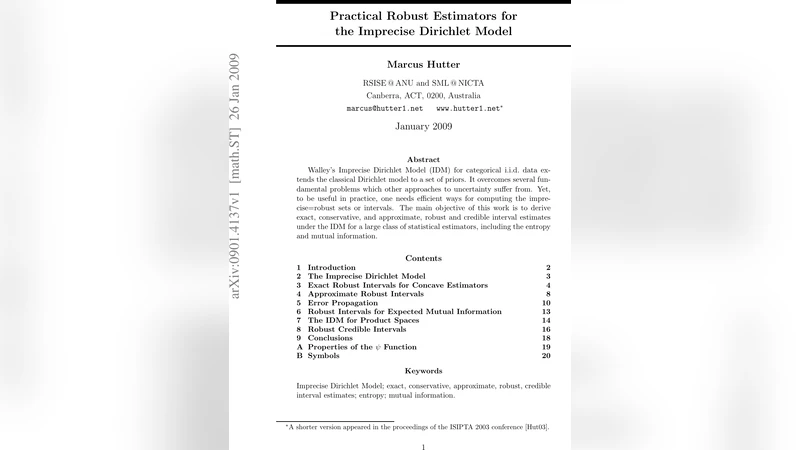
Walley’s Imprecise Dirichlet Model (IDM) for categorical i.i.d. data extends the classical Dirichlet model to a set of priors. It overcomes several fundamental problems which other approaches to uncertainty suffer from. Yet, to be useful in practice, one needs efficient ways for computing the imprecise=robust sets or intervals. The main objective of this work is to derive exact, conservative, and approximate, robust and credible interval estimates under the IDM for a large class of statistical estimators, including the entropy and mutual information.
💡 Research Summary
The paper tackles the practical deployment of Walley’s Imprecise Dirichlet Model (IDM), a Bayesian framework that replaces a single Dirichlet prior with a whole set of priors to capture prior‑model uncertainty for categorical i.i.d. data. While IDM resolves several conceptual issues of traditional Bayesian inference—most notably the sensitivity to an arbitrary prior choice—its adoption has been hampered by the lack of efficient algorithms for computing robust (imprecise) posterior intervals for quantities of interest.
The authors first formalize the IDM setting: given observed counts (n = (n_1,\dots,n_K)) and a strength parameter (s\in
Comments & Academic Discussion
Loading comments...
Leave a Comment