A sequence to compute the Brauer group of certain quasi-triangular Hopf algebras
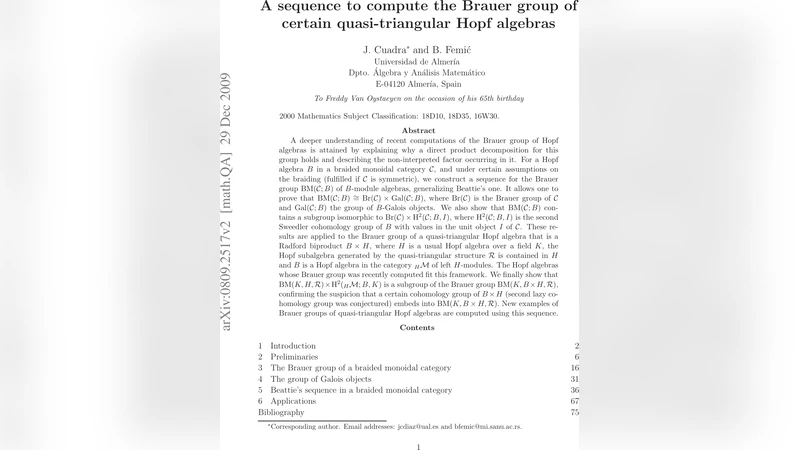
A deeper understanding of recent computations of the Brauer group of Hopf algebras is attained by explaining why a direct product decomposition for this group holds and describing the non-interpreted factor occurring in it. For a Hopf algebra $B$ in a braided monoidal category $\C$, and under certain assumptions on the braiding (fulfilled if $\C$ is symmetric), we construct a sequence for the Brauer group $\BM(\C;B)$ of $B$-module algebras, generalizing Beattie’s one. It allows one to prove that $\BM(\C;B) \cong \Br(\C) \times \Gal(\C;B),$ where $\Br(\C)$ is the Brauer group of $\C$ and $\Gal(\C;B)$ the group of $B$-Galois objects. We also show that $\BM(\C;B)$ contains a subgroup isomorphic to $\Br(\C) \times \Hc(\C;B,I),$ where $\Hc(\C;B,I)$ is the second Sweedler cohomology group of $B$ with values in the unit object $I$ of $\C$. These results are applied to the Brauer group of a quasi-triangular Hopf algebra that is a Radford biproduct $B \times H$, where $H$ is a usual Hopf algebra over a field $K$, the Hopf subalgebra generated by the quasi-triangular structure $\R$ is contained in $H$ and $B$ is a Hopf algebra in the category ${}_H\M$ of left $H$-modules. The Hopf algebras whose Brauer group was recently computed fit this framework. We finally show that $\BM(K,H,\R) \times \Hc({}_H\M;B,K)$ is a subgroup of the Brauer group $\BM(K,B \times H,\R),$ confirming the suspicion that a certain cohomology group of $B \times H$ (second lazy cohomology group was conjectured) embeds into $\BM(K,B \times H,\R).$ New examples of Brauer groups of quasi-triangular Hopf algebras are computed using this sequence.
💡 Research Summary
The paper develops a categorical framework for computing the Brauer group of certain quasi‑triangular Hopf algebras. Working in a braided monoidal category 𝒞, the authors consider a Hopf algebra B that lives as a Hopf object in 𝒞. Under the hypothesis that the braiding is “central’’ for B – a condition automatically satisfied when 𝒞 is symmetric – they construct an exact sequence that generalises Beattie’s Brauer–Galois sequence. The sequence reads
1 → Br(𝒞) → BM(𝒞;B) → Gal(𝒞;B) → 1,
where Br(𝒞) is the Brauer group of the ambient category, BM(𝒞;B) denotes the Brauer group of B‑module algebras, and Gal(𝒞;B) is the group of B‑Galois objects. The centrality hypothesis forces the extension to split, yielding a direct‑product decomposition
BM(𝒞;B) ≅ Br(𝒞) × Gal(𝒞;B).
The authors then identify a natural subgroup of BM(𝒞;B) coming from the second Sweedler cohomology group H²(𝒞;B,I), where I is the unit object of 𝒞. They prove that
Br(𝒞) × H²(𝒞;B,I) ≤ BM(𝒞;B),
showing that “lazy’’ 2‑cocycles for B give rise to non‑trivial Brauer classes.
The abstract machinery is applied to Hopf algebras of the form B × H, a Radford biproduct, where H is an ordinary Hopf algebra over a field K, B is a Hopf algebra in the category of left H‑modules {}_H𝔐, and the quasi‑triangular structure ℛ lies inside H. In this setting 𝒞 is taken to be {}_H𝔐, so the previous results give
BM(K, B×H, ℛ) ≅ Br({}_H𝔐) × Gal({}_H𝔐; B).
Since Br({}_H𝔐) coincides with the classical Brauer group of K, the new factor Gal({}_H𝔐; B) captures the contribution of the B‑part. Moreover, the authors verify that the second Sweedler cohomology H²({}_H𝔐; B,K) embeds as a subgroup of BM(K, B×H, ℛ). This confirms a conjecture that the “lazy’’ cohomology of the biproduct should sit inside its Brauer group.
To illustrate the theory, the paper computes explicit Brauer groups for several concrete examples, notably Nichols algebras of low dimension and their associated Radford biproducts. The calculations recover previously known results and, importantly, exhibit new Brauer classes arising from non‑trivial lazy 2‑cocycles.
Overall, the work achieves three major advances: (1) a categorical generalisation of Beattie’s exact sequence that yields a clean direct‑product decomposition under mild braiding conditions; (2) the identification of a cohomological subgroup H²(𝒞;B,I) inside the Brauer group, clarifying the role of lazy cohomology; and (3) a unified treatment of the Brauer groups of quasi‑triangular Hopf algebras that are Radford biproducts, providing both theoretical insight and concrete computations. These results deepen the connection between Hopf‑algebraic cohomology and non‑commutative Brauer theory, and they open new avenues for studying Brauer groups in more general braided or quasi‑triangular settings.
Comments & Academic Discussion
Loading comments...
Leave a Comment