Simplicity of Completion Time Distributions for Common Complex Biochemical Processes
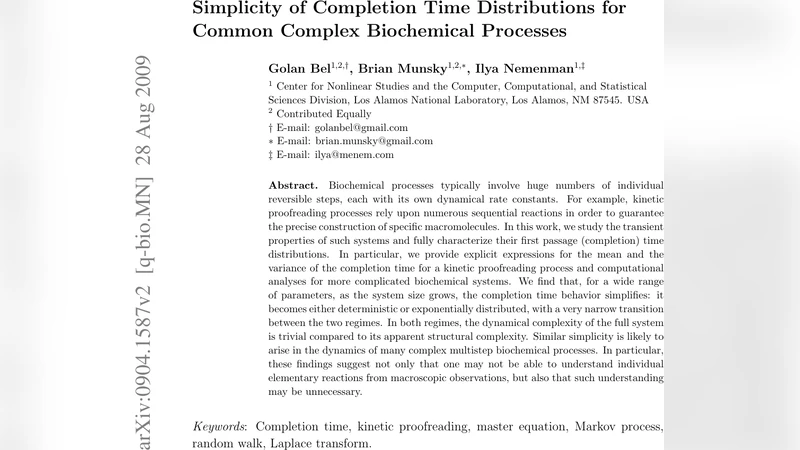
Biochemical processes typically involve huge numbers of individual reversible steps, each with its own dynamical rate constants. For example, kinetic proofreading processes rely upon numerous sequential reactions in order to guarantee the precise construction of specific macromolecules. In this work, we study the transient properties of such systems and fully characterize their first passage (completion) time distributions. In particular, we provide explicit expressions for the mean and the variance of the completion time for a kinetic proofreading process and computational analyses for more complicated biochemical systems. We find that, for a wide range of parameters, as the system size grows, the completion time behavior simplifies: it becomes either deterministic or exponentially distributed, with a very narrow transition between the two regimes. In both regimes, the dynamical complexity of the full system is trivial compared to its apparent structural complexity. Similar simplicity is likely to arise in the dynamics of many complex multi-step biochemical processes. In particular, these findings suggest not only that one may not be able to understand individual elementary reactions from macroscopic observations, but also that such understanding may be unnecessary.
💡 Research Summary
The paper investigates the transient dynamics of highly multistep biochemical processes, focusing on the distribution of first‑passage (completion) times. Using kinetic proofreading (KP) as a canonical example, the authors construct a Markov chain with N reversible steps, each characterized by a forward rate k_i and a backward rate r_i. By deriving the moment‑generating function of the first‑passage time, they obtain closed‑form expressions for the mean ⟨T⟩ and variance Var(T) that are valid for arbitrary rate sets. The analysis reveals two distinct asymptotic regimes as the system size grows.
In the “strong‑forward” regime, where the forward‑to‑backward rate ratio α_i = k_i/r_i is much larger than one for most steps, the completion time distribution collapses onto a narrow peak. The relative variance (Var(T)/⟨T⟩²) tends to zero, indicating deterministic behavior. The mean scales roughly linearly with the number of steps, but fluctuations become negligible, reminiscent of a law‑of‑large‑numbers effect.
Conversely, in the “balanced” regime where α_i ≈ 1, the distribution becomes exponential. Here the coefficient of variation approaches one, and the process behaves like a memoryless Poisson process. The mean no longer grows linearly with N; instead it saturates logarithmically as the forward bias diminishes.
Between these two regimes lies an extremely narrow transition band. Numerical simulations using Gillespie’s stochastic algorithm confirm that the width of this band is essentially independent of N and is governed by a small tolerance ε (typically <0.1) around α = 1. The authors quantify the transition using a Chebyshev–Schwarz inequality, providing a precise criterion for when the system switches from deterministic to exponential statistics.
To test the generality of the findings, the authors extend the KP framework to include feedback loops, multiple parallel pathways, and heterogeneous rate distributions. Remarkably, even in these more intricate networks the same dichotomy persists: the overall forward‑to‑backward bias determines whether the completion time is effectively deterministic or exponentially distributed. Detailed microscopic variations are “washed out” by the aggregate bias, implying that the macroscopic observable (the first‑passage time) is insensitive to the fine‑grained kinetic details.
The biological implications are profound. Many experimental measurements—such as single‑molecule enzyme turnover times, ribosomal translation pauses, or signaling cascade delays—often display exponential waiting‑time statistics. According to the paper, such observations do not necessarily reveal the underlying number of intermediate steps; rather, they indicate that the system operates in the balanced regime where forward and backward rates are comparable. Conversely, a sharply peaked distribution would suggest a highly biased forward progression, even if the underlying pathway comprises dozens of reversible reactions.
In summary, the study demonstrates that the apparent structural complexity of multi‑step biochemical processes does not translate into complex dynamical behavior. As the number of steps increases, the completion‑time distribution simplifies dramatically, collapsing into either a deterministic limit or an exponential law, with a very narrow parameter window separating the two. This “dynamic simplicity” suggests that macroscopic kinetic measurements may be adequately described by low‑dimensional effective models, and that attempting to infer every elementary reaction from such data may be both unnecessary and impossible.
Comments & Academic Discussion
Loading comments...
Leave a Comment