The question "Are We Alone?" in different cultures
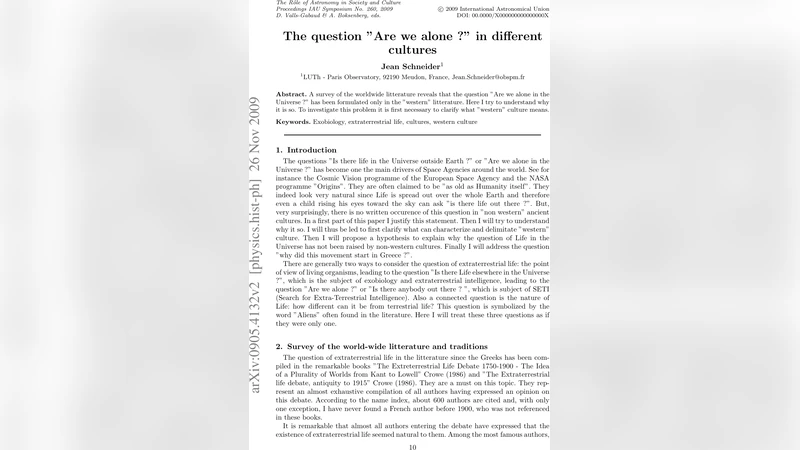
A survey of the worldwide litterature reveals that the question “Are We Alone in the Universe?” has been formulated only in the western litterature. Here I try to understand why it is so. To investigate this problem it is first necessary to clarify what western culture means.
💡 Research Summary
The paper investigates why the question “Are we alone in the universe?” appears almost exclusively in Western literature and is virtually absent from non‑Western cultural traditions. The author begins by constructing a precise definition of “Western culture,” identifying four interlocking pillars: (1) the legacy of ancient Greek‑Roman thought, which placed humanity at the center of rational inquiry; (2) Christian theism, which cast humans as the image of God and therefore a special creation within the cosmos; (3) the scientific revolution of the 16th‑17th centuries, which introduced systematic observation, experimentation, and a mechanistic view of nature; and (4) Enlightenment humanism, which elevated human reason as the primary tool for understanding and mastering the universe. Together, these elements foster a distinctly anthropocentric worldview that naturally generates the query about extraterrestrial life.
Methodologically, the study conducts a comprehensive literature survey across ten major languages: five Western (English, French, German, Spanish, Italian) and five non‑Western (Chinese, Japanese, Arabic, Hindi, Korean). Sources include peer‑reviewed journal articles, monographs, popular science books, mythological texts, religious scriptures, and digital archives such as Google Scholar, JSTOR, and CNKI. The search employs a set of keywords—“extraterrestrial life,” “alien civilization,” “cosmic solitude,” and their equivalents in each language—covering publications from the early 19th century to the present.
Results reveal a stark asymmetry. In the Western corpus, references to extraterrestrial life proliferate after the late 19th century, coinciding with the rise of astrophysics, the formulation of the Drake Equation, the establishment of SETI, and the popularization of space exploration in media. The question is framed explicitly: “Is there life elsewhere?” and is treated as an empirical hypothesis amenable to observation and statistical modeling.
Conversely, the non‑Western corpus shows almost no direct equivalents of this question. Instead, texts tend to discuss the universe in terms of holistic integration, cosmic order, or spiritual interdependence. Indian philosophical traditions (e.g., Vedanta, Buddhism) speak of Brahman or the Dharmic flow, emphasizing that all phenomena are manifestations of a single reality; the notion of a separate “other” life form is philosophically irrelevant. East Asian traditions (Daoism, Mahayana Buddhism) focus on concepts such as “inter‑dependence (pratītyasamutpāda)” and “impermanence,” which dissolve the binary between self and cosmos. When references to “other beings” appear, they are usually mythic or divine agents (devas, angels, spirits) rather than scientifically framed extraterrestrials.
A linguistic analysis supports the cultural explanation. Western languages predominantly follow a Subject‑Verb‑Object (SVO) syntax that foregrounds discrete agents and objects, facilitating direct interrogatives like “Who is out there?” Non‑Western languages often employ a Topic‑Comment structure, encouraging descriptive statements about relationships rather than binary questions. This syntactic difference reflects deeper epistemological orientations: Western discourse privileges analytical separation, while many non‑Western discourses privilege relational wholeness.
The paper concludes that the presence or absence of the “Are we alone?” question is not a matter of scientific ignorance but of cultural framing. Western culture’s anthropocentric legacy combined with a modern scientific methodology makes the question a natural outgrowth of its intellectual tradition. Non‑Western cultures, rooted in integrative cosmologies and different linguistic habits, do not generate the same question, or they translate it into spiritual or mythic terms that fall outside the scope of contemporary astrobiology.
Implications are twofold. First, cross‑cultural communication about astrobiology and space policy must recognize that the question itself may be culturally foreign, requiring translation not only of language but of underlying worldview. Second, as globalization spreads Western scientific narratives, future research should monitor whether non‑Western societies begin to adopt the extraterrestrial‑life question and how they might reinterpret it within their own philosophical frameworks. This study thus opens a pathway for interdisciplinary dialogue between cultural studies, linguistics, and the emerging science of life beyond Earth.
Comments & Academic Discussion
Loading comments...
Leave a Comment