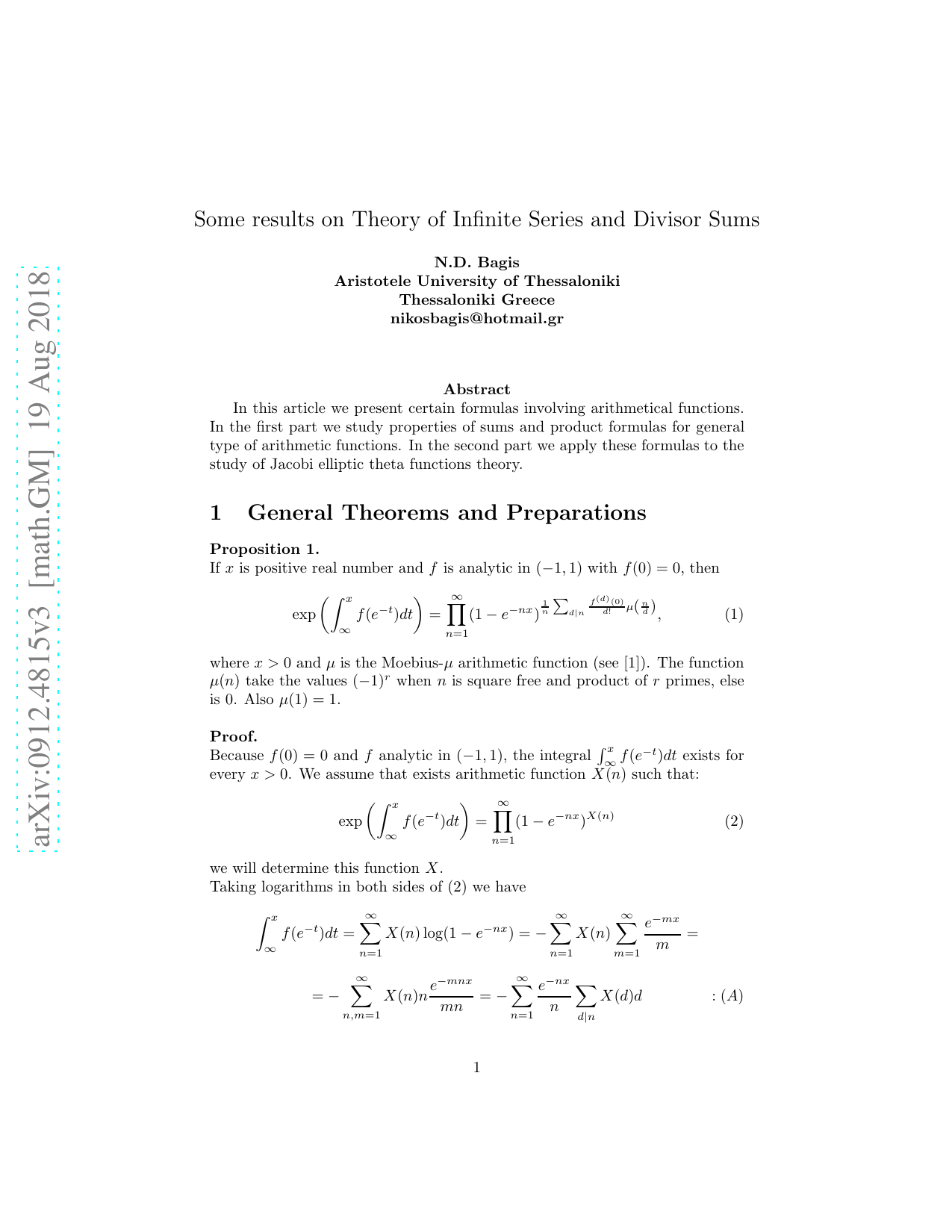
In this article we present certain formulas involving arithmetical functions. In the first part we study properties of sums and product formulas for general type of arithmetic functions. In the second part we apply these formulas to the study of Jacobi elliptic theta functions theory.
Deep Dive into Some results on Theory of Infinite Series and Divisor Sums.
In this article we present certain formulas involving arithmetical functions. In the first part we study properties of sums and product formulas for general type of arithmetic functions. In the second part we apply these formulas to the study of Jacobi elliptic theta functions theory.
1 General Theorems and Preparations Proposition 1. If x is positive real number and f is analytic in (-1, 1) with f (0) = 0, then
where x > 0 and µ is the Moebius-µ arithmetic function (see [1]). The function µ(n) take the values (-1) r when n is square free and product of r primes, else is 0. Also µ(1) = 1.
Because f (0) = 0 and f analytic in (-1, 1), the integral
x ∞ f (e -t )dt exists for every x > 0. We assume that exists arithmetic function X(n) such that:
we will determine this function X.
Taking logarithms in both sides of (2) we have But from analytic property of f in (-1, 1) we have
and consequently
Therefore from (B) and the above relation it must be
By applying the Moebius inversion theorem (see [1]) we get
This completes the proof. Note also that holds the following similar expression
Examples on Proposition 1. 1) If f (x) = x then f (n) (0) n! = δ n , n = 1, 2, 3, . . . i.e δ 1 = 1, 0 else. Hence
)
= n, n = 1, 2, 3, . . ., then f (x) = x (x-1) 2 and X(n
-ν (n) n
, i.e σ ν (n) = d|n d ν is the sum of the ν-th power of divisors of n and σ (-1) ν is its arithmetic inverse. This means d|n σ ν (d)σ
where σ
Proof.
Easy consequence of Proposition 1.
If a is positive real number then
Proof.
Set x = a > 0 in (1) and take the logarithmic derivative in both sides with respect to a.
Proof.
Set x = a and x = 2a in (1) to take two relations, divide them. Take the logarithms and derivate. After a few simplifications we get (9).
If A(n) is arbitrary arithmetic function, then for x > 0 we have
Proof.
Using again Proposition 1 we get the result.
Lemma 1.
Proof.
, then from Moebius inversion theorem we have
Using Proposition 2 we get the result.
and |q| < 1, then for every f we have
Summing with respect to m we have
and the result follows.
Let d|n X(d) = g (n) (0) n! , then for every f and |q| < 1 we have
where
- Also setting
or the equivalent
where Li ν (x) = ∞ n=1
x n n ν .
- With h n = δ n in Theorem 2 and f (n) → a(n), we get
Differentiating with respect to q and setting q = e 2πiz , Im(z) > 0, we get
The case
lead us to some kind of “Eisenstein series” (we have set
where
and
Then from Hecke theorem for modular forms we have
If M k+1 denotes the k + 1-th space of modular forms (that is of weight k + 1) and
then we can say f (z) ∈ M iff f (z) can be written as a sum of p different weight modular forms.
The same thing happens and with f in which
Then f is a sum of modular forms of different weights.
Hence we can state that if a function is a “mixed” modular form
and
then
where
and
Moreover holds the next Hecke-type theorem for derivatives of modular forms:
then we have
where
and Λ * (s) satisfies the functional equation Λ * (s)
Remarks. i) Here the weight is k. ii) The proof of the theorem is based on Proposition 11 and Hecke’s theorem.
Assume that
Set also
and hence
From the above we get the following
2 Results in the theory of theta functions Set (n, m) = gcd(n, m) to be the greatest common divisor of n, m. Then one can easily see, using arguments of [1] chapter 2, that
From the relation d|n φ(d) = n and relation (11) we get
From Proposition 5 we have for general arithmetic function F :
integrating the above relation we get:
), then we have the next version of Jacobi triple product identity (see [4]):
Setting e -aπ = q, a > 0 and F (x) = cos(2tx) in (50) and using (51) we get
where
is Jacobi’s 4th theta function (see [2]).
Setting t = π 2 in (52) we get
Hence we can state the next
Proof.
We use (see [6] pg.488):
and (see [2] pg.107 and related theory):
and relation (53). The functions k = k r , K = K(k) are the elliptic singular modulus and elliptic integral of the first kind at singular values respectively. The function
Then using the summable version of Jacobi triple product identity (relation (51)), we get after differentiating with respect to t:
Hence from (50) we have
is a modular form of weight 2ν, where
are the known Eisenstein series (see [18]).
Theorem 6.
For ν = 1, 2, . . ., we have
Proof.
Easy. From (60) we immediately get the result.
Let F (n) = a 2 n 2 + a 4 n 4 + . . . + a 2k n 2k + . . . be even function with
Another interesting result which follows from relation (59
. This can be done by writing
Expanding the logarithm on the left into power series we get
From this we arrive to (66) and we have the next
with
Relation (67) can also be found if we use directly the Jacobi’s formula
This can be done integrating (68) from z = 0 to z = t. Then we arive to (67) expanding q n 1-q 2n = x 1-x 2 into Taylor series of x = q n and making the double infinite series into single using divisor sumation.
The above formula (67) for t = π 2 gives Proposition 9.
where
Theorem 9.
The above transformation T a(n) = b n is given from relation
where b 0 = 1. Hence given the general form of a n , we can construct all T a(n).
Notes. In general hold the following relations
This happens because exp -
and
with lim N →∞ (T
…(Full text truncated)…
This content is AI-processed based on ArXiv data.