Optimal sequential multiple hypothesis tests
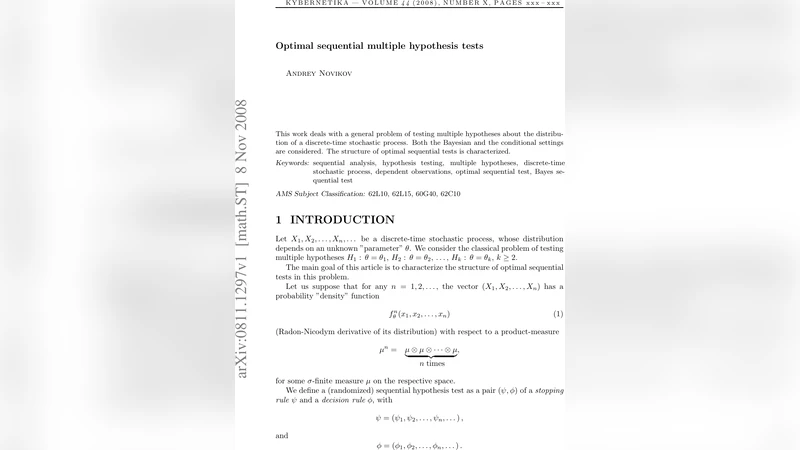
This work deals with a general problem of testing multiple hypotheses about the distribution of a discrete-time stochastic process. Both the Bayesian and the conditional settings are considered. The structure of optimal sequential tests is characterized.
💡 Research Summary
The paper addresses the fundamental problem of sequentially testing multiple hypotheses about the distribution of a discrete‑time stochastic process. It formulates the problem in a unified decision‑theoretic framework, where at each time step the decision maker observes the process, decides whether to stop, and if stopping, selects one of the M competing hypotheses. Two distinct settings are examined: a Bayesian formulation with prior probabilities and a conditional (non‑Bayesian) formulation that relies solely on the observed data.
In the Bayesian case the authors introduce prior probabilities π_i, a cost matrix C_{ij} for mis‑classification, and a per‑observation cost c. The overall loss is the expected sum of the stopping error cost and the accumulated observation cost. By applying dynamic programming, they derive a Bellman equation for the value function V_n(x₁ⁿ). The immediate‑stop cost is the expected mis‑classification cost given the current posterior, while the continuation cost is c plus the expected future value. Crucially, the posterior probabilities can be expressed through likelihood ratios Λ_i(n) = π_i ∏_{k=1}^n P_i(X_k)/P_0(X_k). The value function depends only on the logarithms of these ratios, leading to a set of linear decision boundaries.
The main structural result is that the optimal sequential test is characterized by a collection of upper and lower thresholds γ_i^U, γ_i^L for each hypothesis i. When the log‑likelihood ratio for hypothesis i stays within its interval (γ_i^L, γ_i^U) the test continues; crossing either boundary triggers immediate stopping and acceptance of the corresponding hypothesis. This “multi‑boundary” rule generalizes Wald’s Sequential Probability Ratio Test (SPRT) from two to arbitrarily many hypotheses. The thresholds are obtained by solving a system of optimality equations that balance the marginal benefit of an extra observation against its cost.
In the conditional setting the prior probabilities are omitted, and the decision maker minimizes a conditional risk that depends only on the observed data. The authors define a conditional risk function R_n(i|x₁ⁿ) for each hypothesis and show that the optimal stopping rule again reduces to comparing the log‑likelihood ratios with the same type of thresholds. Hence, both Bayesian and conditional optimal policies share the same geometric structure: a partition of the log‑likelihood ratio space into continuation and stopping regions.
Beyond the theoretical characterization, the paper proposes an efficient computational scheme. Because likelihood ratios can be updated recursively, the test can be implemented online with O(1) per‑sample complexity after a one‑time offline computation of the thresholds. The authors validate the approach through Monte‑Carlo simulations, demonstrating substantial reductions in average sample number relative to fixed‑sample-size tests while maintaining prescribed error probabilities.
Finally, the authors discuss extensions to continuous‑time processes, non‑Gaussian models, and state‑dependent observation costs, arguing that the dynamic‑programming methodology and the resulting multi‑boundary structure remain applicable. Potential applications span communication systems (sequential channel state detection), industrial quality control (real‑time defect detection), and medical diagnostics (early disease identification). In sum, the work provides a rigorous, unified theory of optimal sequential multiple‑hypothesis testing, bridging the gap between abstract optimality results and practical, implementable algorithms.
Comments & Academic Discussion
Loading comments...
Leave a Comment