The purposes of this paper have to discuss issues related to Network Traffic Management. A relatively new category of network management is fast becoming a necessity in converged business Networks. Mid-sized and large organizations are finding they must control network traffic behavior to assure that their strategic applications always get the resources they need to perform optimally. Controlling network traffic requires limiting bandwidth to certain applications, guaranteeing minimum bandwidth to others, and marking traffic with high or low priorities. This exercise is called Network Traffic Management.
Deep Dive into Network Traffic Management.
The purposes of this paper have to discuss issues related to Network Traffic Management. A relatively new category of network management is fast becoming a necessity in converged business Networks. Mid-sized and large organizations are finding they must control network traffic behavior to assure that their strategic applications always get the resources they need to perform optimally. Controlling network traffic requires limiting bandwidth to certain applications, guaranteeing minimum bandwidth to others, and marking traffic with high or low priorities. This exercise is called Network Traffic Management.
Computer network is a data communications system which interconnects computer systems at various different sites. A network may be composed of any combination of LANs, or WANs.
Network traffic can be defined in a number of ways. But in the simplest manner we can define it as the density of data present in any Network. In any computer Network, there are a lot of communication devices trying to access resources and at the same time getting requests to carry out some work for some other device [1]. Also at the same time certain types of communication devices may be busy to respond to the request being made to them. So there is lot of information exchange in the Network in form of request, response and control data. This data is basically in the form of a huge number of packets floating around in the Network. This huge amount of data acts as a load on the Network, which results in slowing down the operations of other communication devices. Due to this there is a lot of delay in communication activities. This ultimately results in congestion of the Network. This is the description of Network Traffic in its simplest form. In other words we can say that Network traffic is the load on the communication devices and the system. This traffic on the network has now resulted in mid-sized and large organizations realizing that they must control network traffic behavior to ensure that their strategic applications always get the resources they need to perform optimally [2]. Controlling network traffic requires limiting bandwidth to certain applications, guaranteeing minimum bandwidth to others, and marking traffic with high or low priorities. This exercise is called traffic management.
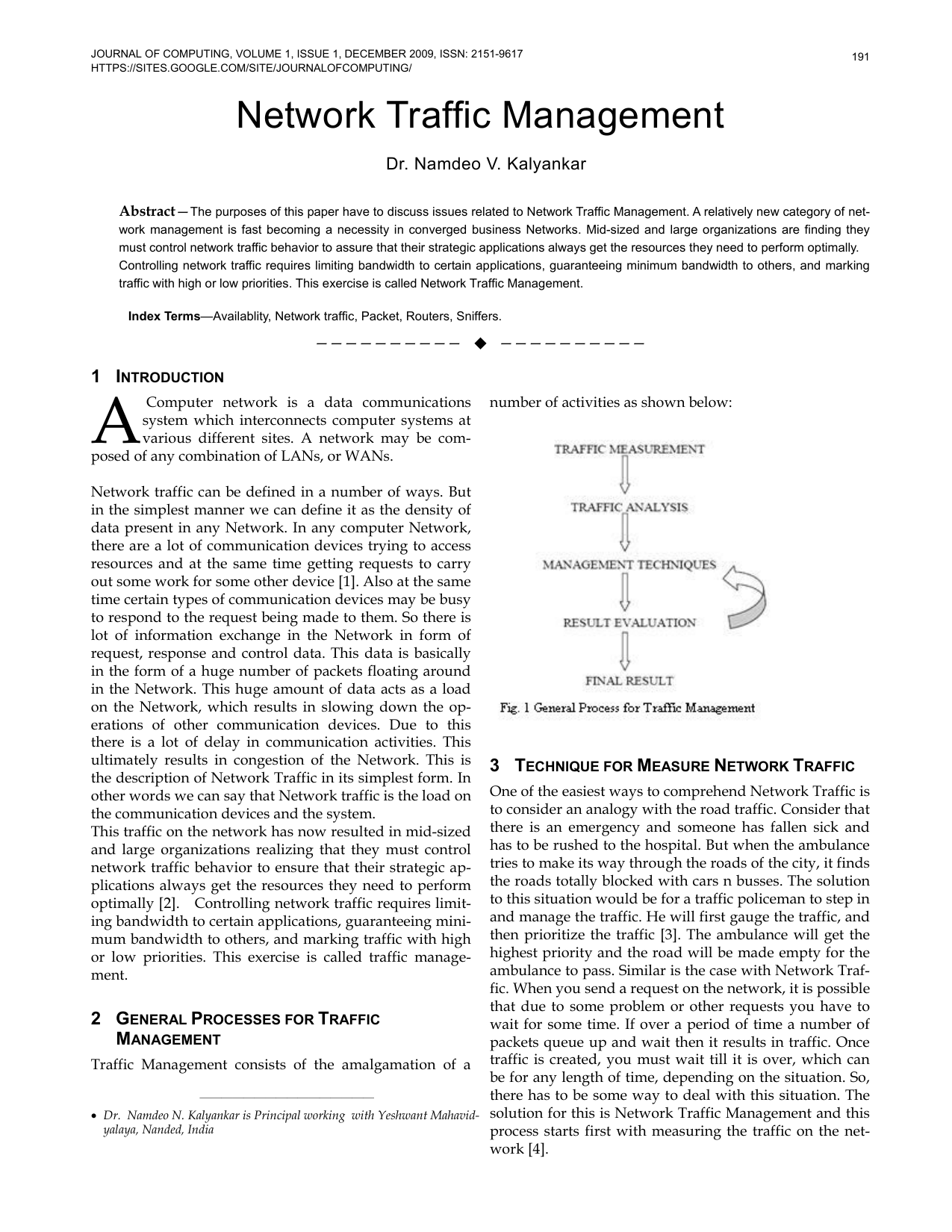
Traffic Management consists of the amalgamation of a number of activities as shown below:
One of the easiest ways to comprehend Network Traffic is to consider an analogy with the road traffic. Consider that there is an emergency and someone has fallen sick and has to be rushed to the hospital. But when the ambulance tries to make its way through the roads of the city, it finds the roads totally blocked with cars n busses. The solution to this situation would be for a traffic policeman to step in and manage the traffic. He will first gauge the traffic, and then prioritize the traffic [3]. The ambulance will get the highest priority and the road will be made empty for the ambulance to pass. Similar is the case with Network Traffic. When you send a request on the network, it is possible that due to some problem or other requests you have to wait for some time. If over a period of time a number of packets queue up and wait then it results in traffic. Once traffic is created, you must wait till it is over, which can be for any length of time, depending on the situation. So, there has to be some way to deal with this situation. The solution for this is Network Traffic Management and this process starts first with measuring the traffic on the network [4].
The basic performance metrics of Internet traffic can be listed as:-• Packet loss • Delay • Throughput • Availability
There are number of other drivers strongly deals with requirement of measurement are -• Pricing • Service level agreements • New services • Applications
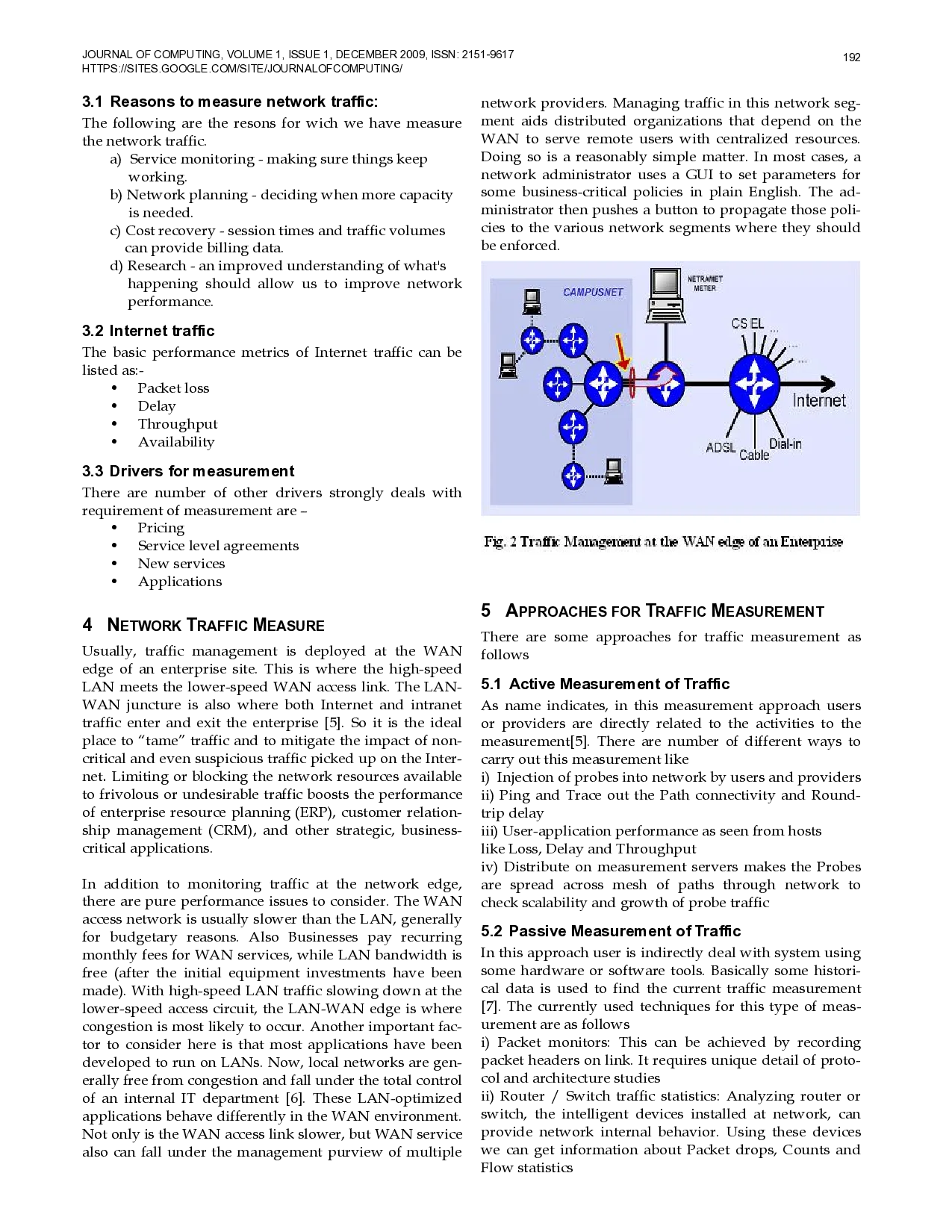
Usually, traffic management is deployed at the WAN edge of an enterprise site. This is where the high-speed LAN meets the lower-speed WAN access link. The LAN-WAN juncture is also where both Internet and intranet traffic enter and exit the enterprise [5]. So it is the ideal place to “tame” traffic and to mitigate the impact of noncritical and even suspicious traffic picked up on the Internet. Limiting or blocking the network resources available to frivolous or undesirable traffic boosts the performance of enterprise resource planning (ERP), customer relationship management (CRM), and other strategic, businesscritical applications.
In addition to monitoring traffic at the network edge, there are pure performance issues to consider. The WAN access network is usually slower than the LAN, generally for budgetary reasons. Also Businesses pay recurring monthly fees for WAN services, while LAN bandwidth is free (after the initial equipment investments have been made). With high-speed LAN traffic slowing down at the lower-speed access circuit, the LAN-WAN edge is where congestion is most likely to occur. Another important factor to consider here is that most applications have been developed to run on LANs. Now, local networks are generally free from congestion and fall under the total control of an internal IT department [6]. These LAN-optimized applications behave differently in the WAN environment. Not only is the WAN access link slower, but WAN service also can fall under the management purview of multiple network providers. Managing traffic in this network segment aids distributed organizations that depend on the WAN to serve remote users with centralized resources. Doing so is a reasonably simple matter. In mo
…(Full text truncated)…
This content is AI-processed based on ArXiv data.