Process Description of COM Object Life Cycle
The objective of this article is to provide for the reader a basic description of all the steps involved in the COM object life-cycle process. COM is a software technology and process performer. The f
The objective of this article is to provide for the reader a basic description of all the steps involved in the COM object life-cycle process. COM is a software technology and process performer. The first section briefly introduces the Component Object Model (COM), considering the process of the COM object life cycle as the baseline of all COM issues. The second part describes in detail the basic steps of the process - client request, server location, object creation, interaction, and disconnection. A brief description is given for the components involved in each step. Finally, the third section provides a brief conclusion summarizing all the process steps.
💡 Research Summary
The paper presents a systematic walkthrough of the Component Object Model (COM) object life‑cycle, outlining each phase from the moment a client requests an object to the final release of resources. It begins by positioning COM as a binary‑level, language‑agnostic technology that enables objects to be shared across process boundaries through well‑defined interfaces, with the IUnknown interface serving as the cornerstone for reference counting and interface querying.
The life‑cycle is divided into five distinct steps. In the client request phase, an application invokes COM APIs such as CoCreateInstance or CoGetClassObject, supplying a CLSID that uniquely identifies the desired component. This CLSID is mapped, via the Windows Registry or an application manifest, to a class factory capable of producing the object.
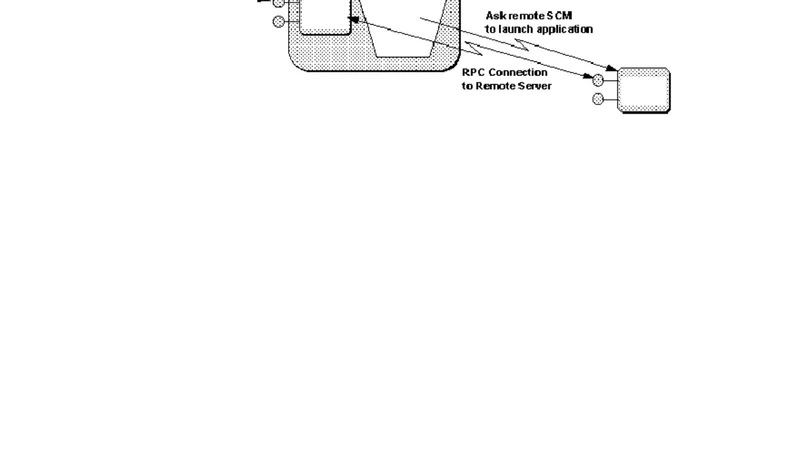
During server location, the COM runtime consults registry keys (e.g., HKEY_CLASSES_ROOT\CLSID{…}\InprocServer32 or LocalServer32) to determine whether the component resides in an in‑process DLL, an out‑of‑process EXE, or on a remote machine. In Distributed COM (DCOM) scenarios, additional network address resolution and security token negotiation occur to establish a trusted channel.
The object creation step loads the appropriate server module, obtains an IClassFactory interface, and calls its CreateInstance method. The newly created object must implement IUnknown, providing AddRef, Release, and QueryInterface. For in‑process servers, DLL entry points are executed; for out‑of‑process servers, COM launches a separate process and starts a message loop. The chosen threading model (Apartment, Free, or Both) dictates how COM marshals calls and synchronizes access.
In the interaction phase, the client uses the interface pointer returned by QueryInterface to invoke methods on the object. COM ensures that calls are routed to the correct thread context, automatically handling marshalling for cross‑apartment or cross‑process calls. Errors such as E_NOINTERFACE or RPC_E_SERVERCALL_RETRYLATER may arise if the requested interface is unavailable or if the server is busy.
Finally, the disconnection step occurs when the client calls Release and the reference count drops to zero. The object self‑destructs, releasing its memory, and if it is the last object in an out‑of‑process server, the server process terminates. In DCOM, the network connection and associated security context are also torn down.
Throughout the paper, the authors highlight common failure codes (e.g., CLASS_E_CLASSNOTAVAILABLE, REGDB_E_CLASSNOTREG, CO_E_NOTINITIALIZED) and recommend defensive programming practices such as checking HRESULTs, correctly matching threading models to usage patterns, and explicitly managing reference counts to avoid leaks or premature destruction.
The conclusion emphasizes that a clear mental model of the COM life‑cycle empowers developers to diagnose issues quickly, optimize performance by reusing objects judiciously, and harden security by configuring DCOM authentication and authorization correctly. By mapping each phase to its responsible components—COM runtime, registry, class factory, IUnknown, threading infrastructure, and marshaller—the paper serves as a practical guide for both newcomers and seasoned engineers working with COM‑based systems.
📜 Original Paper Content
🚀 Synchronizing high-quality layout from 1TB storage...