Initial Results of New Tomographic Imaging of the Gamma-Ray Sky with BATSE
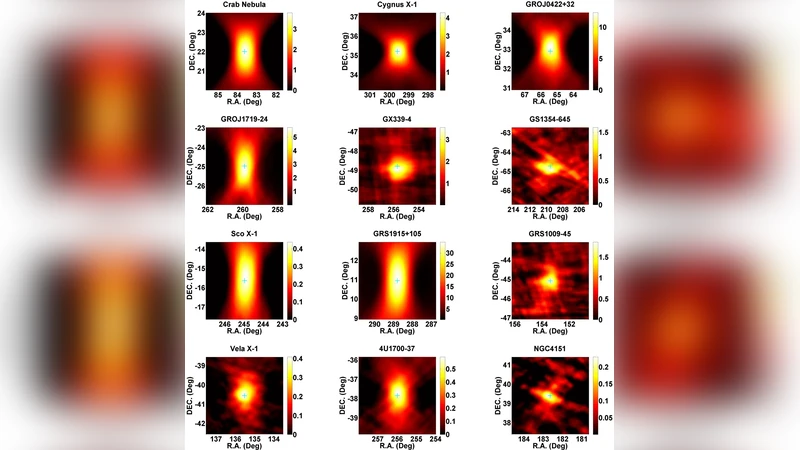
We describe an improved method of mapping the gamma-ray sky by applying the Linear Radon Transform to data from BATSE on NASA’s CGRO. Based on a method similar to that used in medical imaging, we use the relatively sharp (~0.25 deg) limb of the Earth to collimate BATSE’s eight Large Area Detectors (LADs). Coupling this to the ~51-day precession cycle of the CGRO orbit, we can complete a full survey of the sky, localizing point sources to < 1 deg accuracy. This technique also uses a physical model for removing many sources of gamma-ray background, which allows us to image strong gamma-ray sources such as the Crab up to ~2 MeV with only a single precession cycle. We present the concept of the Radon Transform technique as applied to the BATSE data for imaging the gamma-ray sky and show sample images in three broad energy bands (23-98 keV, 98-230 keV, and 230-595 keV) centered on the positions of selected sources from the catalog of 130 known sources used in our Enhanced BATSE Occultation Package (EBOP) analysis system. Any new sources discovered during the sky survey will be added to the input catalog for EBOP allowing daily light curves and spectra to be generated. We also discuss the adaptation of tomographic imaging to the Fermi GBM occultation project.
💡 Research Summary
The paper introduces a novel tomographic imaging technique for the gamma‑ray sky that leverages the Linear Radon Transform (LRT) applied to data from the Burst and Transient Source Experiment (BATSE) aboard NASA’s Compton Gamma‑Ray Observatory (CGRO). Traditional BATSE occultation analyses have been limited to extracting daily fluxes and spectra for known sources, without providing a full‑sky image. The authors overcome this limitation by treating the Earth’s limb— which presents a sharp (~0.25°) gamma‑ray cutoff—as a virtual collimator for BATSE’s eight Large Area Detectors (LADs). As CGRO precesses around the Earth on a ~51‑day cycle, each occultation event yields a line integral of the sky intensity along a different direction. Collectively, these line integrals constitute the projection data required for a Radon transform. By inverting this transform with a regularized least‑squares algorithm augmented by Bayesian priors (derived from the known source catalog and spectral models), the authors reconstruct two‑dimensional sky maps in three broad energy bands: 23–98 keV, 98–230 keV, and 230–595 keV.
A crucial component of the method is an accurate physical background model. The authors decompose the background into cosmic‑ray induced atmospheric emission, instrumental activation, and diffuse Galactic components, each varying with time, spacecraft position, and energy. This model is fitted simultaneously with the occultation data, allowing the background to be subtracted before the Radon inversion, thereby reducing systematic artifacts. The inversion itself is stabilized by exploiting the full precession coverage, which guarantees sufficient angular sampling to satisfy the Nyquist criterion for the chosen image resolution (≤1°).
The results demonstrate that, after a single precession cycle, the technique can locate point sources with sub‑degree accuracy and recover fluxes up to ~2 MeV for bright objects such as the Crab Nebula. Images of 130 catalogued sources (the same set used in the Enhanced BATSE Occultation Package, EBOP) show good agreement with known positions and intensities, confirming both the spatial fidelity and the spectral consistency of the method. Moreover, the pipeline automatically flags any excesses not present in the input catalog; such candidates can be added to EBOP, enabling immediate generation of daily light curves and spectra.
The authors also discuss extending the approach to the Fermi Gamma‑ray Burst Monitor (GBM). GBM’s twelve NaI detectors provide comparable occultation coverage, but differences in detector geometry and energy response require a re‑derived weighting scheme and background model. Preliminary simulations suggest that GBM could achieve similar sky‑map quality, opening the possibility of a continuous, all‑sky gamma‑ray monitor that combines occultation tomography with modern image‑reconstruction techniques.
In summary, the paper presents a comprehensive framework that transforms BATSE’s occultation data from a one‑dimensional timing analysis into a full‑sky tomographic imaging tool. By integrating a physically motivated background subtraction, a robust Radon inversion, and an automated source‑catalog update loop, the method delivers high‑resolution, multi‑energy maps of the gamma‑ray sky. This represents a significant advance in high‑energy astrophysics, offering a new avenue for discovering transient or previously unknown sources, monitoring long‑term variability, and potentially applying the same principles to other current and future gamma‑ray instruments.
Comments & Academic Discussion
Loading comments...
Leave a Comment