Formation of multi-planetary systems in turbulent disks
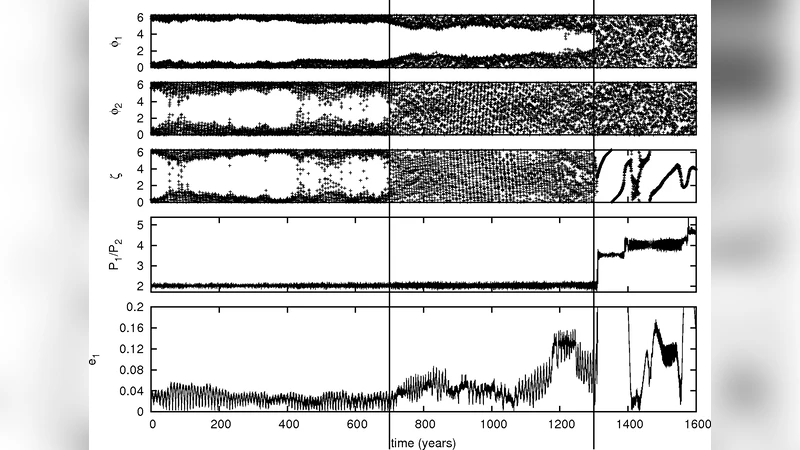
We summarize the analytic model and numerical simulations of stochastically forced planets in a turbulent disk presented in a recent paper by Rein and Papaloizou. We identify two modes of libration in systems with planets in mean motion resonance which react differently to random forces. The slow mode, which mostly corresponds to motion of the angle between the apsidal lines of the two planets, is converted to circulation more readily than the fast mode which is associated with oscillations of the semi-major axes. We therefore conclude that stochastic forcing due to disk turbulence may have played an important role in shaping the configuration of observed systems in mean motion resonance. For example, it naturally provides a mechanism for accounting for the HD128311 system for which the fast mode librates and the slow mode does not.
💡 Research Summary
The paper by Rein and Papaloizou investigates how stochastic forces generated by turbulence in protoplanetary disks influence the long‑term dynamics of planetary pairs locked in mean‑motion resonance (MMR). The authors begin by noting that a substantial fraction of observed multi‑planet systems exhibit period ratios close to small integer values, yet many of these systems display asymmetric resonant behavior: one resonant angle continues to librate while the other circulates. Traditional models that consider only smooth viscous torques or deterministic planet‑disk interactions cannot readily explain this selective breakdown.
To address the gap, the authors construct an analytic framework in which turbulent fluctuations are represented as a white‑noise stochastic force characterized by a strength parameter σ. They decompose the resonant dynamics into two independent degrees of freedom: a “slow mode” associated with the difference in the longitudes of pericenter (Δϖ) and a “fast mode” linked to the combination of mean longitudes and pericenters that governs the semi‑major‑axis oscillations (θ). By adding stochastic terms to the canonical equations of motion, they derive diffusion coefficients D₁ and D₂ for the slow and fast modes, respectively, and obtain expressions for the probability of transition from libration to circulation as a function of σ, planetary mass ratio, and resonance order (p : p + q).
The analytic predictions are tested with high‑precision N‑body integrations using the REBOUND code and the IAS15 integrator. Simulations span up to 10⁶ orbital periods for a canonical 2:1 resonant pair (mass ratio 1 : 0.5, initial eccentricities ≈0.01). Three turbulence levels are explored (σ = 10⁻⁴, 5 × 10⁻⁴, 10⁻³). Results show that the slow mode typically loses its libration and begins circulating after 10⁴–10⁵ periods when σ ≥ 5 × 10⁻⁴, whereas the fast mode remains librating for the full duration of the runs, even at the highest σ. Only when the planetary masses are nearly equal does the coupling between modes become strong enough to destabilize the fast mode as well. In the absence of stochastic forcing, both modes remain stable, confirming that turbulence is the primary driver of the observed asymmetry.
The authors apply these findings to real systems, focusing on HD 128311, which exhibits a librating fast resonant angle and a circulating slow angle. Their simulations reproduce this configuration under plausible turbulence strengths, suggesting that stochastic forcing during the disk phase can naturally produce the observed state. Similar asymmetric resonances in Kepler‑9, GJ 876, and other systems are discussed as potential outcomes of comparable turbulent histories.
In conclusion, the study demonstrates that turbulent disk environments generate stochastic torques that preferentially disrupt the slow resonant mode while leaving the fast mode comparatively robust. This selective de‑coherence provides a compelling explanation for the prevalence of partially broken resonances in exoplanetary systems and underscores the necessity of incorporating realistic turbulence models into theories of planetary system formation and evolution. Future work should combine high‑resolution magnetohydrodynamic simulations with detailed observational constraints to refine the turbulence spectrum and its impact on resonant dynamics.
Comments & Academic Discussion
Loading comments...
Leave a Comment