We present an explicit formula for integrals of the open 2D Toda lattice of type $A_n$. This formula is applicable for various reductions of this lattice. To illustrate the concept we find integrals of the Toda $G_2$ lattice. We also reveal a connection between the open Toda $A_n$ and Shabat-Yamilov lattices.
Deep Dive into Integrals of open 2D lattices.
We present an explicit formula for integrals of the open 2D Toda lattice of type $A_n$. This formula is applicable for various reductions of this lattice. To illustrate the concept we find integrals of the Toda $G_2$ lattice. We also reveal a connection between the open Toda $A_n$ and Shabat-Yamilov lattices.
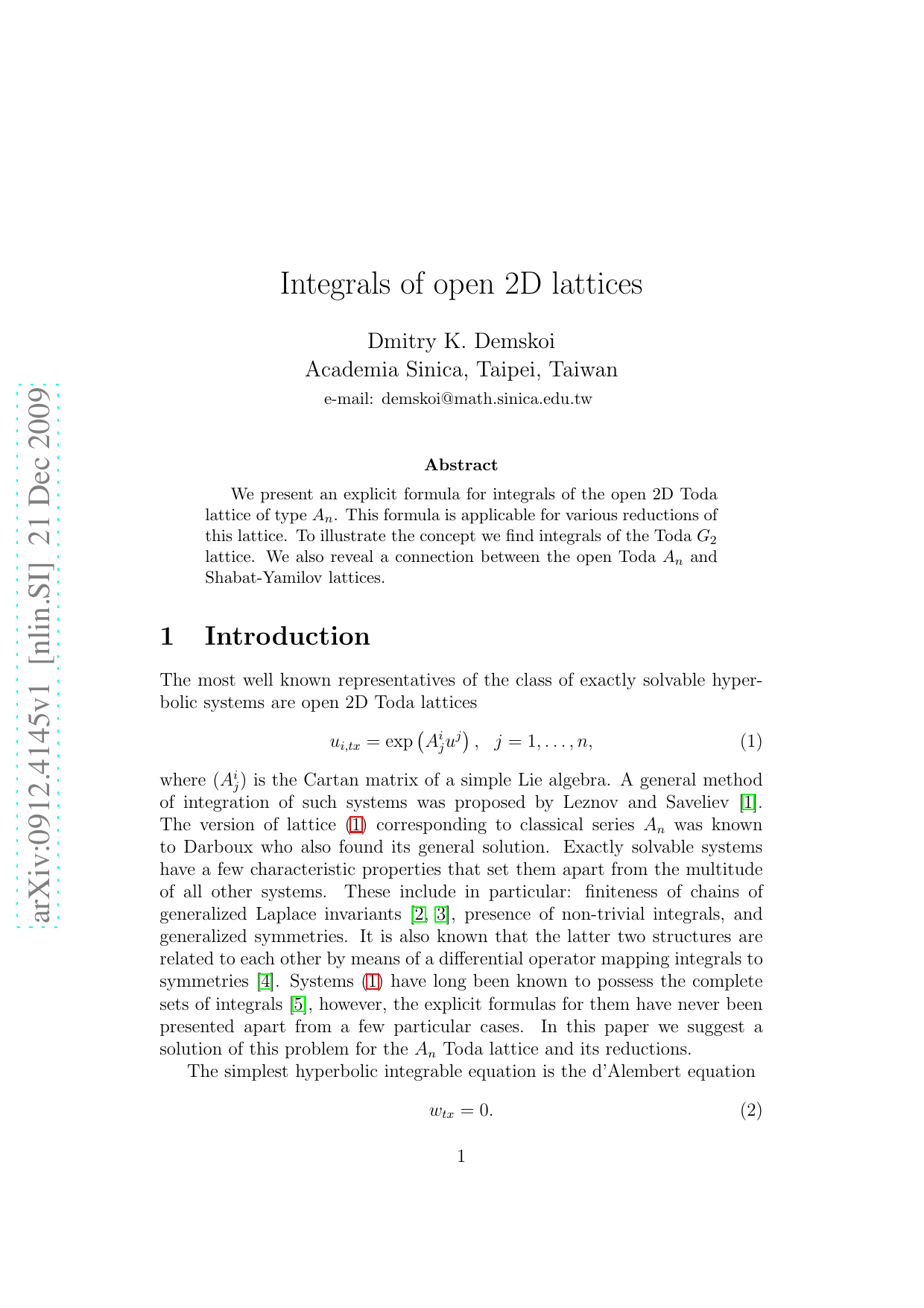
The most well known representatives of the class of exactly solvable hyperbolic systems are open 2D Toda lattices u i,tx = exp A i j u j , j = 1, . . . , n,
where (A i j ) is the Cartan matrix of a simple Lie algebra. A general method of integration of such systems was proposed by Leznov and Saveliev [1]. The version of lattice (1) corresponding to classical series A n was known to Darboux who also found its general solution. Exactly solvable systems have a few characteristic properties that set them apart from the multitude of all other systems. These include in particular: finiteness of chains of generalized Laplace invariants [2,3], presence of non-trivial integrals, and generalized symmetries. It is also known that the latter two structures are related to each other by means of a differential operator mapping integrals to symmetries [4]. Systems (1) have long been known to possess the complete sets of integrals [5], however, the explicit formulas for them have never been presented apart from a few particular cases. In this paper we suggest a solution of this problem for the A n Toda lattice and its reductions.
The simplest hyperbolic integrable equation is the d’Alembert equation
It is not obvious, however, how this equation can be generalized to the case of higher order equations or systems of equations when it is written in this form.
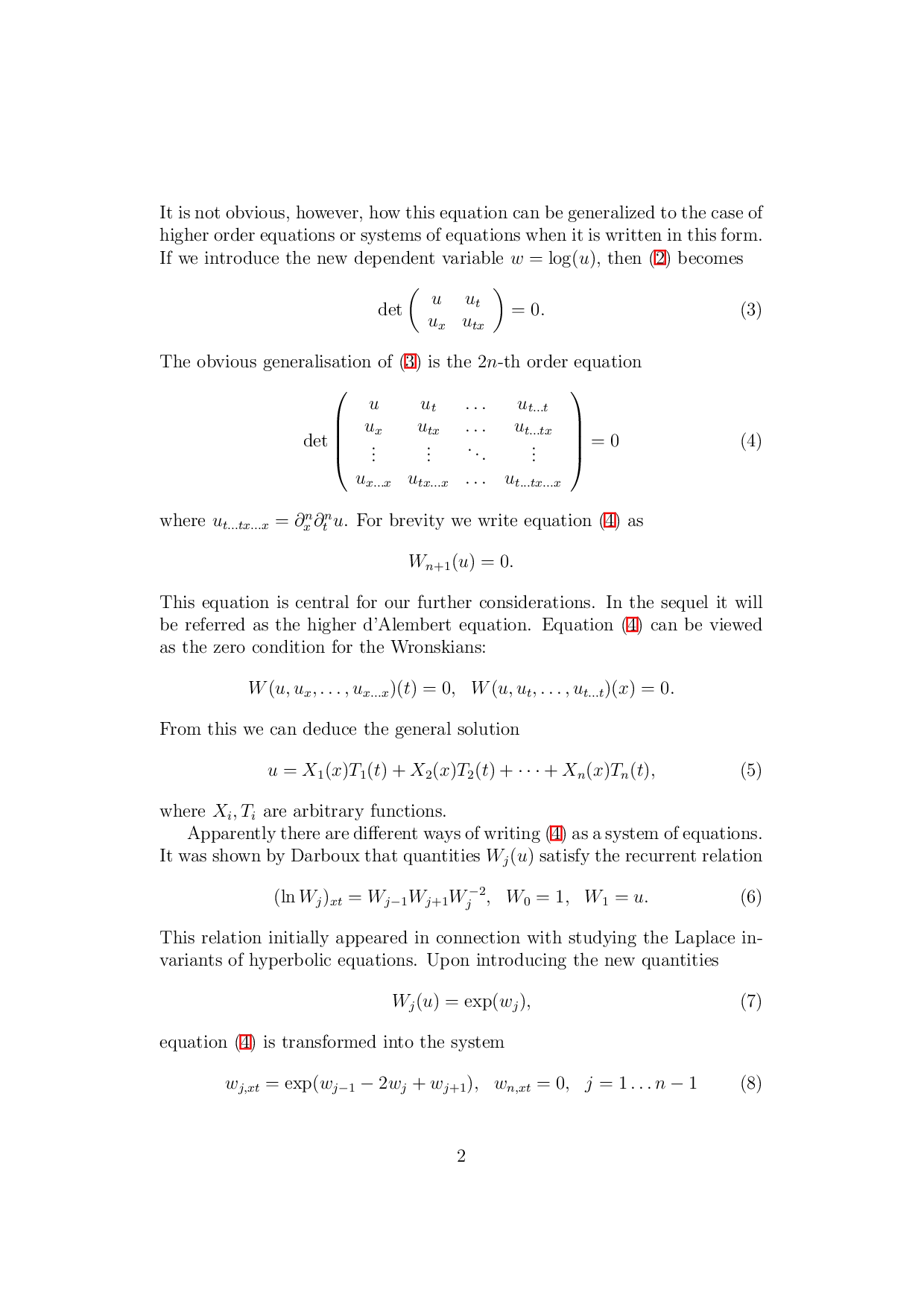
If we introduce the new dependent variable w = log(u), then (2) becomes
The obvious generalisation of (
This equation is central for our further considerations. In the sequel it will be referred as the higher d’Alembert equation. Equation ( 4) can be viewed as the zero condition for the Wronskians:
W (u, u x , . . . , u x…x )(t) = 0, W (u, u t , . . . , u t…t )(x) = 0.
From this we can deduce the general solution
where X i , T i are arbitrary functions. Apparently there are different ways of writing (4) as a system of equations. It was shown by Darboux that quantities W j (u) satisfy the recurrent relation
This relation initially appeared in connection with studying the Laplace invariants of hyperbolic equations. Upon introducing the new quantities
equation ( 4) is transformed into the system
with the boundary condition w 0 = 0. Note that we can eliminate w n from this system by means of the transformation
System ( 9) is often referred as the open (finite, non-periodic) A n-1 Toda lattice. Therefore equation ( 4) and the open A n Toda lattice are arguably the simplest generalisations of the d’Alembert equation for higher order equations and systems of equations. We may wonder if there are other systems related to equation ( 4) which have reasonably compact form? Apparently any other system reducible to equation ( 4) must also be related to (8). The other question we are interested in is: How other structures related the solvability of the higher d’Alembert equation are related to those of corresponding systems of equations. Obviously the integrals of equation ( 4) are integrals of (8) as well. Surprisingly the formula for the scalar equation is much simpler than for the corresponding system of equations.
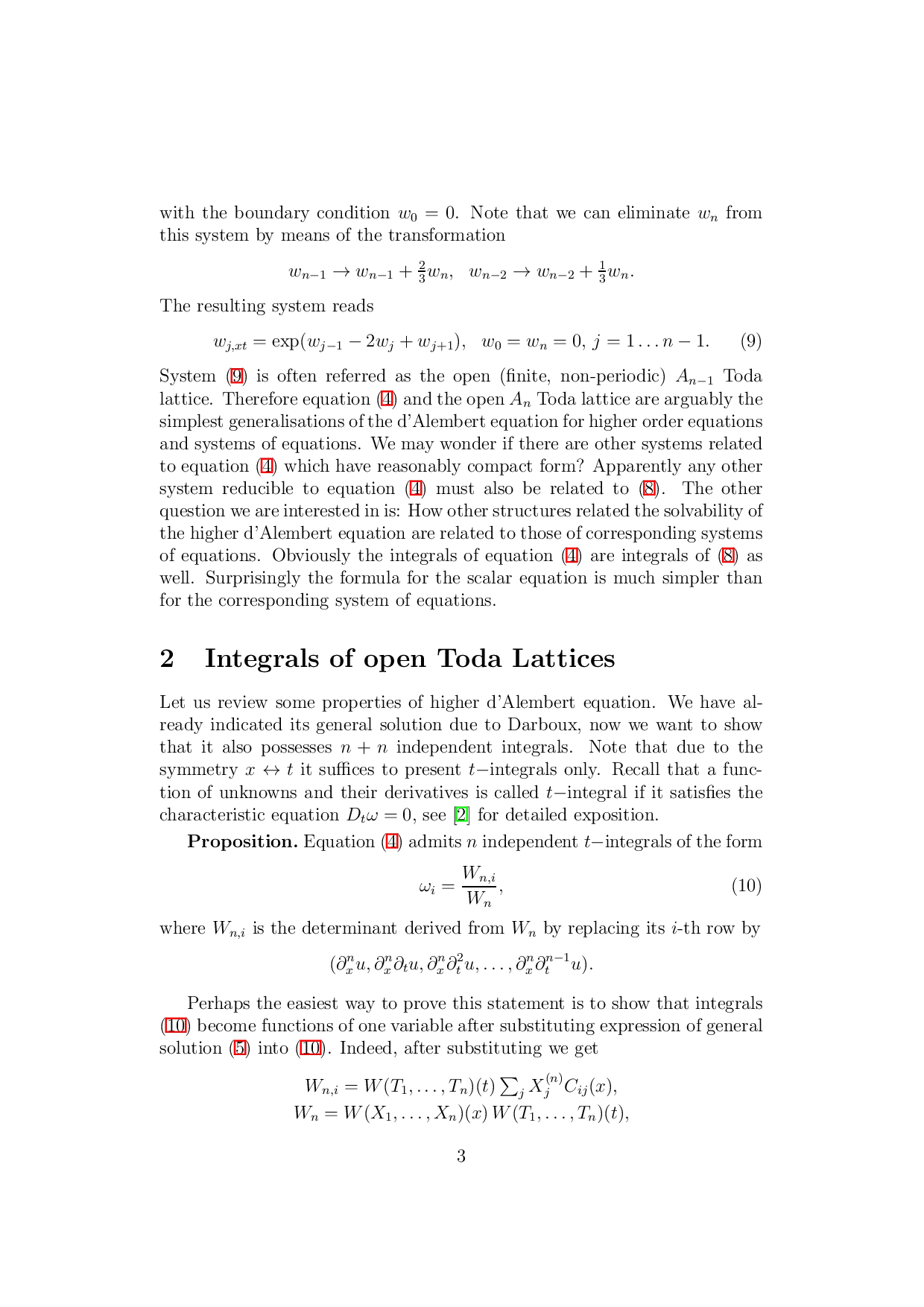
Let us review some properties of higher d’Alembert equation. We have already indicated its general solution due to Darboux, now we want to show that it also possesses n + n independent integrals. Note that due to the symmetry x ↔ t it suffices to present t-integrals only. Recall that a function of unknowns and their derivatives is called t-integral if it satisfies the characteristic equation D t ω = 0, see [2] for detailed exposition. Proposition. Equation (4) admits n independent t-integrals of the form
where W n,i is the determinant derived from W n by replacing its i-th row by
Perhaps the easiest way to prove this statement is to show that integrals (10) become functions of one variable after substituting expression of general solution (5) into (10). Indeed, after substituting we get
where C ij (x) is the cofactor of the entry (W (X 1 , . . . , X n )(x)) ij . Therefore the integrals of (4) are parametrized by functions X i (x) the following way
.
Independence of these integrals follows from formula (10) itself.
Remark. Formula (10) provides us with the explicit expression for integrals not only of ( 4), but of (8) as well. Note that u = W 1 = exp(w 1 ), and hence ω i can be expressed in terms of the single quantity w 1 = log(u).
Instead of ( 4) and ( 8) we could have started with system (9). One can show that the latter is equivalent to the scalar equation [1] W n (u) = (-1) n(n-1)/2 .
In this case the formulas for integrals should be modified:
where W * n,i is the determinant derived from W n by replacing its i-th row by
Formulas (10) and (11) can be used for finding integrals of various lattices derived from equation ( 4). This includes the 2D Toda lattice corresponding to Cartan matrix of the Lie Algebra A n and its reductions, other version of the 2D Toda lattice given by (18), and also the Shabat-Yamilov lattice (see below). These form
…(Full text truncated)…
This content is AI-processed based on ArXiv data.