Gerbes on orbifolds and exotic smooth R^4
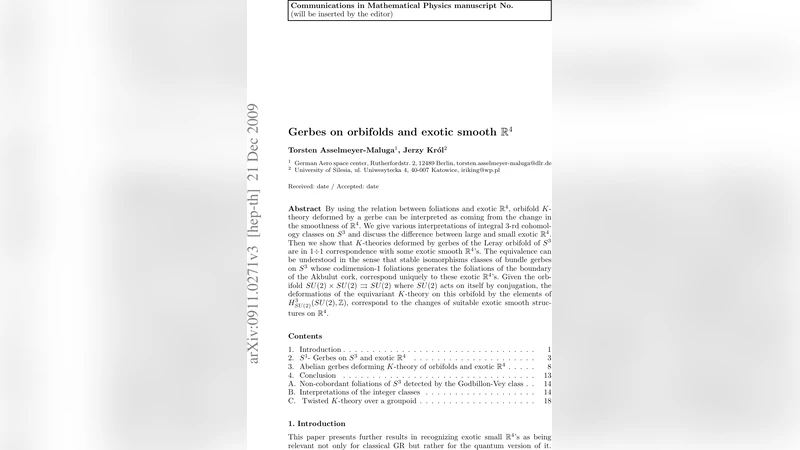
By using the relation between foliations and exotic R^4, orbifold $K$-theory deformed by a gerbe can be interpreted as coming from the change in the smoothness of R^4. We give various interpretations of integral 3-rd cohomology classes on S^3 and discuss the difference between large and small exotic R^4. Then we show that $K$-theories deformed by gerbes of the Leray orbifold of S^3 are in one-to-one correspondence with some exotic smooth R^4’s. The equivalence can be understood in the sense that stable isomorphisms classes of bundle gerbes on S^{3} whose codimension-1 foliations generates the foliations of the boundary of the Akbulut cork, correspond uniquely to these exotic R^{4}’s. Given the orbifold $SU(2)\times SU(2)\rightrightarrows SU(2)$ where SU(2) acts on itself by conjugation, the deformations of the equivariant $K$-theory on this orbifold by the elements of $H_{SU(2)}^{3}(SU(2),\mathbb{Z})$, correspond to the changes of suitable exotic smooth structures on R^4.
💡 Research Summary
The paper establishes a deep correspondence between twisted orbifold K‑theory and exotic smooth structures on ℝ⁴. Starting from the well‑known Akbulut cork, whose boundary is the three‑sphere S³, the authors recall that codimension‑one foliations of S³ are classified by integral third cohomology classes H³(S³,ℤ) ≅ ℤ via Thurston’s theory. Each such class can be realized as a bundle gerbe, a higher‑dimensional analogue of a line bundle, whose curvature is a closed 3‑form representing the class. When a gerbe is used to twist the K‑theory of an orbifold, the resulting “twisted K‑group” encodes additional topological data.
The central claim is that for the Leray orbifold associated with S³, the set of gerbe‑twisted K‑theories is in bijection with a family of exotic ℝ⁴’s. More precisely, stable isomorphism classes of bundle gerbes on S³ whose associated foliations generate the foliation on the cork’s boundary correspond uniquely to distinct exotic smooth structures. The authors distinguish between “large” exotic ℝ⁴’s, which admit infinitely many non‑diffeomorphic smoothings, and “small” exotic ℝ⁴’s, which are tied to a specific Casson handle construction and admit only a limited set of smooth variations.
To make the correspondence concrete, the paper studies the orbifold SU(2)×SU(2) ⇉ SU(2) where SU(2) acts on itself by conjugation. The equivariant cohomology group H³_{SU(2)}(SU(2),ℤ) classifies SU(2)‑equivariant gerbes on this orbifold. Each element of this group defines a twist of the equivariant K‑theory, and the authors show that varying the twist precisely reproduces the change of smooth structure in a corresponding exotic ℝ⁴. The proof relies on a combination of stack‑theoretic techniques, the geometry of foliations, and the theory of bundle gerbes, together with known results about the topology of the Akbulut cork and its embedding in ℝ⁴.
Beyond the pure mathematical interest, the authors point out parallels with physics: the gerbe twist resembles the B‑field background in string theory, and the resulting twisted K‑theory matches the classification of D‑brane charges in such backgrounds. Consequently, the work suggests that exotic smoothness in four dimensions may have a physical manifestation through background fluxes that twist K‑theory. In summary, the paper provides a rigorous framework linking gerbe‑twisted orbifold K‑theory to exotic ℝ⁴, clarifying the role of third cohomology classes, distinguishing large and small exotic smoothings, and offering a bridge between four‑dimensional topology and modern theoretical physics.
Comments & Academic Discussion
Loading comments...
Leave a Comment