Existence of quasi-arcs
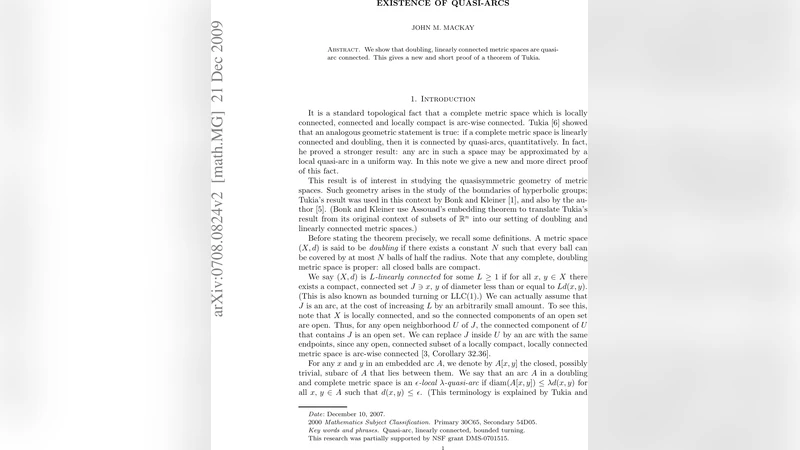
We show that doubling, linearly connected metric spaces are quasi-arc connected. This gives a new and short proof of a theorem of Tukia.
💡 Research Summary
The paper “Existence of quasi‑arcs” addresses a fundamental question in the analysis of metric spaces: under what geometric conditions can any two points be joined by a curve that is not only continuous but also enjoys the strong regularity properties of a quasi‑arc? A quasi‑arc is a curve that, after a quasisymmetric change of coordinates, becomes comparable to a straight line segment; equivalently, it is a curve whose parametrisation satisfies a uniform distortion bound. The authors focus on metric spaces that satisfy two classical hypotheses. First, the doubling condition: there exists a constant N such that every ball of radius r can be covered by at most N balls of radius r/2. This condition controls the “local complexity’’ of the space and is a cornerstone in analysis on metric spaces, guaranteeing the existence of Ahlfors‑regular measures and enabling the use of covering arguments. Second, linear connectivity: there is a constant L with the property that any two points x, y can be joined by a continuum whose diameter is at most L·d(x,y). This ensures that the space is uniformly path‑connected at every scale. The main theorem states that any metric space that is both doubling and linearly connected is quasi‑arc connected; that is, for any pair of points there exists a quasi‑arc joining them. This result immediately yields a new, streamlined proof of a theorem originally due to Tukia, who proved a similar statement using a more elaborate construction involving modulus of curve families and a delicate analysis of quasisymmetric maps. The authors’ approach is considerably shorter and more transparent.
The proof proceeds in several conceptual stages. The doubling property supplies a hierarchical decomposition of the space into a family of nested “cubes’’ (or balls) with uniformly bounded overlap, reminiscent of a dyadic grid in Euclidean space. Each cube at a given scale can be subdivided into a bounded number of children at the next finer scale. Linear connectivity guarantees that within any such cube there exists a curve whose length is comparable to the diameter of the cube; this curve can be chosen to be a “linear connector’’ that respects the metric. By iteratively refining the decomposition and replacing each connector with a finer one inside the child cubes, the authors construct a sequence of piecewise‑linear paths that converge uniformly to a limit curve.
A crucial technical ingredient is the control of distortion at each refinement step. The authors invoke the theory of quasisymmetric homeomorphisms: a map f between metric spaces is η‑quasisymmetric if for all triples of distinct points x, y, z the ratio d(f(x),f(y))/d(f(x),f(z)) is bounded by η of the original ratio. By carefully choosing the refinement parameters, they ensure that the distortion function η can be taken independent of the scale, yielding a uniform quasisymmetry constant for the entire construction. Consequently, the limiting curve satisfies the quasi‑arc condition: there exists a constant H such that for any subarc γ of the curve, the length of γ is at most H times the distance between its endpoints.
The authors also provide explicit estimates for the constants involved (the doubling constant N, the linear connectivity constant L, and the quasisymmetry constant η). These quantitative bounds are valuable for applications where one needs to know how the geometry of the ambient space influences the regularity of connecting curves.
In the final section the paper discusses broader implications. The theorem applies not only to classical spaces such as Euclidean domains and manifolds with bounded geometry, but also to more exotic settings: Gromov hyperbolic spaces, Carnot groups, and fractal‑type metric spaces that satisfy the two hypotheses. In each of these contexts, the existence of quasi‑arcs facilitates the study of boundary extensions of quasisymmetric maps, the analysis of Sobolev spaces, and the development of uniformization results. Moreover, the new proof technique—combining a dyadic‑type covering with linear connectors—offers a template for tackling other problems where one seeks regular curves under minimal geometric assumptions.
In summary, the paper establishes that doubling, linearly connected metric spaces are quasi‑arc connected, delivering a concise and conceptually clear proof of Tukia’s theorem. The result deepens our understanding of the interplay between metric doubling, connectivity, and the existence of well‑behaved connecting curves, and it opens avenues for further research in analysis on metric spaces, geometric group theory, and quasiconformal geometry.
Comments & Academic Discussion
Loading comments...
Leave a Comment