Since its launch in June 2008, the Large Area Telescope (LAT), onboard the \emph{Fermi} Gamma-ray Space Telescope, has greatly added to our understanding of gamma-ray pulsars. Its fine point spread function and large effective area, combined with the time-differencing method, make it the first gamma-ray instrument capable of discovering a new population of gamma-ray pulsars. We will present the recent discovery of the youngest (~4600 yr) radio-quiet gamma-ray pulsar discovered in a blind frequency search so far: PSR J1022-5746, a pulsar associated with an extended TeV source. We also present multiwavelength observations of the source, including X-ray observations.
Deep Dive into Discovery of a Young Gamma-ray Pulsar Associated with an Extended TeV Gamma-ray Source.
Since its launch in June 2008, the Large Area Telescope (LAT), onboard the \emph{Fermi} Gamma-ray Space Telescope, has greatly added to our understanding of gamma-ray pulsars. Its fine point spread function and large effective area, combined with the time-differencing method, make it the first gamma-ray instrument capable of discovering a new population of gamma-ray pulsars. We will present the recent discovery of the youngest (~4600 yr) radio-quiet gamma-ray pulsar discovered in a blind frequency search so far: PSR J1022-5746, a pulsar associated with an extended TeV source. We also present multiwavelength observations of the source, including X-ray observations.
There is an interesting cluster of bright gamma-ray sources located within the Galactic plane, roughly at l ∼ 285 • , extending about ±5 • . This region houses six Fermi sources, most of them gamma-ray pulsars. These sources include radio-loud pulsars PSR J1048-5832 and PSR J1028-5819 and radio-quiet PSR J1044-5737, recently discovered in a blind frequency search [1]. The new pulsar, PSR J1022-5746, is located within this region.
This source was found early on in the mission as a bright gamma-ray source, published in the Fermi Bright Source List (0FGL J1024.0-5754) [2]. However, it was not detected in a blind frequency search for several reasons. The 0FGL position is ∼ 17 ′ away from the timed pulsar location, which is insufficient for blind pulsation searches. In addition, this pulsar has a non-neglible f correction. These two factors made detection at an early date very challenging.
We will discuss how J1022-5746 was discovered in a blind search, list its timing properties, and discuss multiwavelength observations, especially in the TeV regeme.
Gamma-ray photon data from pulsars is very sparse, requiring long integration times for sufficient statistics. The length of the integration time, or viewing period, increases the resolution of the FFT used to detect the periodic signal since the number of FFT bins N is N = 2T f max . Moreover, the long viewing period requires us to scan tens of thousands of ḟ trials to correct for the spin-down of the pulsar. In addition, young pulsars typically have timing noise, or can suddenly and abruptly change their rotational frequencies (known as glitches), making an FFT of the full time series computationally intensive.
Instead, we look for periodicity using the timedifferencing method [3]. Since periodicity in photon arrival times will also be present in the differences between arrival times, we calculate all differences between arrival times up to a maximum differencing window of about 6 days (T = 2 19 s). The loss in sensitivity is made up for by the reduced number of ḟ trials, and the computational time is dramatically reduced. We cover zero spin-down to the spin-down of the Crab pulsar ( ḟ f = -1.125 × 10 -11 s -1 ). This method is very efficient at finding pulsars and has resulted in the discovery of 16 pulsars in the first few months of the mission [4], including PSR J1022-5746.
PSR J1022-5746 has the largest ḟ and f of all the pulsars found in the blind search, making it difficult to find in a long span of data without correcting for f .
We used a circular region of interest (ROI) of radius R ≤ 0.8 • , minimum energy of 300 MeV, and diffuse class photons [5].
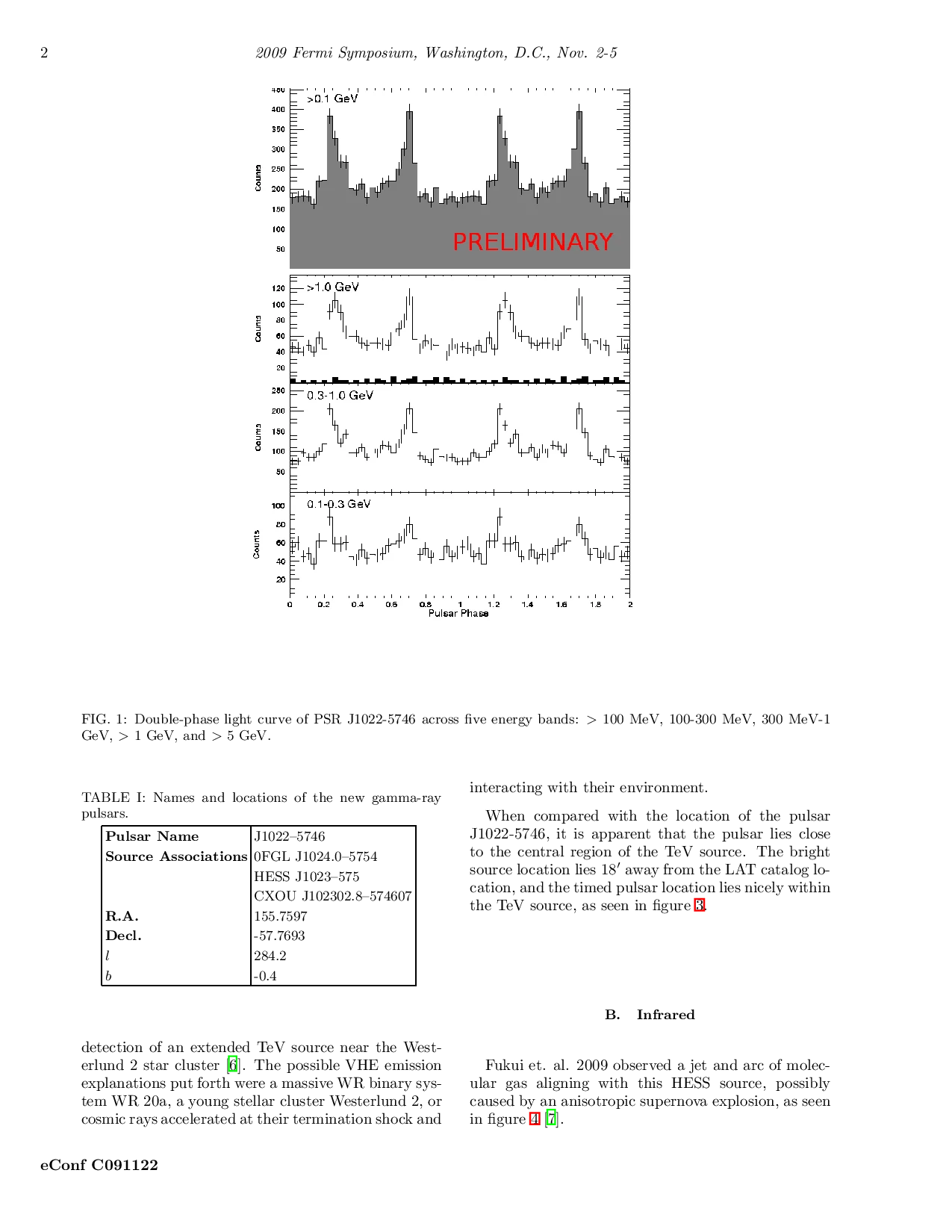
The double-phase light curve of the pulsar is found in figure 1. We can see the double peak structure across the multiple energy bands (> 100 MeV, 100-300 MeV, 300 MeV-1 GeV, > 1 GeV, > 5 GeV). Also, we have shifted the first peak to φ = 0.25 for clarity. The peak separation is 0.45 ± 0.01 and the off-pulse region is 0.75 -1.18.
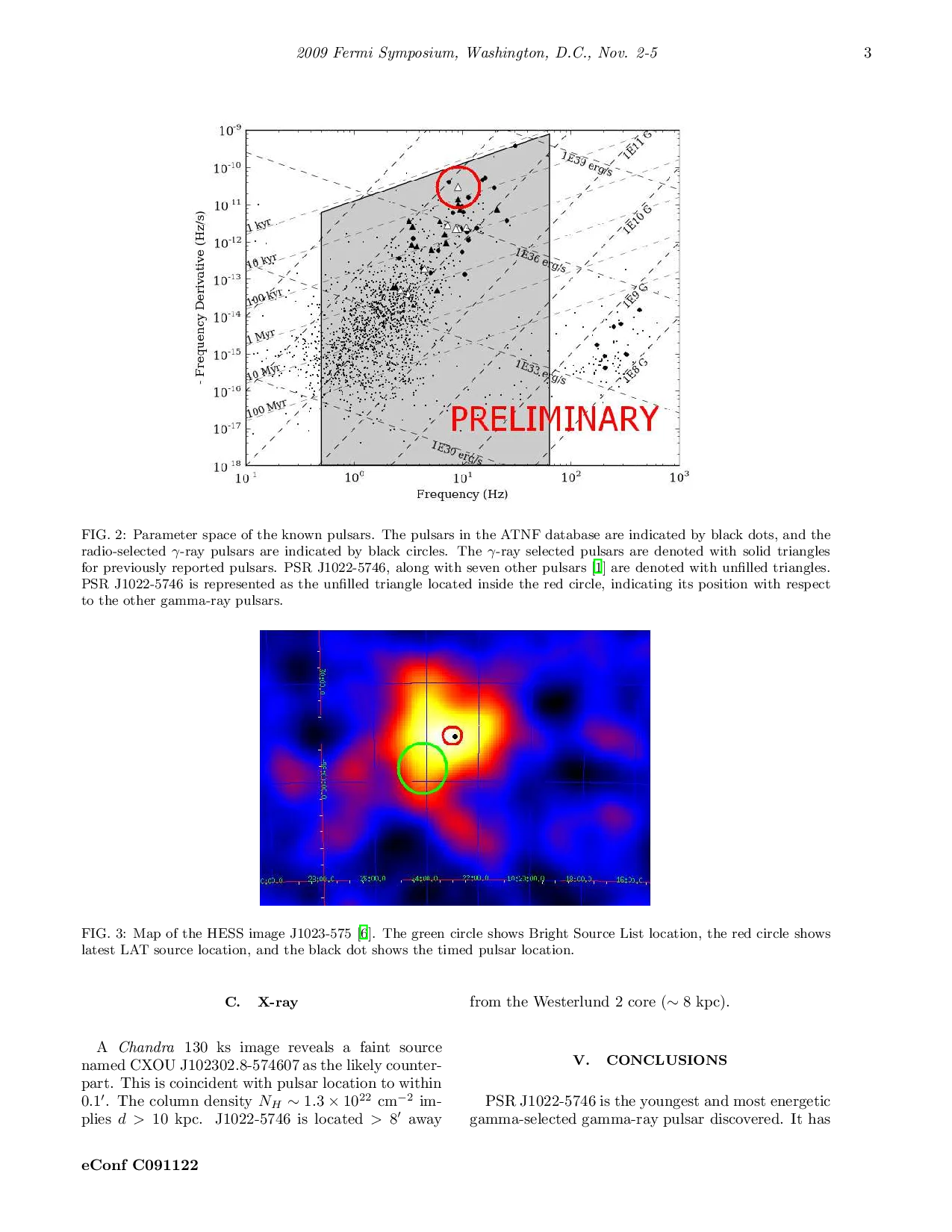
We can compare this pulsar to the known pulsar population in figure 2. This pulsar is one of the youngest gamma-ray pulsars, and the youngest pulsar discovered in a blind search. Also, it is the most highly energetic blind search pulsar. The rotational ephemerides can be found in table II. detection of an extended TeV source near the Westerlund 2 star cluster [6]. The possible VHE emission explanations put forth were a massive WR binary system WR 20a, a young stellar cluster Westerlund 2, or cosmic rays accelerated at their termination shock and interacting with their environment.
When compared with the location of the pulsar J1022-5746, it is apparent that the pulsar lies close to the central region of the TeV source. The bright source location lies 18 ′ away from the LAT catalog location, and the timed pulsar location lies nicely within the TeV source, as seen in figure 3.
Fukui et. al. 2009 observed a jet and arc of molecular gas aligning with this HESS source, possibly caused by an anisotropic supernova explosion, as seen in figure 4 [7].
A Chandra 130 ks image reveals a faint source named CXOU J102302.8-574607 as the likely counterpart. This is coincident with pulsar location to within 0.1 ′ . The column density N H ∼ 1.3 × 10 22 cm -2 implies d > 10 kpc. J1022-5746 is located > 8 ′ away from the Westerlund 2 core (∼ 8 kpc).
PSR J1022-5746 is the youngest and most energetic gamma-selected gamma-ray pulsar discovered. It has eConf C091122
FIG. 4: Distribution of 12 CO emission for the arc and jet [7]. The pulsar source lies near the center of HESS source (orange cross), and the Westerlund 2 cluster is located at the pink cross. TABLE II: Rotational ephemerides for the new pulsars. For all timing solutions, the reference epoch is MJD 54800. Row 1 gives the pulsar name. Row 2 lists the number of photons from the standard cut over the 11 month observational period. Row 3 gives the flux above 100 MeV in units of 10 -8 cm -2 s -1 using P6v3 IRFs. Rows 4 and 5 list the fre
…(Full text truncated)…
This content is AI-processed based on ArXiv data.