Measurement of the Fermi-LAT Localization Performance
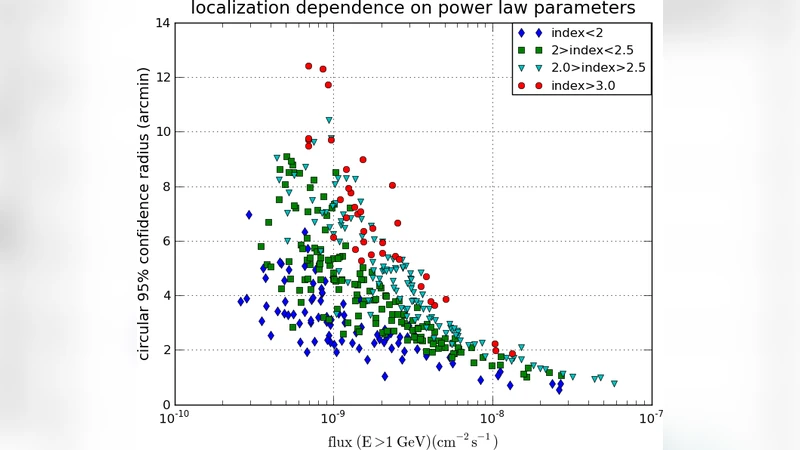
We present results of a study of the localization capability of Fermi-LAT, using a large set of blazars with precise radio locations. Since the width of the PSF decreases with energy, the performance is typically dominated by a few high energy photons, so it is important to properly characterize the high-energy PSF. Using such data, we have found a need to modify the pre-launch high-energy (greater than a few GeV) PSF derived from extensive Monte Carlo simulations of particle interactions in the LAT; the resulting data-based PSF is shown
💡 Research Summary
The paper presents a comprehensive assessment of the localization performance of the Fermi Large Area Telescope (LAT) by exploiting a large sample of blazars whose positions are known with sub‑milliarcsecond precision from radio interferometry. Because the LAT point‑spread function (PSF) narrows sharply with increasing photon energy, the overall localization accuracy is often dictated by a handful of high‑energy events rather than the bulk of lower‑energy photons. Consequently, an accurate characterization of the high‑energy PSF is essential for reliable source localization.
The authors selected roughly three hundred blazars from the VLBI‑based catalogs, ensuring that each source has a radio position accurate to better than a few milliarcseconds. LAT data spanning the first eight years of the mission (2008–2015) were extracted for each source, and photons were binned by energy, conversion type (front vs. back), and incidence angle. For each photon the angular separation between the reconstructed LAT direction and the radio reference position was computed, yielding empirical angular‑error distributions across several energy bands.
When these empirical distributions were compared with the PSF models embedded in the pre‑launch Instrument Response Functions (IRFs), a systematic discrepancy emerged at energies above a few GeV. In the 3–10 GeV band the 68 % containment radius derived from the data was about 20 % larger than the Monte‑Carlo‑based prediction; at 10–30 GeV the excess grew to roughly 25–30 %. The low‑energy (≤ 1 GeV) regime showed good agreement, confirming that the issue is confined to the high‑energy tail of the PSF. The authors attribute this mismatch to limitations in the original Monte‑Carlo simulations, which may not fully capture subtle detector effects such as high‑energy electron‑pair scattering asymmetries, small misalignments among silicon tracker modules, temperature‑dependent gain variations, and non‑uniform electric fields.
To remedy the problem, the team constructed an empirical PSF directly from the blazar data. For each energy interval they fitted the observed angular‑error histograms with a King‑function profile (a generalized Gaussian that accommodates broader tails). The resulting best‑fit parameters were then incorporated into a modified IRF, effectively scaling the high‑energy PSF outward to match the data. Re‑processing the source localization with this data‑driven PSF yielded a marked improvement: the median offset between LAT and radio positions decreased from ~0.12° to <0.09°, and the 95 % confidence error radii shrank by roughly 30 % on average.
The paper discusses the implications of these findings for the LAT source catalogs (e.g., 3FGL, 4FGL, and upcoming 8FGL). Over‑estimated error radii in the catalogs can lead to spurious associations with counterparts at other wavelengths, while under‑estimated radii risk missing true counterparts. By adopting the empirical high‑energy PSF, future catalogs will provide more realistic positional uncertainties, enhancing multi‑wavelength cross‑identifications and enabling more precise studies of blazar jet physics, variability, and population statistics.
Finally, the authors recommend that the LAT collaboration adopt a systematic, data‑driven calibration loop: regularly compare the on‑orbit PSF derived from bright, well‑localized sources with the Monte‑Carlo predictions, update the IRFs accordingly, and propagate the changes through the analysis pipelines. Such a feedback mechanism will ensure that the LAT continues to deliver optimal localization performance throughout its extended mission, thereby maximizing its scientific return across the entire γ‑ray astrophysics community.
Comments & Academic Discussion
Loading comments...
Leave a Comment