Fusion subcategories of representation categories of twisted quantum doubles of finite groups
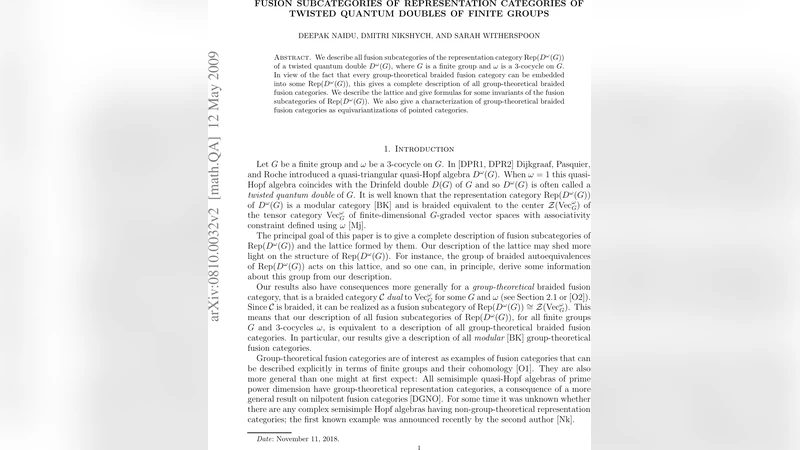
We describe all fusion subcategories of the representation category of a twisted quantum double of a finite group. In view of the fact that every group-theoretical braided fusion category can be embedded into a representation category of a twisted quantum double of a finite group, this gives a complete description of all group-theoretical braided fusion categories. We describe the lattice and give formulas for some invariants of the fusion subcategories of representation category of a twisted quantum double of a finite group. We also give a characterization of group-theoretical braided fusion categories as equivariantizations of pointed categories.
💡 Research Summary
The paper gives a complete classification of fusion subcategories of the representation category of a twisted quantum double (D^{\omega}(G)) of a finite group (G). A twisted quantum double is a quasi‑Hopf algebra obtained from a 3‑cocycle (\omega\in Z^{3}(G,\mathbb{C}^{\times})); its representation category (\operatorname{Rep}(D^{\omega}(G))) is a non‑degenerate braided fusion category. Objects in this category are pairs ((g,\rho)) where (g\in G) and (\rho) is an irreducible projective representation of the centralizer (C_{G}(g)) twisted by the restriction of (\omega).
The central result (Theorem 3.5) shows that any fusion subcategory (\mathcal C\subseteq\operatorname{Rep}(D^{\omega}(G))) is uniquely determined by a pair ((H,\psi)) consisting of a normal subgroup (H\le G) and a (G)-invariant cohomology class (\psi\in H^{2}(H,\mathbb{C}^{\times})). The subgroup must satisfy the condition that the restriction of (\omega) to (H) is a coboundary, i.e. (\omega|{H}= \delta\phi) for some 2‑cochain (\phi); the class (\psi) is the image of (\phi) in (H^{2}(H,\mathbb{C}^{\times})). Conversely, given such a pair one constructs a fusion subcategory (\mathcal C(H,\psi)) whose simple objects are precisely those ((g,\rho)) with (g\in H) and (\rho) an irreducible (\psi)-projective representation of (C{G}(g)).
The paper then analyses the lattice formed by these subcategories. The meet (intersection) of (\mathcal C(H_{1},\psi_{1})) and (\mathcal C(H_{2},\psi_{2})) is (\mathcal C(H_{1}\cap H_{2},\psi_{1}|{H{1}\cap H_{2}})); the join (generated subcategory) is (\mathcal C(\langle H_{1},H_{2}\rangle,\tilde\psi)), where (\tilde\psi) is a coherent extension of the two 2‑cocycles. Hence the lattice of fusion subcategories is isomorphic to the lattice of normal subgroups of (G) equipped with additional cohomological labels.
A major conceptual contribution is the reinterpretation of group‑theoretical braided fusion categories. It is known that any such category embeds into some (\operatorname{Rep}(D^{\omega}(G))). The authors prove the converse: every fusion subcategory (\mathcal C(H,\psi)) is equivalent to the equivariantization of a pointed fusion category (\operatorname{Vec}_{H}^{\psi}) by the action of the quotient group (G/H). In symbols, \
Comments & Academic Discussion
Loading comments...
Leave a Comment