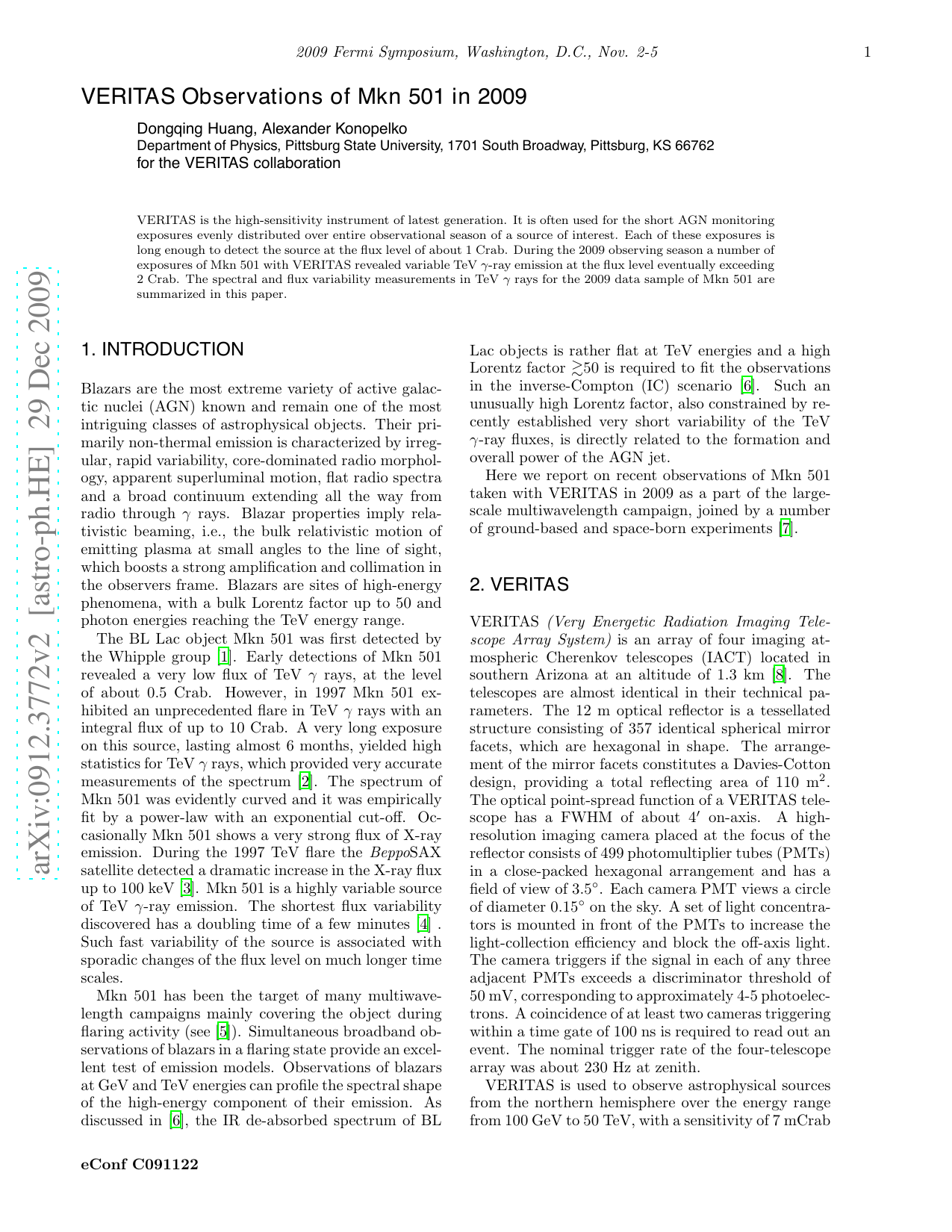
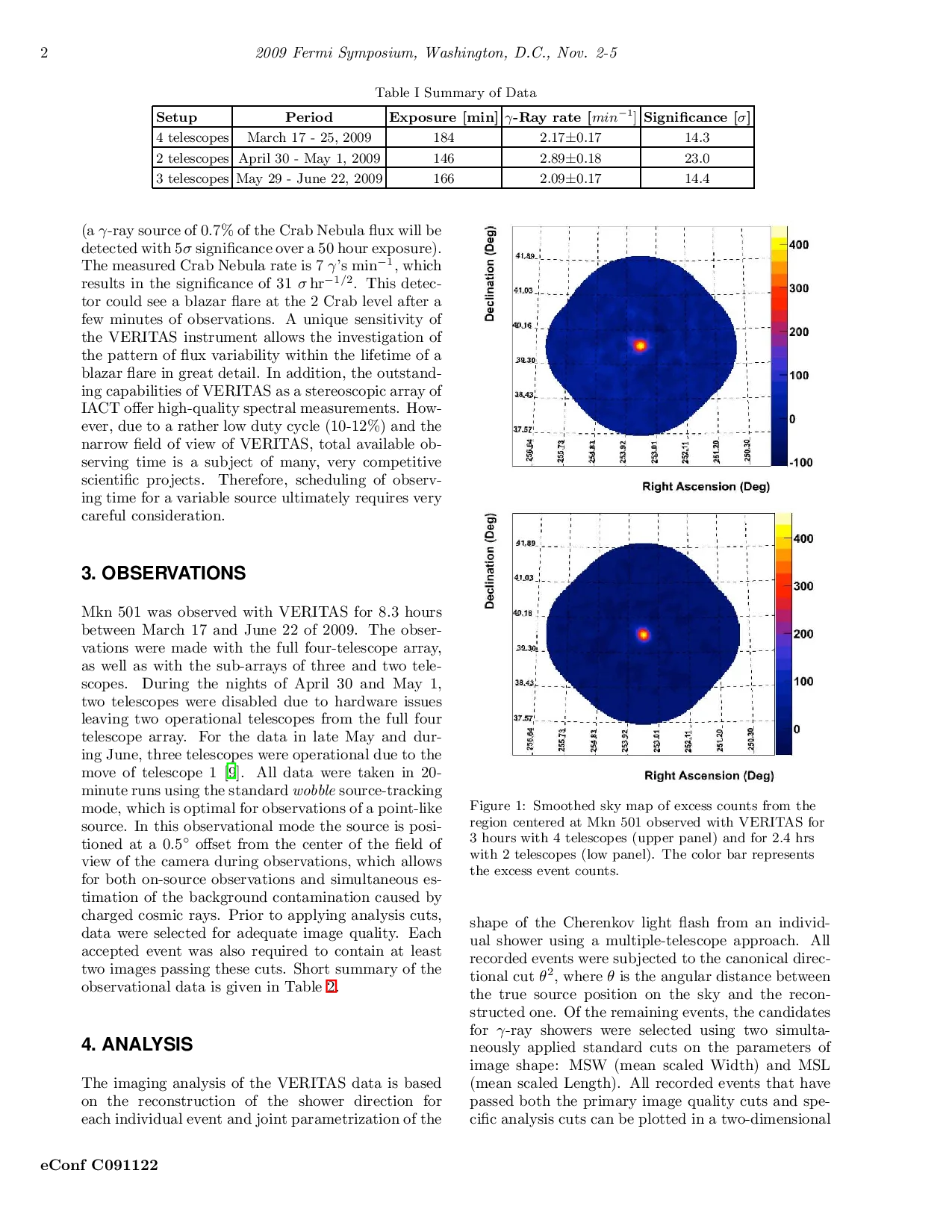
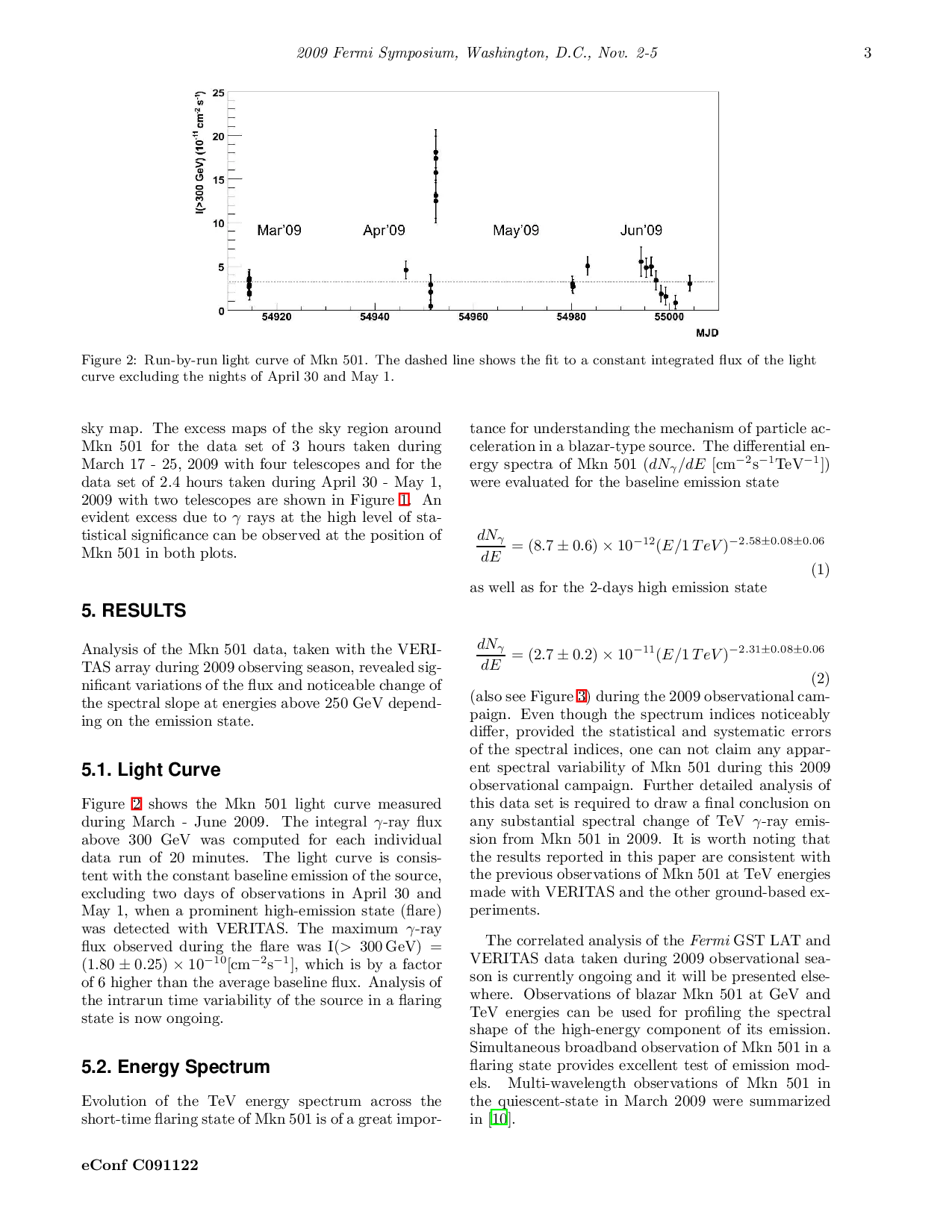
VERITAS is the high-sensitivity instrument of latest generation. It is often used for the short AGN monitoring exposures evenly distributed over entire observational season of a source of interest. Each of these exposures is long enough to detect the source at the flux level of about 1 Crab. During the 2009 observing season a number of exposures of Mkn 501 with VERITAS revealed variable TeV gamma-ray emission at the flux level eventually exceeding 2 Crab. The spectral and flux variability measurements in TeV gamma rays for the 2009 data sample of Mkn 501 are summarized in this paper.
Deep Dive into VERITAS Observations of Mkn 501 in 2009.
VERITAS is the high-sensitivity instrument of latest generation. It is often used for the short AGN monitoring exposures evenly distributed over entire observational season of a source of interest. Each of these exposures is long enough to detect the source at the flux level of about 1 Crab. During the 2009 observing season a number of exposures of Mkn 501 with VERITAS revealed variable TeV gamma-ray emission at the flux level eventually exceeding 2 Crab. The spectral and flux variability measurements in TeV gamma rays for the 2009 data sample of Mkn 501 are summarized in this paper.
Blazars are the most extreme variety of active galactic nuclei (AGN) known and remain one of the most intriguing classes of astrophysical objects. Their primarily non-thermal emission is characterized by irregular, rapid variability, core-dominated radio morphology, apparent superluminal motion, flat radio spectra and a broad continuum extending all the way from radio through γ rays. Blazar properties imply relativistic beaming, i.e., the bulk relativistic motion of emitting plasma at small angles to the line of sight, which boosts a strong amplification and collimation in the observers frame. Blazars are sites of high-energy phenomena, with a bulk Lorentz factor up to 50 and photon energies reaching the TeV energy range.
The BL Lac object Mkn 501 was first detected by the Whipple group [1]. Early detections of Mkn 501 revealed a very low flux of TeV γ rays, at the level of about 0.5 Crab. However, in 1997 Mkn 501 exhibited an unprecedented flare in TeV γ rays with an integral flux of up to 10 Crab. A very long exposure on this source, lasting almost 6 months, yielded high statistics for TeV γ rays, which provided very accurate measurements of the spectrum [2]. The spectrum of Mkn 501 was evidently curved and it was empirically fit by a power-law with an exponential cut-off. Occasionally Mkn 501 shows a very strong flux of X-ray emission. During the 1997 TeV flare the BeppoSAX satellite detected a dramatic increase in the X-ray flux up to 100 keV [3]. Mkn 501 is a highly variable source of TeV γ-ray emission. The shortest flux variability discovered has a doubling time of a few minutes [4] . Such fast variability of the source is associated with sporadic changes of the flux level on much longer time scales.
Mkn 501 has been the target of many multiwavelength campaigns mainly covering the object during flaring activity (see [5]). Simultaneous broadband observations of blazars in a flaring state provide an excellent test of emission models. Observations of blazars at GeV and TeV energies can profile the spectral shape of the high-energy component of their emission. As discussed in [6], the IR de-absorbed spectrum of BL Lac objects is rather flat at TeV energies and a high Lorentz factor > ∼ 50 is required to fit the observations in the inverse-Compton (IC) scenario [6]. Such an unusually high Lorentz factor, also constrained by recently established very short variability of the TeV γ-ray fluxes, is directly related to the formation and overall power of the AGN jet.
Here we report on recent observations of Mkn 501 taken with VERITAS in 2009 as a part of the largescale multiwavelength campaign, joined by a number of ground-based and space-born experiments [7].
VERITAS (Very Energetic Radiation Imaging Telescope Array System) is an array of four imaging atmospheric Cherenkov telescopes (IACT) located in southern Arizona at an altitude of 1.3 km [8]. The telescopes are almost identical in their technical parameters. The 12 m optical reflector is a tessellated structure consisting of 357 identical spherical mirror facets, which are hexagonal in shape. The arrangement of the mirror facets constitutes a Davies-Cotton design, providing a total reflecting area of 110 m 2 . The optical point-spread function of a VERITAS telescope has a FWHM of about 4 ′ on-axis. A highresolution imaging camera placed at the focus of the reflector consists of 499 photomultiplier tubes (PMTs) in a close-packed hexagonal arrangement and has a field of view of 3.5 • . Each camera PMT views a circle of diameter 0.15 • on the sky. A set of light concentrators is mounted in front of the PMTs to increase the light-collection efficiency and block the off-axis light. The camera triggers if the signal in each of any three adjacent PMTs exceeds a discriminator threshold of 50 mV, corresponding to approximately 4-5 photoelectrons. A coincidence of at least two cameras triggering within a time gate of 100 ns is required to read out an event. The nominal trigger rate of the four-telescope array was about 230 Hz at zenith.
VERITAS is used to observe astrophysical sources from the northern hemisphere over the energy range from 100 GeV to 50 TeV, with a sensitivity of 7 mCrab eConf C091122 (a γ-ray source of 0.7% of the Crab Nebula flux will be detected with 5σ significance over a 50 hour exposure).
The measured Crab Nebula rate is 7 γ’s min -1 , which results in the significance of 31 σ hr -1/2 . This detector could see a blazar flare at the 2 Crab level after a few minutes of observations. A unique sensitivity of the VERITAS instrument allows the investigation of the pattern of flux variability within the lifetime of a blazar flare in great detail. In addition, the outstanding capabilities of VERITAS as a stereoscopic array of IACT offer high-quality spectral measurements. However, due to a rather low duty cycle (10-12%) and the narrow field of view of VERITAS, total available observing time is a subject of many, very competitive scientific proj
…(Full text truncated)…
This content is AI-processed based on ArXiv data.