In the last couple of years the Magic air Cherenkov telescope has made significant contributions to very high energy $\gamma$-ray astronomy. These include the detection of the galactic binary system LSI +61 303 and the observation of pulsed emission from the Crab pulsar. Extragalactic objects like the famous FSRQ 3C 279 and the LBL S5 0716+714 have both been detected during optical high states, and the radio galaxy M87 could be observed during an unexpected strong $\gamma$-ray outburst. Given its low energy trigger threshold (~50 GeV) and fast repositioning time of less than 30s the Magic air Cherenkov telescope is particularly well suited for the observation of fast transient objects like AGN or GRBs. So far no GRB could be detected with Magic, however. In this paper we present selected highlights from recent MAGIC observations of extragalactic objects.
Deep Dive into Results from the observation of extragalactic objects with the MAGIC telescope.
In the last couple of years the Magic air Cherenkov telescope has made significant contributions to very high energy $\gamma$-ray astronomy. These include the detection of the galactic binary system LSI +61 303 and the observation of pulsed emission from the Crab pulsar. Extragalactic objects like the famous FSRQ 3C 279 and the LBL S5 0716+714 have both been detected during optical high states, and the radio galaxy M87 could be observed during an unexpected strong $\gamma$-ray outburst. Given its low energy trigger threshold (~50 GeV) and fast repositioning time of less than 30s the Magic air Cherenkov telescope is particularly well suited for the observation of fast transient objects like AGN or GRBs. So far no GRB could be detected with Magic, however. In this paper we present selected highlights from recent MAGIC observations of extragalactic objects.
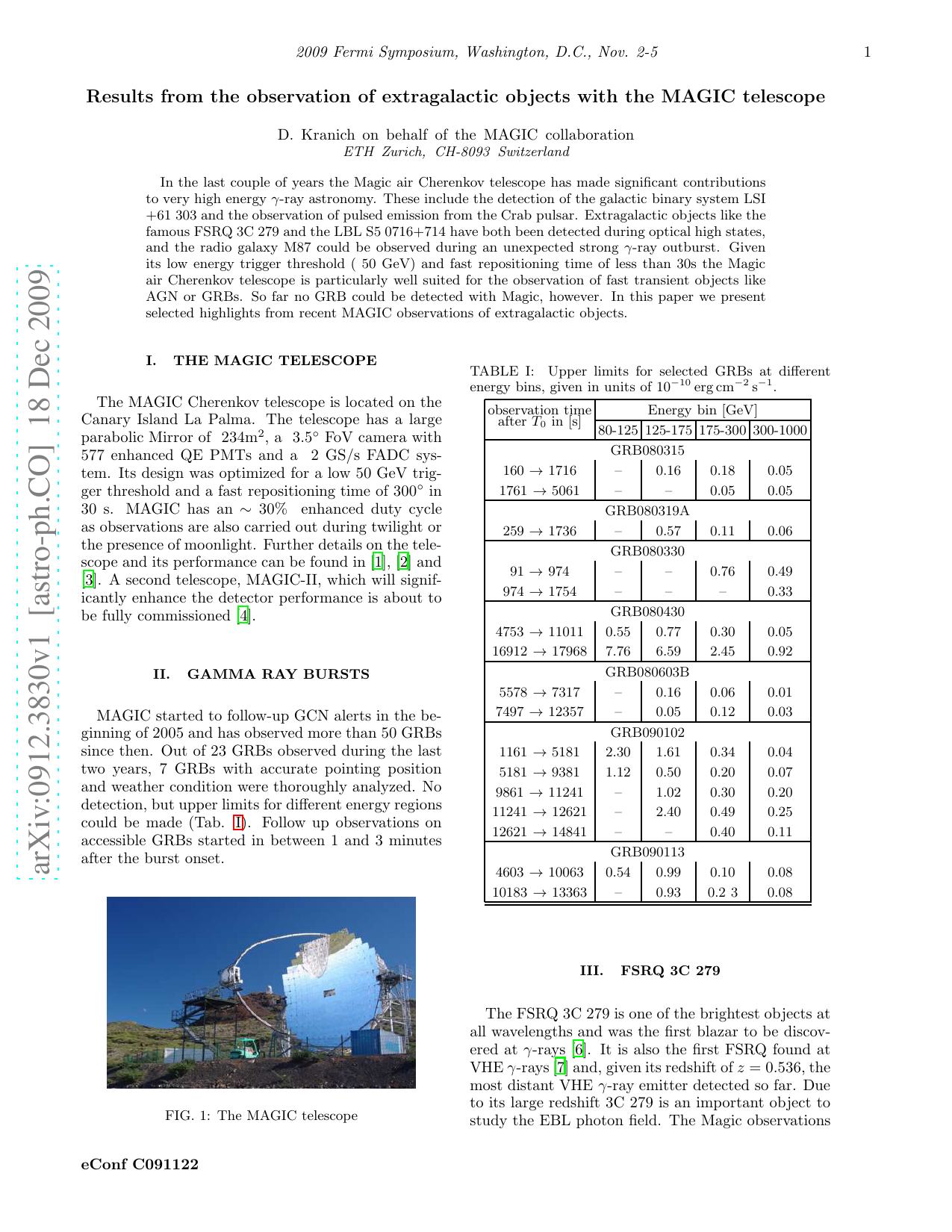
The MAGIC Cherenkov telescope is located on the Canary Island La Palma. The telescope has a large parabolic Mirror of 234m 2 , a 3.5 • FoV camera with 577 enhanced QE PMTs and a 2 GS/s FADC system. Its design was optimized for a low 50 GeV trigger threshold and a fast repositioning time of 300 • in 30 s. MAGIC has an ∼ 30% enhanced duty cycle as observations are also carried out during twilight or the presence of moonlight. Further details on the telescope and its performance can be found in [1], [2] and [3]. A second telescope, MAGIC-II, which will significantly enhance the detector performance is about to be fully commissioned [4].
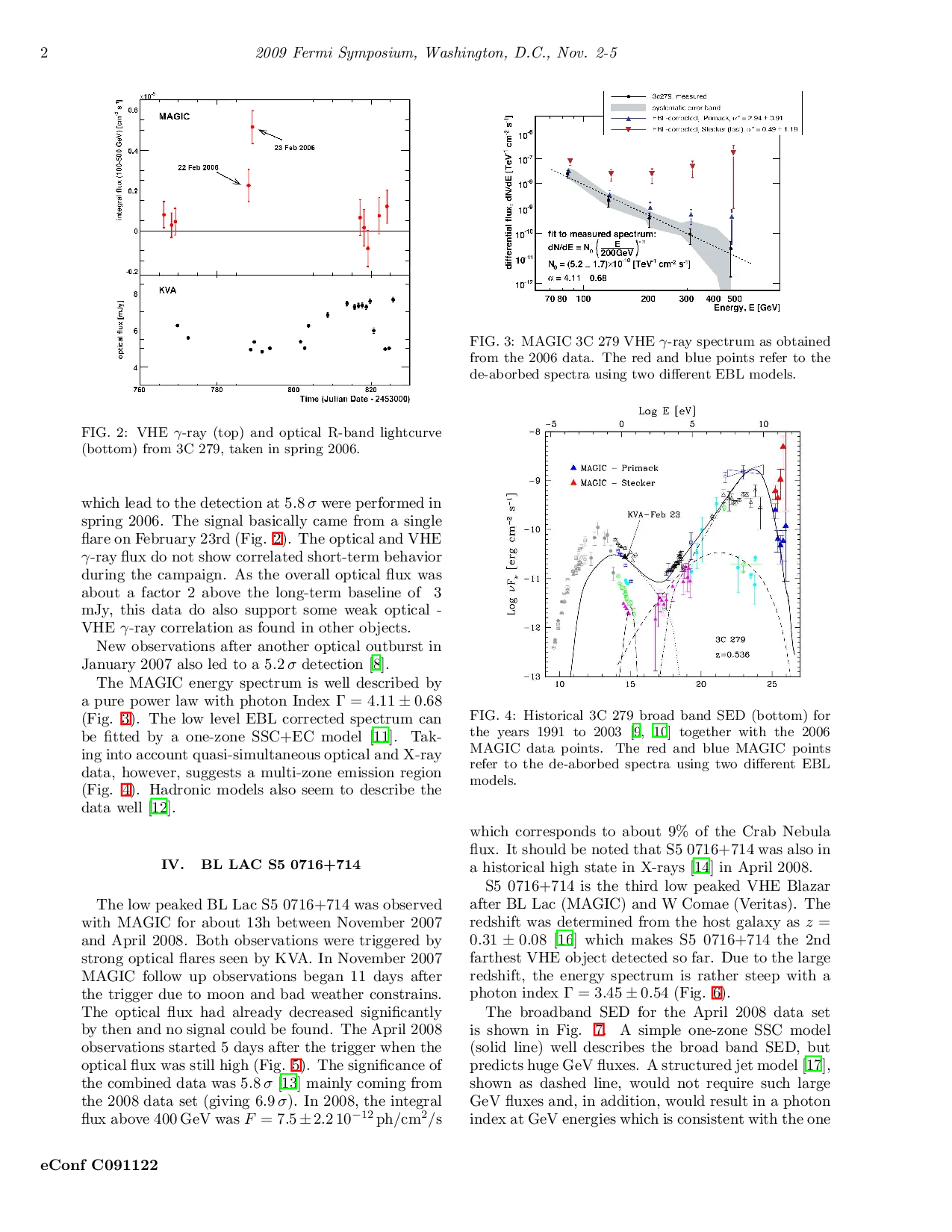
MAGIC started to follow-up GCN alerts in the beginning of 2005 and has observed more than 50 GRBs since then. Out of 23 GRBs observed during the last two years, 7 GRBs with accurate pointing position and weather condition were thoroughly analyzed. No detection, but upper limits for different energy regions could be made (Tab. I). Follow up observations on accessible GRBs started in between 1 and 3 minutes after the burst onset. The FSRQ 3C 279 is one of the brightest objects at all wavelengths and was the first blazar to be discovered at γ-rays [6]. It is also the first FSRQ found at VHE γ-rays [7] and, given its redshift of z = 0.536, the most distant VHE γ-ray emitter detected so far. Due to its large redshift 3C 279 is an important object to study the EBL photon field. The Magic observations eConf C091122 which lead to the detection at 5.8 σ were performed in spring 2006. The signal basically came from a single flare on February 23rd (Fig. 2). The optical and VHE γ-ray flux do not show correlated short-term behavior during the campaign. As the overall optical flux was about a factor 2 above the long-term baseline of 3 mJy, this data do also support some weak optical -VHE γ-ray correlation as found in other objects.
New observations after another optical outburst in January 2007 also led to a 5.2 σ detection [8].
The MAGIC energy spectrum is well described by a pure power law with photon Index Γ = 4.11 ± 0.68 (Fig. 3). The low level EBL corrected spectrum can be fitted by a one-zone SSC+EC model [11]. Taking into account quasi-simultaneous optical and X-ray data, however, suggests a multi-zone emission region (Fig. 4). Hadronic models also seem to describe the data well [12].
The low peaked BL Lac S5 0716+714 was observed with MAGIC for about 13h between November 2007 and April 2008. Both observations were triggered by strong optical flares seen by KVA. In November 2007 MAGIC follow up observations began 11 days after the trigger due to moon and bad weather constrains. The optical flux had already decreased significantly by then and no signal could be found. The April 2008 observations started 5 days after the trigger when the optical flux was still high (Fig. 5). The significance of the combined data was 5.8 σ [13] mainly coming from the 2008 data set (giving 6.9 σ). In 2008, the integral flux above 400 GeV was F = 7.5 ± 2.2 10 -12 ph/cm 2 /s which corresponds to about 9% of the Crab Nebula flux. It should be noted that S5 0716+714 was also in a historical high state in X-rays [14] in April 2008. S5 0716+714 is the third low peaked VHE Blazar after BL Lac (MAGIC) and W Comae (Veritas). The redshift was determined from the host galaxy as z = 0.31 ± 0.08 [16] which makes S5 0716+714 the 2nd farthest VHE object detected so far. Due to the large redshift, the energy spectrum is rather steep with a photon index Γ = 3.45 ± 0.54 (Fig. 6).
The broadband SED for the April 2008 data set is shown in Fig. 7 FIG. 6: S5 0716+714 energy spectrum as obtained from the 2008 data set. The de-absorbed spectrum was derived using the EBL model of [15] and assuming z = 0.26 measured by Fermi (blue bow tie in Fig. 7) during a presumably different intensity state.
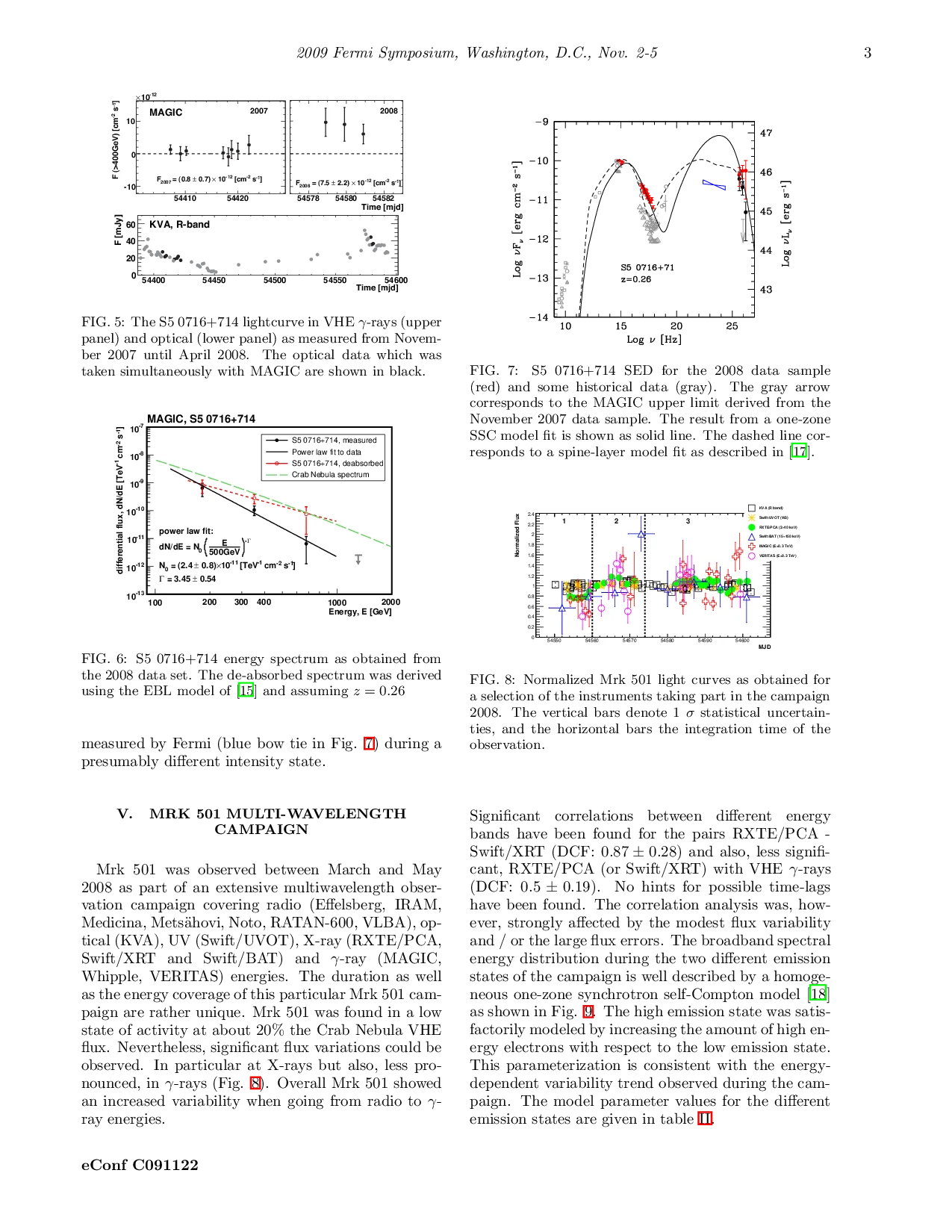
Mrk 501 was observed between March and May 2008 as part of an extensive multiwavelength observation campaign covering radio (Effelsberg, IRAM, Medicina, Metsähovi, Noto, RATAN-600, VLBA), optical (KVA), UV (Swift/UVOT), X-ray (RXTE/PCA, Swift/XRT and Swift/BAT) and γ-ray (MAGIC, Whipple, VERITAS) energies. The duration as well as the energy coverage of this particular Mrk 501 campaign are rather unique. Mrk 501 was found in a low state of activity at about 20% the Crab Nebula VHE flux. Nevertheless, significant flux variations could be observed. In particular at X-rays but also, less pronounced, in γ-rays (Fig. 8). Overall Mrk 501 showed an increased variability when going from radio to γray energies. Significant correlations between different energy bands have been found for the pairs RXTE/PCA -Swift/XRT (DCF: 0.87 ± 0.28) and also, less significant, RXTE/PCA (or Swift/XRT) with VHE γ-rays (DCF: 0.5 ± 0.19). No hints for possible time-lags have been found. The correlation analysis was, however, strongly affected by the modest flux variability and / or the large flux errors. The broadband spectral energy distribution during the two
…(Full text truncated)…
This content is AI-processed based on ArXiv data.