Amplified Hardness of Approximation for VCG-Based Mechanisms
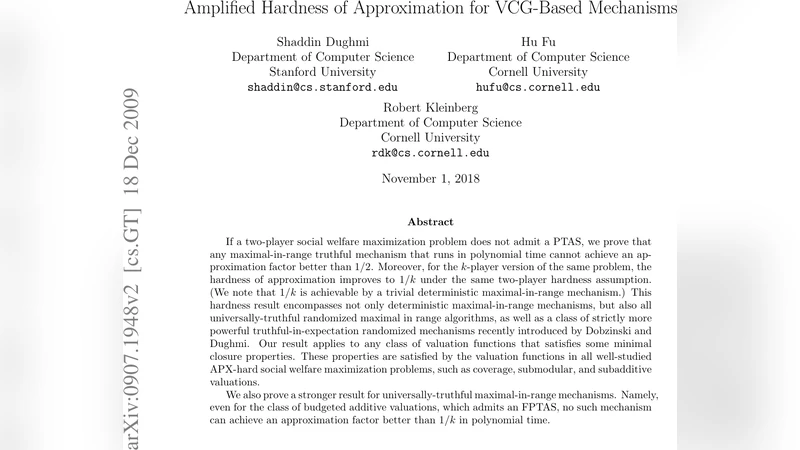
If a two-player social welfare maximization problem does not admit a PTAS, we prove that any maximal-in-range truthful mechanism that runs in polynomial time cannot achieve an approximation factor better than 1/2. Moreover, for the k-player version of the same problem, the hardness of approximation improves to 1/k under the same two-player hardness assumption. (We note that 1/k is achievable by a trivial deterministic maximal-in-range mechanism.) This hardness result encompasses not only deterministic maximal-in-range mechanisms, but also all universally-truthful randomized maximal in range algorithms, as well as a class of strictly more powerful truthful-in-expectation randomized mechanisms recently introduced by Dobzinski and Dughmi. Our result applies to any class of valuation functions that satisfies some minimal closure properties. These properties are satisfied by the valuation functions in all well-studied APX-hard social welfare maximization problems, such as coverage, submodular, and subadditive valuations. We also prove a stronger result for universally-truthful maximal-in-range mechanisms. Namely, even for the class of budgeted additive valuations, which admits an FPTAS, no such mechanism can achieve an approximation factor better than 1/k in polynomial time.
💡 Research Summary
The paper investigates the approximation limits of VCG‑based mechanisms that are maximal‑in‑range (MIR), a widely studied class of truthful mechanisms for social welfare maximization. The authors start from a simple yet powerful assumption: there exists a two‑player welfare maximization problem that does not admit a polynomial‑time approximation scheme (PTAS). Under this assumption they prove that any polynomial‑time MIR mechanism—whether deterministic, universally truthful randomized, or truthful‑in‑expectation (the latter introduced by Dobzinski and Dughmi)—cannot achieve an approximation factor better than 1/2. In other words, no such mechanism can guarantee more than half of the optimal social welfare on worst‑case instances.
The result is then extended to the k‑player setting. By constructing instances where each player’s contribution to the optimal welfare is evenly split, the authors show that the same reasoning forces any polynomial‑time MIR mechanism to be bounded by an approximation factor of 1/k. This bound matches the performance of the most trivial deterministic MIR algorithm, which simply selects the highest‑valued single‑player allocation and thus guarantees exactly 1/k of the optimum. Consequently, the paper demonstrates that, within the MIR framework, no sophisticated design can surpass this trivial benchmark.
A key technical contribution is the “hardness amplification” technique. The authors first leverage the known APX‑hardness of the underlying two‑player problem to establish a baseline inapproximability. They then argue that an MIR mechanism’s range—i.e., the set of allocations it is allowed to output—must be polynomially bounded in size if the mechanism runs in polynomial time. By carefully embedding the hard two‑player instance into a larger k‑player instance, they force any MIR mechanism to choose its output from a limited range that cannot capture more than a 1/k fraction of the optimal welfare. This argument simultaneously handles deterministic and randomized mechanisms because the range restriction applies to the support of any universally truthful distribution as well as to the expected allocation of truthful‑in‑expectation mechanisms.
The paper’s applicability is broad. The authors identify a minimal set of closure properties (closed under scaling, addition, and restriction to subsets of items) that a class of valuation functions must satisfy for the hardness results to hold. These properties are met by all classic APX‑hard valuation families, including coverage, submodular, and subadditive valuations. Therefore, the 1/k lower bound automatically extends to any social welfare problem defined over these valuations.
Beyond the general APX‑hard setting, the authors prove a stronger impossibility for a class that admits a fully polynomial‑time approximation scheme (FPTAS): budgeted additive valuations. Even though an FPTAS exists for welfare maximization with budgeted additive bidders, any universally truthful MIR mechanism still cannot beat the 1/k approximation barrier in polynomial time. This striking separation shows that the truthfulness constraint alone can dominate the computational tractability of the problem.
In summary, the paper delivers three major insights: (1) a universal 1/2 hardness for two‑player MIR mechanisms under any PTAS‑impossibility; (2) a tight 1/k hardness for k‑player MIR mechanisms that matches the trivial deterministic algorithm; and (3) an even stronger impossibility for budgeted additive valuations, despite the existence of an FPTAS. These results close a significant gap in the literature on truthful mechanism design, establishing that within the MIR paradigm, improving approximation ratios beyond these simple bounds is impossible without either abandoning the MIR structure or relaxing the truthfulness requirement. The work thus sets a clear frontier for future research, encouraging the exploration of alternative truthful mechanisms beyond maximal‑in‑range or the investigation of weaker incentive constraints.
Comments & Academic Discussion
Loading comments...
Leave a Comment