Large scale geometry of certain solvable groups
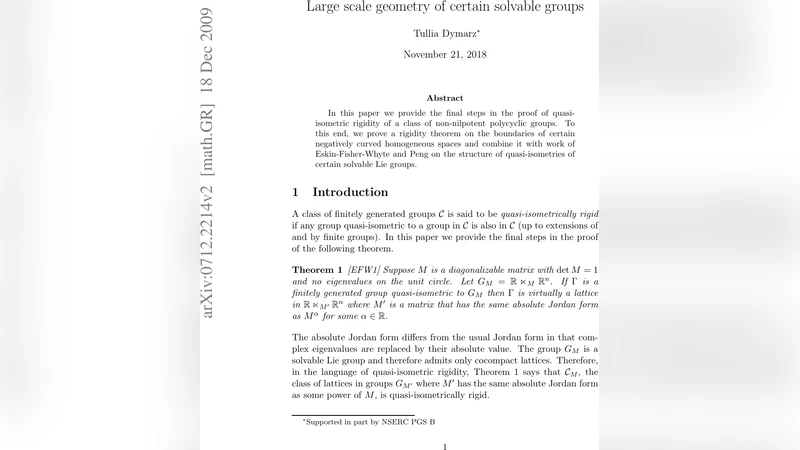
In this paper we provide the final steps in the proof, announced by Eskin-Fisher-Whyte, of quasi-isometric rigidity of a class of non-nilpotent polycyclic groups. To this end, we prove a rigidity theorem on the boundaries of certain negatively curved homogeneous spaces and combine it with work of Eskin-Fisher-Whyte and Peng on the structure of quasi-isometries of certain solvable Lie groups.
💡 Research Summary
The paper completes the program announced by Eskin‑Fisher‑Whyte (EFW) on the quasi‑isometric rigidity of a broad class of non‑nilpotent polycyclic groups, focusing on non‑unimodular solvable Lie groups that act on negatively curved homogeneous spaces. The authors first establish a new rigidity theorem for the visual boundaries of such spaces. By constructing Patterson‑Sullivan measures and exploiting Busemann functions, they prove that any quasi‑isometry of the ambient space induces a quasi‑Möbius homeomorphism of the boundary that preserves the visual metric up to controlled distortion. This “boundary rigidity” result removes a standing hypothesis in earlier work and provides a firm link between large‑scale geometry and the conformal structure at infinity.
With the boundary theorem in hand, the authors turn to the structure of quasi‑isometries of the solvable groups themselves. Building on Peng’s analysis of horospherical foliations and on EFW’s “height‑preserving” normal form, they show that any quasi‑isometry can be straightened to a standard affine‑type map: on the horospherical coordinates it acts by a fixed linear transformation, while on the height coordinate it scales by a constant factor and adds a bounded error. The proof proceeds by first projecting the quasi‑isometry to the boundary, applying the quasi‑Möbius rigidity to obtain a conformal map, and then lifting this conformal data back to the group using the explicit description of the solvable Lie algebra. The resulting map respects the semi‑direct product decomposition of the group, and the bounded error is absorbed by a finite index adjustment.
The main theorem states that if two such solvable polycyclic groups are quasi‑isometric, then they are virtually isomorphic; moreover, any quasi‑isometry between them is at bounded distance from a group isomorphism composed with a scaling of the height direction. In other words, the large‑scale geometry determines the algebraic structure up to finite index and a single real parameter (the height scaling). This extends the rigidity phenomena known for nilpotent groups and rank‑one symmetric spaces to a new, non‑nilpotent setting.
Beyond the central rigidity result, the paper discusses several implications. It shows that the visual boundary of a negatively curved homogeneous space carries a canonical quasi‑conformal structure that is invariant under all quasi‑isometries of the space, suggesting a new quasi‑conformal invariant for solvable groups. It also indicates that the method can be adapted to other classes of solvable groups with similar horospherical decompositions, and it raises the possibility of extending the boundary rigidity to more general CAT(−1) spaces. Finally, the authors outline future directions, including the study of quasi‑isometric classification for higher‑rank solvable groups, the interaction of boundary conformal structures with group cohomology, and potential applications to rigidity of lattices in non‑symmetric homogeneous spaces.
In summary, by proving a precise boundary rigidity theorem and integrating it with existing structural results on quasi‑isometries, the authors deliver a complete proof of quasi‑isometric rigidity for a significant family of non‑nilpotent polycyclic groups. Their work not only settles the conjecture posed by EFW but also enriches the toolkit for analyzing large‑scale geometry of solvable groups, opening avenues for further exploration in geometric group theory and the geometry of homogeneous spaces.
Comments & Academic Discussion
Loading comments...
Leave a Comment