A cluster of galaxies is a huge system bounded by gravitation, and cosmic rays are thought to be confined in the system, thus it should contain much non-thermal components. Many theories predict significant gamma-ray emission that could be detectable by state-of-the-art gamma-ray telescopes. Some clusters have already been studied by using Fermi gamma-ray space telescope in the GeV band and Cherenkov telescopes in the TeV band, but most clusters are not studied in both energy bands. Here I present results on GeV gamma-ray emission from clusters of galaxies which have been given upper limits by Cherenkov telescopes using Fermi archival data.
Deep Dive into Search for GeV gamma-ray emission from clusters of galaxies studied by TeV telescopes.
A cluster of galaxies is a huge system bounded by gravitation, and cosmic rays are thought to be confined in the system, thus it should contain much non-thermal components. Many theories predict significant gamma-ray emission that could be detectable by state-of-the-art gamma-ray telescopes. Some clusters have already been studied by using Fermi gamma-ray space telescope in the GeV band and Cherenkov telescopes in the TeV band, but most clusters are not studied in both energy bands. Here I present results on GeV gamma-ray emission from clusters of galaxies which have been given upper limits by Cherenkov telescopes using Fermi archival data.
A cluster of galaxies is a huge system bounded by gravitation, and is thought to be an ideal site for cosmic-ray acceleration, since cosmic-rays are confined in the system for a long time (see, e.g. Aharonian [1]). High-energy particles, accelerated at large-scale shockes associated with accretion and merger processes, or in other processes, interact with ambient matter and radiation fields to produce non-thermal emission from radio to gamma-ray energies.
Gamma-ray emission in clusters may come from several processes (see, e.g. review by Blasi et al. [2]). Collision of hign-energy protons with intra-cluster medium produce gamma-ray emission via decay of neutral pions. High-energy electrons can upscatter ambient photons such as cosmic microwave background (CMB), infrared, starlight and other soft photon fields to gamma-ray energies. Gamma-ray production from inverse Compton scattering by secondary electrons generated when ultra-high-energy protons interact with CMB via pγ → pe -e + process. Dark matter annihilation could also be a source of gammarays.
In the GeV band, association between clusters of galaxies and EGRET untidentified sources have been claimed by Totani & Kitayama [3], Colafrancesco [4], Kawasaki & Totani [5], and Scharf & Mukherjee [6], but Reimer et al. [7] could not confirm the association and gave upper limits for 58 clusters. At TeV energies, there are several attempts to search for emission from nearby clusters, but so far only upper limits have been reported for the Perseus and Abell 2029 clusters with the Whipple telescope [8], Perseus with MAGIC [9], Abell 496 and Abell 85 with H.E.S.S. [10], Coma with H.E.S.S. [11], Abell 3667 and Abell 4038 with CANGAROO-III [12] (see Table I).
Recently, Bechtol et al. [13] reported results on 15 clusteres which are top-ranked by Pfrommer [14] using the Fermi Gamma-ray Space Telescope, but most of these cluster samples do not overlap with clusters observed at TeV energies. Here I report on a search for gamma-ray emission in the GeV band with Fermi for clusters which are already observed by TeV telescopes as above, in order to increase multiwavelength coverage of emission from clusters for further discussion on their high-energy behavior.
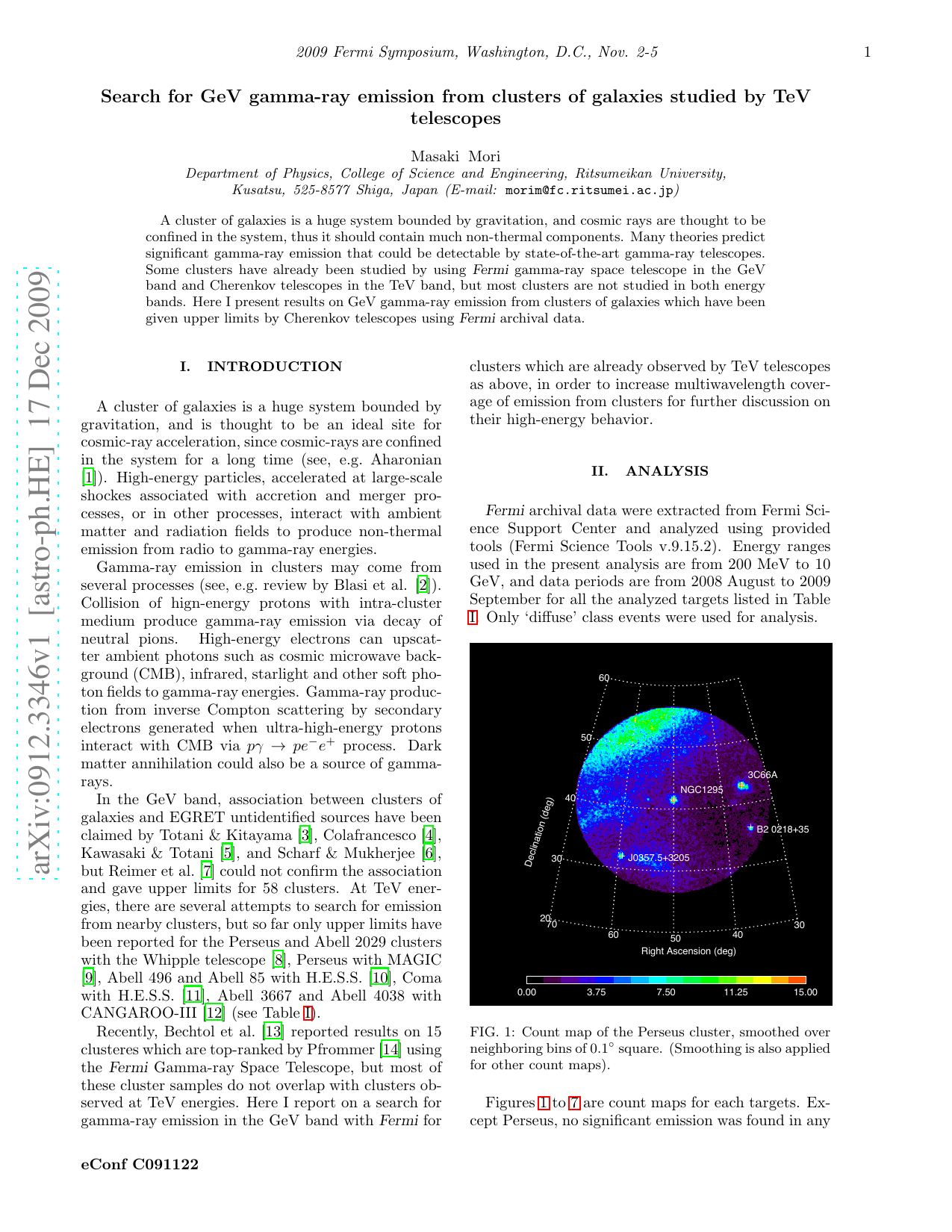
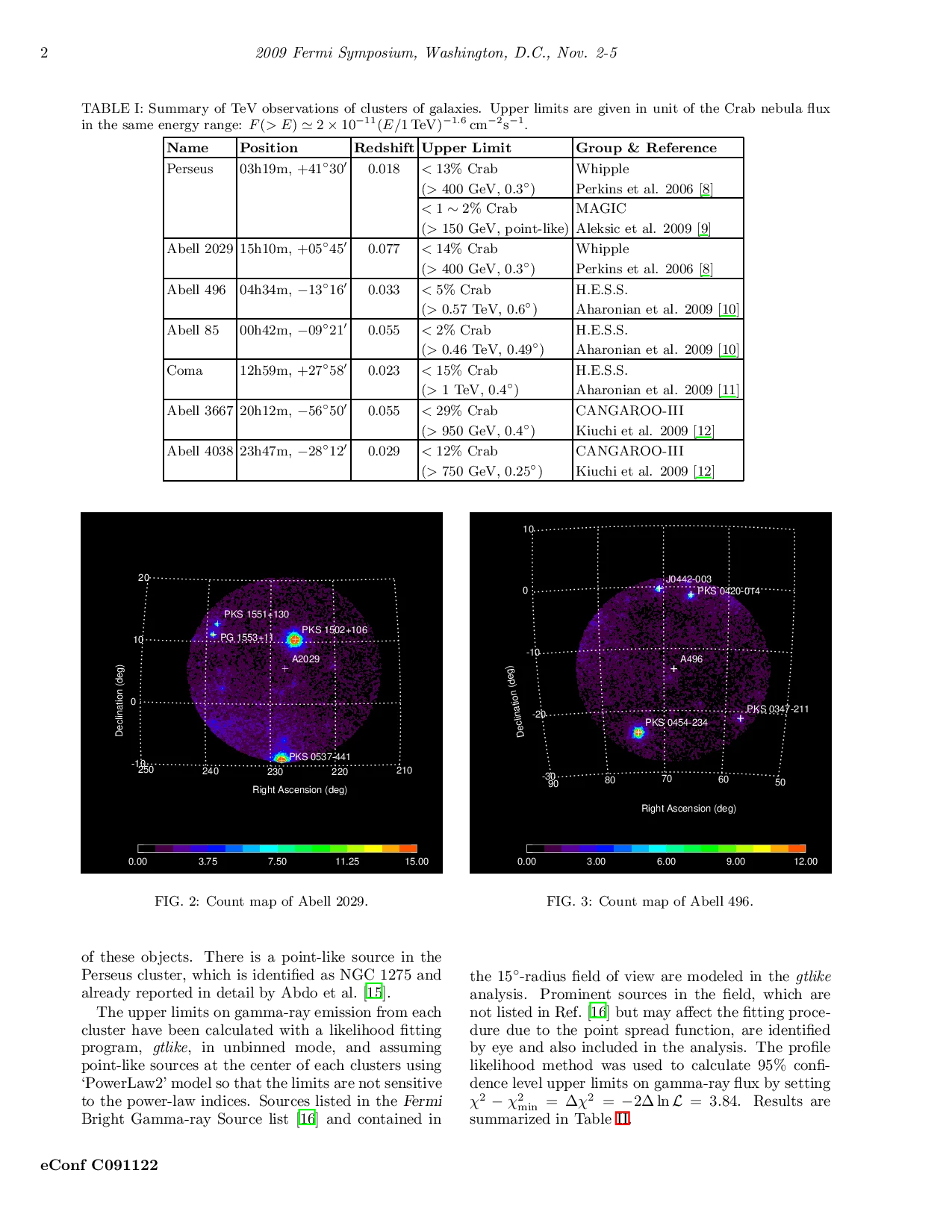
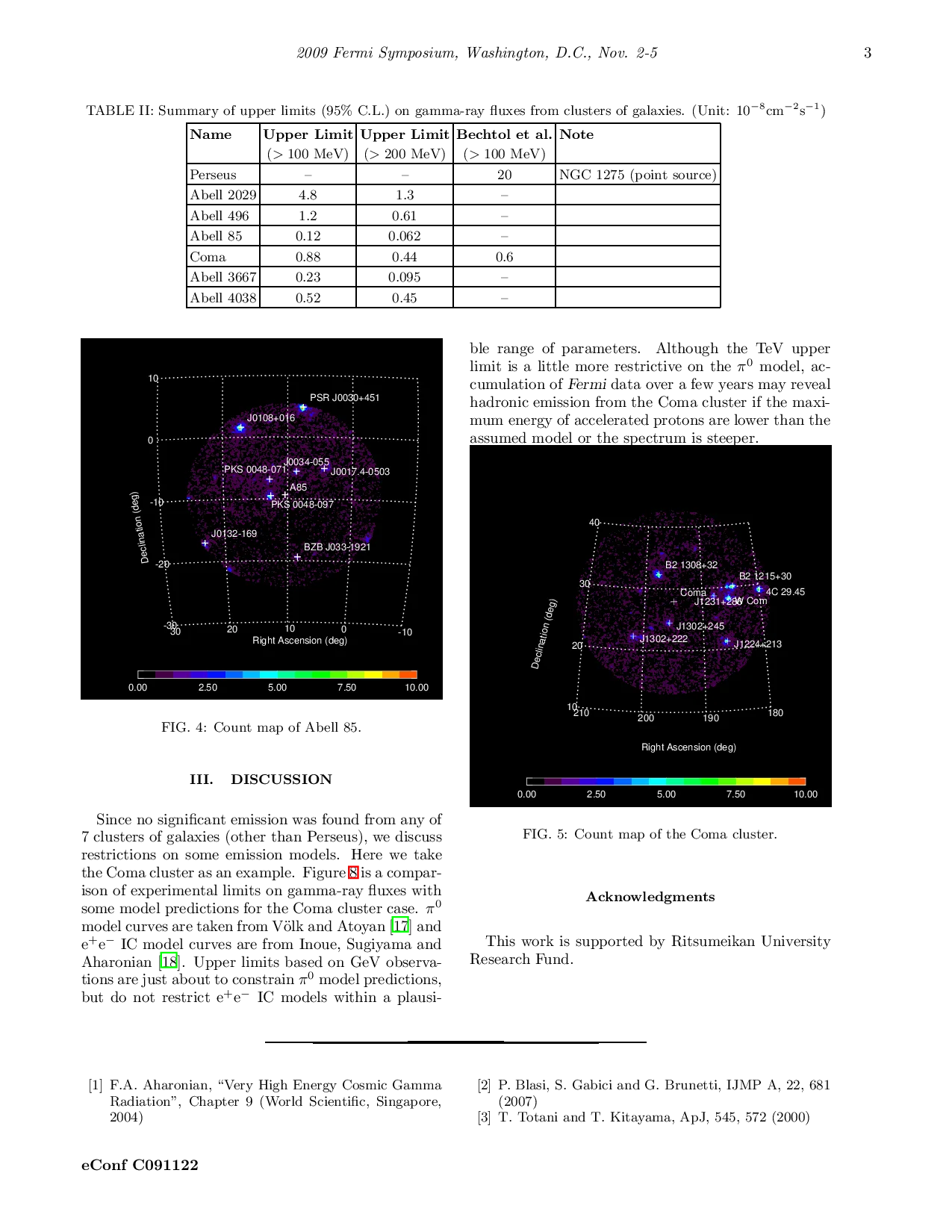
Fermi archival data were extracted from Fermi Science Support Center and analyzed using provided tools (Fermi Science Tools v.9.15.2). Energy ranges used in the present analysis are from 200 MeV to 10 GeV, and data periods are from 2008 August to 2009 September for all the analyzed targets listed in Table I. Only ‘diffuse’ class events were used for analysis. of these objects. There is a point-like source in the Perseus cluster, which is identified as NGC 1275 and already reported in detail by Abdo et al. [15].
The upper limits on gamma-ray emission from each cluster have been calculated with a likelihood fitting program, gtlike, in unbinned mode, and assuming point-like sources at the center of each clusters using ‘PowerLaw2’ model so that the limits are not sensitive to the power-law indices. Sources listed in the Fermi Bright Gamma-ray Source list [16] and contained in the 15 • -radius field of view are modeled in the gtlike analysis. Prominent sources in the field, which are not listed in Ref. [16] but may affect the fitting procedure due to the point spread function, are identified by eye and also included in the analysis. The profile likelihood method was used to calculate 95% confidence level upper limits on gamma-ray flux by setting χ 2χ 2 min = ∆χ 2 = -2∆ ln L = 3.84. Results are summarized in Table II.
Since no significant emission was found from any of 7 clusters of galaxies (other than Perseus), we discuss restrictions on some emission models. Here we take the Coma cluster as an example. Figure 8 is a comparison of experimental limits on gamma-ray fluxes with some model predictions for the Coma cluster case. π 0 model curves are taken from Völk and Atoyan [17] and e + e -IC model curves are from Inoue, Sugiyama and Aharonian [18]. Upper limits based on GeV observations are just about to constrain π 0 model predictions, but do not restrict e + e -IC models within a plausi-ble range of parameters. Although the TeV upper limit is a little more restrictive on the π 0 model, accumulation of Fermi data over a few years may reveal hadronic emission from the Coma cluster if the maximum energy of accelerated protons are lower than the assumed model or the spectrum is steeper. [17] and e + e -IC from Inoue, Sugiyama and Aharonian [18].
• ) Kiuchi et al. 2009 [12] Abell 4038 23h47m, -28 • 12 ′ 0.029 < 12% Crab CANGAROO-III (> 750 GeV, 0.25 • ) Kiuchi et al. 2009 [12]
This content is AI-processed based on ArXiv data.