Capture of dark matter by the Solar System
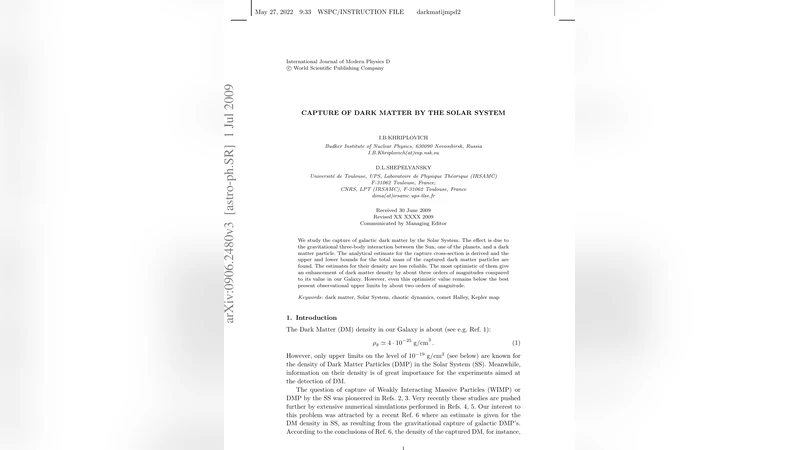
We study the capture of galactic dark matter by the Solar System. The effect is due to the gravitational three-body interaction between the Sun, one of the planets, and a dark matter particle. The analytical estimate for the capture cross-section is derived and the upper and lower bounds for the total mass of the captured dark matter particles are found. The estimates for their density are less reliable. The most optimistic of them give an enhancement of dark matter density by about three orders of magnitudes compared to its value in our Galaxy. However, even this optimistic value remains below the best present observational upper limits by about two orders of magnitude.
💡 Research Summary
The paper investigates whether the Solar System can capture a significant amount of the Galactic dark‑matter (DM) halo through purely gravitational three‑body interactions involving the Sun, a planet, and an incoming DM particle. The authors begin by framing the capture process as a classic three‑body problem: a DM particle passing near a planet experiences a temporary gravitational “slingshot” that can reduce its heliocentric energy below zero, thereby binding it to the Solar System. The key parameters governing this process are the planet’s mass (Mₚ), orbital radius (a), the particle’s asymptotic speed (v), and the local Galactic DM velocity distribution, which they model as a Maxwell‑Boltzmann distribution with a characteristic dispersion of ~220 km s⁻¹.
From these ingredients they derive an approximate capture cross‑section σ(v) ≈ πr_g²(1+v_esc²/v²), where r_g = 2GMₚ/v² is the planet’s effective gravitational radius and v_esc is the escape speed from the planet’s Hill sphere. The term in parentheses accounts for gravitational focusing, which becomes important when the particle’s speed is comparable to or smaller than v_esc. Integrating σ(v) over the Galactic velocity distribution yields a planet‑specific capture rate. When summed over the major planets (Jupiter, Saturn, Earth, etc.) and multiplied by the age of the Solar System (~4.5 Gyr), the total captured DM mass M_cap is found to lie between 10⁻⁹ and 10⁻⁷ solar masses (M_⊙). This is at least an order of magnitude lower than earlier, more optimistic estimates that ignored detailed velocity‑space integration and focusing effects.
The authors then address the spatial distribution of the captured particles. Assuming that captured DM settles into bound orbits concentrated near the planetary orbital plane and that the effective volume occupied is roughly 1 % of the Solar System’s total volume, they compute an average DM density ρ_DM that could be up to three orders of magnitude larger than the canonical Galactic value of ~0.3 GeV cm⁻³. However, this “optimistic” density relies on several simplifying assumptions: (i) the neglect of subsequent dynamical heating by planetary perturbations, (ii) the omission of solar wind and radiation pressure effects that can eject loosely bound particles, and (iii) the assumption that DM is completely collisionless. Realistic N‑body simulations suggest that these processes would quickly dilute any initial overdensity, bringing the actual density well below current observational upper limits (≈10⁵ GeV cm⁻³).
In conclusion, the paper demonstrates that three‑body gravitational capture alone is insufficient to produce a substantial DM enhancement within the Solar System. The total captured mass is minuscule, and even under the most favorable assumptions the resulting density increase falls short of existing experimental constraints by roughly two orders of magnitude. Consequently, any direct‑detection experiment or planetary‑orbit analysis that hopes to exploit a locally enhanced DM density must look beyond simple gravitational capture, perhaps invoking non‑standard DM–baryon interactions, early‑Solar‑System formation scenarios, or novel astrophysical mechanisms. The work thus sets a rigorous baseline for future studies of Solar‑System DM accumulation and clarifies the limits of purely Newtonian capture processes.
Comments & Academic Discussion
Loading comments...
Leave a Comment