Quantum and classical structures in nondeterminstic computation
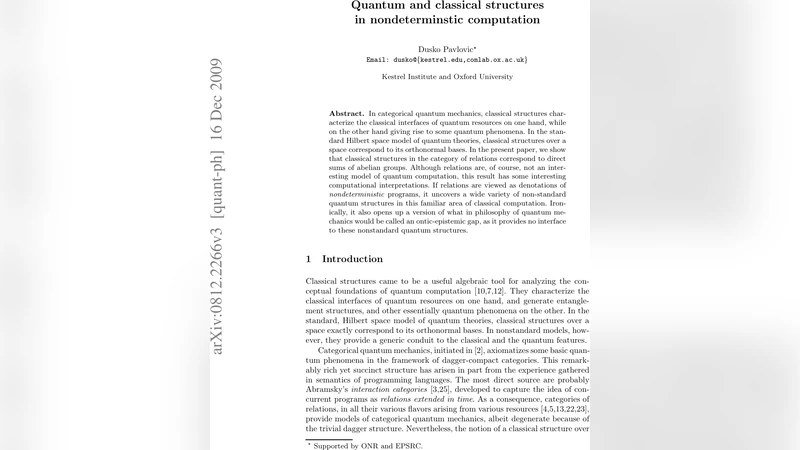
In categorical quantum mechanics, classical structures characterize the classical interfaces of quantum resources on one hand, while on the other hand giving rise to some quantum phenomena. In the standard Hilbert space model of quantum theories, classical structures over a space correspond to its orthonormal bases. In the present paper, we show that classical structures in the category of relations correspond to biproducts of abelian groups. Although relations are, of course, not an interesting model of quantum computation, this result has some interesting computational interpretations. If relations are viewed as denotations of nondeterministic programs, it uncovers a wide variety of non-standard quantum structures in this familiar area of classical computation. Ironically, it also opens up a version of what in philosophy of quantum mechanics would be called an ontic-epistemic gap, as it provides no direct interface to these nonstandard quantum structures.
💡 Research Summary
The paper investigates classical structures—central objects in categorical quantum mechanics (CQM)—within the category of relations (Rel). In CQM, a classical structure consists of a comonoid (copy and delete) and a monoid (multiply and unit) that satisfy the Frobenius law and a specialness condition. In the standard Hilbert‑space model these structures correspond precisely to orthonormal bases, providing the interface between quantum resources and classical data. The authors ask whether an analogous notion exists in the much simpler relational setting, which is widely used as a denotational semantics for nondeterministic programs: objects are sets, morphisms are binary relations, composition is relational composition, and the monoidal product is the Cartesian product.
The main theorem proves that a classical structure in Rel is exactly a biproduct of abelian groups. A biproduct is a categorical object that simultaneously serves as a product and a coproduct; in Rel this means the underlying set can be decomposed as a disjoint union of groups, each equipped with its own addition operation. The proof proceeds by translating the Frobenius and specialness axioms into relational language. The copy and delete maps must be functional relations that duplicate and erase elements; this forces the underlying set to carry a commutative, associative binary operation with an identity—precisely the structure of an abelian group. Moreover, the existence of both product and coproduct projections forces the whole object to be a direct sum of such groups, i.e., a biproduct. Conversely, any biproduct of abelian groups supplies the required comonoid and monoid maps, satisfying the Frobenius law automatically because group addition is both a monoid and a comonoid under the relational interpretation.
Interpreting relations as denotations of nondeterministic programs yields a striking computational insight. A nondeterministic program that can branch in several ways can be seen as operating on a state space that is a direct sum of abelian groups. The copy operation corresponds to duplicating a nondeterministic choice, while the multiplication corresponds to merging independent choices. Thus, even in a purely classical setting, there is a hidden “quantum‑like” linear structure: the program’s nondeterminism can be organized as a superposition of group‑theoretic components, reminiscent of quantum superposition but without any physical Hilbert‑space machinery.
Despite this rich internal structure, the relational model does not provide a direct physical interface to the quantum phenomena that classical structures usually mediate. In standard CQM the classical structure lets one measure a quantum system in a chosen basis and recover classical data. In Rel, the biproduct of abelian groups exists mathematically, but there is no counterpart to a physical qubit or observable; the structure remains purely abstract. The authors term this situation an “ontic‑epistemic gap”: the ontology (the underlying mathematical object) contains quantum‑style structure, yet the epistemic layer (what can be observed or extracted by a program) cannot access it in the usual quantum‑mechanical sense.
The paper concludes by emphasizing that the discovery broadens the scope of categorical quantum ideas beyond physics into classical computation. It suggests new avenues such as using the group‑theoretic decomposition to analyze nondeterministic algorithm complexity, designing programming languages that make the biproduct structure explicit, and comparing Rel’s classical structures with those in other categories (e.g., spans, profunctors). The work thus bridges categorical quantum foundations with the theory of nondeterministic computation, while highlighting a philosophical tension between the existence of quantum‑like mathematical structures and their lack of operational meaning in a purely classical computational world.
Comments & Academic Discussion
Loading comments...
Leave a Comment